


Table of Contents
- The Real Cost Difference Between Professional Grade Tools and Budget Options
- Durability and Daily Use: What Separates Professional Grade Tools from Consumer Models
- Essential Tools for Car Maintenance Beginners: Do You Need Professional Grade
- DIY vs Professional Tool Quality: Understanding the Trade-Offs
- How to Choose Garage Tools That Match Your Actual Workload
- Warranty Coverage and Serviceability: Hidden Value in Professional Tools
- When Professional Grade Tools Deliver Real ROI
- Conclusion
- Frequently Asked Questions
Last Updated: September 3, 2026
The Real Cost Difference Between Professional Grade Tools and Budget Options
Professional grade tools cost more upfront, but cost isn't the same as value. The gap between professional and consumer tools reflects motor efficiency, gearbox construction, material durability, and how these components behave under sustained workload. A consumer-grade drill handles occasional weekend projects fine, but push it harder and the engineering compromises become impossible to ignore.
Total cost of ownership tells the real story. A tool that fails after two years of regular use costs more than a professional version you keep for ten. According to Consumer Reports' tool durability testing, tools rated for professional use maintain performance standards significantly longer under identical workload conditions.
At Superior Tool Garage and Outdoors, we've helped homeowners and DIY enthusiasts figure out this exact question. The answer isn't always "buy professional grade." It depends on how often you actually use tools, what jobs you tackle, and how much downtime costs you.
Durability and Daily Use: What Separates Professional Grade Tools from Consumer Models
Professional grade tools are engineered for sustained workload capacity. A consumer drill is designed for occasional use, maybe 20-30 hours per year (the CDC). A professional model assumes 200+ hours annually, sometimes in harsh conditions. The engineering reflects this reality: heavier-gauge metals, sealed bearings, reinforced gearboxes, and motors built to dissipate heat rather than overheat.
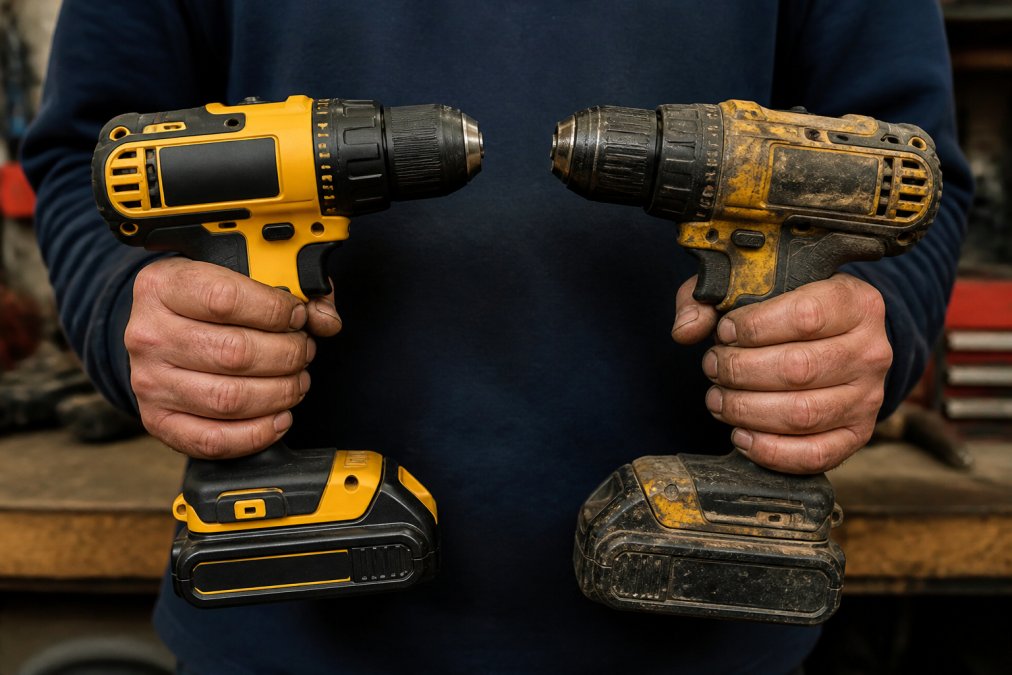
Material fatigue is where the real divergence happens. Consumer tools use thinner plastic housings and lower-grade aluminum. Professional versions use impact-resistant polymers and die-cast metal components. Under repeated stress, the consumer tool's housing cracks, the gearbox develops play, and the motor loses efficiency. A professional tool absorbs that stress and keeps performing.
Battery life and motor efficiency matter more than specs suggest. A 12V professional cordless drill like Superior Tool Garage and Outdoors' 12V Power Cordless Drill ($154.99) uses a brushless motor that delivers consistent torque throughout the charge cycle. Consumer versions often use brushed motors that lose power as the battery drains.
Ergonomics matter more under daily use than most people realize. A tool that's comfortable for 30 minutes becomes punishing after three hours. Professional grade tools distribute weight better, reduce vibration, and feature grip designs that minimize user fatigue.
The warranty difference signals durability confidence. Professional tools typically carry 3-5 year warranties with serviceability options (the FTC). Consumer tools often have 1-year warranties and are designed for replacement, not repair.
Essential Tools for Car Maintenance Beginners: Do You Need Professional Grade
Most homeowners doing basic car maintenance don't need professional grade for everything. Oil changes, air filter replacements, and brake pad swaps don't demand industrial-level equipment. But precision and accuracy standards matter more than beginners realize, especially once you move beyond the basics.
Fastener engagement becomes relevant when tightening bolts on brake components or suspension parts. A torque wrench set like Superior Tool Garage and Outdoors' Torque Wrench Set ($65.99) is safety equipment. The difference between hand-tightening and proper torque specification can mean the difference between a component holding and failing during driving.

Socket quality affects fastener engagement directly. A budget socket set with loose tolerances will round off bolt heads. Professional grade sockets maintain precision tolerances that keep fasteners engaged properly. The 3/8" Drive 16 Piece Metric Socket Set from Superior Tool Garage and Outdoors ($42.99) represents professional-quality engineering at a practical price point.
Hand tools like screwdrivers matter more than power tools for car work. A professional screwdriver set with proper blade fit prevents stripped screws and damaged fasteners. The Professional Screwdriver Set ($20.99) includes precision-engineered tips that fit properly.
Start with professional grade for precision tools (torque wrenches, screwdrivers, sockets) and consumer-grade for occasional-use items.
DIY vs Professional Tool Quality: Understanding the Trade-Offs
The DIY versus professional tool quality question isn't about capability, it's about trade-offs. Professional tools prioritize reliability and durability. DIY tools prioritize affordability and ease of use.
Cost-benefit analysis changes with frequency of use. If you use a tool once per year, spending $150 versus $50 is a poor investment. If you use it weekly, the professional version becomes economical within 18-24 months. Divide the price difference by your estimated annual usage hours. If it's under $1 per hour of use, professional grade usually wins.

Build quality directly affects precision outcomes. A professional circular saw maintains blade alignment and cutting accuracy through hundreds of cuts. A consumer version might drift or vibrate. For framing an entire room or building cabinets, precision tolerance becomes critical to project success.
Serviceability versus replaceability is the hidden trade-off. Professional tools are built to be repaired. Consumer tools are built to be replaced. Over a 10-year span, this difference compounds significantly.
| Factor | Professional Grade | Consumer Grade |
|---|---|---|
| Initial Cost | Higher | Lower |
| Durability Under Daily Use | 5-10 years | 1-3 years |
| Precision Tolerance | Tight (±1-2%) | Loose (±5-10%) |
| Motor Efficiency | Sustained | Degrades with use |
| Repairability | Designed for service | Designed for replacement |
| Warranty | 3-5 years | 1 year |
| Best For | Regular/sustained use | Occasional projects |
How to Choose Garage Tools That Match Your Actual Workload
The biggest mistake people make is buying for an imagined future instead of their actual present. Start with honest assessment. How many hours per month do you actually spend working on projects? Most homeowners spend 2-4 hours per month on garage projects. That's genuinely occasional use.
Track which tools you reach for repeatedly. If you use a drill once every three months, consumer grade is fine. If you use it twice per week, professional grade pays for itself through reliability and performance.
Consider the consequences of tool failure. A drill failing on a weekend project is annoying. A torque wrench failing while you're working on brakes is dangerous and costly. For safety-critical tools, professional grade is non-negotiable.
Match tool quality to project importance. Building a deck? Professional grade circular saw and drill justify the investment. Assembling IKEA furniture? Consumer grade works fine. The stakes determine the tool tier.
Budget allocation matters. Buy professional grade for tools you use frequently and consumer grade for occasional-use items. Allocate your budget to match your actual usage patterns.
Warranty Coverage and Serviceability: Hidden Value in Professional Tools
Warranty coverage reveals how manufacturers view their own products. Professional tools typically carry 3-5 year warranties with serviceability options. Consumer tools often carry 1-year warranties and are designed for replacement. This difference matters significantly.
Serviceability means you can actually repair the tool when something fails. A professional drill with a failed motor can go back to the manufacturer or a service center for motor replacement. A consumer drill gets recycled. Over time, this serviceability difference becomes significant.
The warranty terms reflect durability expectations. A manufacturer confident in a 5-year warranty has built the tool to last that long under normal use. A 1-year warranty suggests the manufacturer expects failures around that mark.
Replacement parts availability is a practical serviceability advantage. Professional tools have parts available for years. Consumer tools often become obsolete within 2-3 years, making parts unavailable. If you need to replace a battery, motor housing, or gearbox, professional tools give you options.
When Professional Grade Tools Deliver Real ROI
Return on investment for professional grade tools happens in specific scenarios. Regular professional use is the clearest case. If you're a contractor, carpenter, or mechanic using tools daily, professional grade delivers obvious ROI through durability and reliability.
Frequent DIY use, more than 100 hours annually, also justifies professional grade. Someone actively renovating their home, building projects regularly, or maintaining multiple vehicles reaches this threshold.
Safety-critical applications demand professional grade regardless of frequency. A torque wrench used monthly for brake work justifies professional grade because the consequences of failure are serious. When accuracy or safety is the priority, professional grade delivers value even with limited use.
Precision requirements create ROI for professional grade. If your project demands tight tolerances, building cabinets, working on precision equipment, or doing detailed repairs, professional grade tools maintain accuracy that consumer tools can't match.
The time value of efficiency matters more than people recognize. A professional drill completes a job in two hours. A consumer drill might take three hours because it loses power or overheats. If you value your time at $20-30 per hour, that extra hour costs real money.
Durability ROI compounds over time. A professional tool lasting 10 years versus a consumer tool lasting 3 years means consistency. You're not learning new tools every few years or dealing with unexpected failures during projects.
Conclusion
Are professional grade tools worth it? The honest answer is context-dependent, but the framework for deciding is simple: match tool quality to your actual usage patterns and the consequences of failure.
Professional grade makes sense when you use tools regularly, when precision matters, when safety is involved, or when tool failure creates real problems. Consumer grade makes sense for occasional projects where cost is the primary concern and failure is merely inconvenient.
Start with Superior Tool Garage and Outdoors to find professional-quality tools that fit your needs. Our Torque Wrench Set ($65.99) delivers precision engineering for safety-critical work. The 12V Power Cordless Drill ($154.99) handles sustained workloads without compromise. Our 3/8" Drive 16 Piece Metric Socket Set ($42.99) combines professional-grade precision with practical pricing. Shop now and invest in tools that match your real workload, not imagined future projects.

Frequently Asked Questions
Q: Are professional grade tools actually more durable than budget options?
A: Professional grade tools typically outlast budget models due to superior motor efficiency, precision engineering in the gearbox, and higher-quality materials. They withstand heavy-duty use and job site performance demands. However, durability depends on how often you use them. For occasional weekend projects, the difference may not justify the cost. For weekly or daily use, professional grade tools pay for themselves through reliability and fewer replacements over time.
Q: What are essential tools for car maintenance beginners, and do they need to be professional grade?
A: Beginners need a torque wrench set, socket sets, screwdrivers, and a cordless drill. A torque wrench set like ours ($65.99) ensures precise fastener engagement to prevent damage. For basic maintenance, professional grade versions prevent costly mistakes. A 3/8" Drive 16 Piece Metric Socket Set ($42.99) provides the precision required for automotive work. Professional grade tools reduce the risk of stripped bolts and misaligned components, which cost far more to repair than the tool investment.
Q: When should I upgrade from consumer-grade to professional grade tools?
A: Upgrade when you use tools weekly, tackle projects that demand precision tolerance, or work on high-value items like vehicles. If you're replacing broken tools frequently, professional grade versions offer better value proposition through longer lifecycle and lower replacement cycle costs. Also upgrade if warranty coverage matters, professional tools typically include extended coverage. For weekend-only homeowners, consumer-grade may suffice if you're willing to replace tools every few years.
Q: Do professional grade tools really come with better warranty coverage?
A: Yes. Professional grade tools typically include longer warranties and serviceability support. Our Torque Wrench Set ($65.99) includes calibration documentation ensuring ±3% accuracy. Many professional tools are repairable rather than disposable, reducing long-term replacement cycle costs. Budget tools often lack repair options and come with minimal warranties. This serviceability difference is significant over time, a professional tool lasting 10 years with one repair costs less than replacing a budget tool three times.