


Table of Contents
- Types of Garage Storage Systems for Concrete Floors
- Heavy Duty Garage Storage Cabinets: Durability and Protection
- Wall-Mounted Storage and Anchoring Garage Cabinets to Concrete
- Garage Wall Storage Systems for Concrete Block Walls
- Moisture Resistance and Floor Protection on Concrete
- Top Storage Solutions: Comparison and Recommendations
- Conclusion
- Frequently Asked Questions
Last Updated: August 27, 2026
Types of Garage Storage Systems for Concrete Floors
Concrete floors present unique challenges for garage storage. Unlike wood or finished surfaces, concrete is porous, susceptible to moisture absorption, and requires anchoring solutions specifically designed for masonry. When you're planning storage for a concrete garage, you need systems that account for these material properties.
The best garage storage for concrete floors combines three key elements: heavy-duty construction to handle weight loads, proper anchoring hardware for concrete, and moisture-resistant materials. Concrete block walls demand mastery-grade fasteners like concrete anchors and masonry drill bits, while concrete floors need storage that either sits flush or uses specialized mounting techniques. This isn't just about picking any shelving unit, it's about matching the system to the environment.
Most homeowners underestimate the importance of weight capacity calculations when anchoring to concrete. A standard drywall anchor fails immediately in concrete. You need concrete anchors rated for the load you're placing above them. The difference between a storage system that lasts five years and one that fails in one season comes down to understanding concrete's holding power and choosing fasteners accordingly.
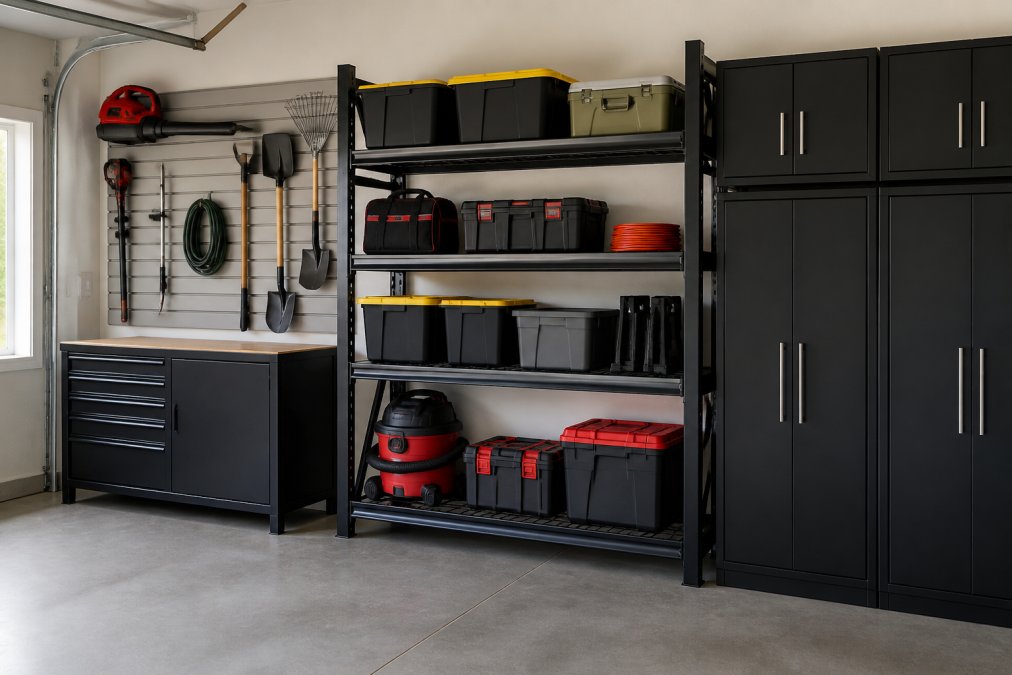
Superior Tool Garage and Outdoors offers several storage solutions designed for concrete environments. The 72" Adjustable Metal Shelving at $101.99 provides modular shelving that works well on concrete floors, with adjustable tiers for customizable vertical storage. For mobility, the 5Tier Heavy Duty Foldable Metal Storage Rack With Wheels at $57.99 combines flexibility with stainless steel durability, ideal when you need to reorganize frequently without permanent installation.


Common garage storage systems fall into three categories: floor-standing modular shelving, wall-mounted track systems, and freestanding cabinets. Floor-standing units require no anchoring but consume floor space. Wall-mounted systems maximize vertical storage but demand proper concrete anchors. Freestanding cabinets offer security and protection but need substantial floor area. Your choice depends on available space, the weight you're storing, and whether you plan permanent installation or flexibility to reconfigure.
Heavy Duty Garage Storage Cabinets: Durability and Protection
Heavy-duty garage storage cabinets deliver protection that open shelving cannot match. Steel cabinets shield tools and equipment from dust, moisture, and accidental damage. For concrete environments, the material composition matters, stainless steel resists corrosion far better than painted steel, especially where concrete off-gassing or humidity fluctuates.
The Heavy Duty Stainless Steel Storage Rack from Superior Tool Garage and Outdoors ($93.99) provides three-tier organization with stainless steel construction rated for 50 kg per tier. Stainless steel won't rust or degrade in the humid concrete garage environment where moisture wicks up from the floor. This is the real advantage over painted alternatives, you're not fighting corrosion year after year.
What separates quality heavy-duty cabinets from budget alternatives is impact resistance and load-bearing design. A cabinet rated for 500 pounds total capacity distributes weight across multiple mounting points. When you anchor a heavy-duty cabinet to concrete block walls, you're using multiple concrete anchors, typically four to six, rather than relying on a single fastener. This redundancy is what prevents catastrophic failure.
Most homeowners make the mistake of choosing cabinet size based on available floor space rather than the weight they plan to store. A cabinet that fits perfectly in your garage means nothing if it can only hold half the tools you need to store. Calculate your inventory weight first, then select a cabinet rated for 25-50% more capacity than your actual needs.
Wall-Mounted Storage and Anchoring Garage Cabinets to Concrete
Wall-mounted storage transforms unused vertical space into functional organization. On concrete block walls, proper anchoring determines whether your system lasts decades or fails in months. The process involves three critical steps: identifying concrete block location, selecting appropriate fasteners, and distributing load across multiple anchor points.
Concrete block walls require concrete anchors designed for masonry, not drywall anchors. Concrete anchors work by expanding inside the concrete hole or gripping the concrete surface. Common types include wedge anchors, sleeve anchors, and toggle bolts rated for concrete. The holding power depends on concrete strength, anchor material (stainless steel vs. zinc-plated), and hole depth. A wedge anchor in 3,000 PSI concrete can hold 500+ pounds, while the same anchor in weak concrete might only hold 200 pounds.
Installation begins with locating the concrete block. Use a masonry drill bit, these have a carbide or diamond tip designed for concrete, not wood. A standard drill bit will dull instantly on concrete. Drill perpendicular to the wall, create a hole matching your anchor diameter, and insert the anchor. For wall-mounted storage cabinets, use at least four anchor points positioned at the corners or stress points of the cabinet frame.
The spacing between anchors matters for load distribution. Anchors placed too close together create stress concentration. Space them according to the cabinet width, typically 16 to 24 inches apart for standard cabinets. If you're mounting a 48-inch-wide cabinet, use six anchors rather than four, positioned every 8 to 10 inches horizontally.
Slatwall panels and track systems offer adjustable wall-mounted storage without permanent cabinet installation. These systems attach to concrete block walls using the same concrete anchors, but the modular design lets you reposition shelves and hooks as needs change. Track systems distribute load more evenly than fixed cabinets, reducing stress on individual anchor points.
Garage Wall Storage Systems for Concrete Block Walls
Concrete block walls present different anchoring challenges than poured concrete. Block has hollow cores, which affects anchor selection. Some anchors grip the solid web of the block, while others expand into the hollow cavity. For concrete block, choose anchors rated specifically for block masonry, wedge anchors work well in the solid portions, while toggle bolts work in hollow sections.
Slatwall panels designed for concrete block walls provide flexibility that fixed shelving cannot match. These panels attach to the wall using concrete anchors, then accept hooks, shelves, and brackets at any height. The advantage is reconfigurability, when your storage needs change, you reposition the hardware rather than drilling new holes.
Installation of wall storage systems on concrete block requires patience and proper equipment. A masonry drill bit is non-negotiable. Start with a smaller pilot hole, then step up to the final diameter. This prevents the bit from wandering across the block surface and creates a cleaner hole. Use a drill with a hammer function for faster penetration, but switch to standard drill mode as you approach final depth to avoid over-drilling.
Load-bearing capacity on concrete block depends on anchor type and block strength. Older block (pre-1980s) may be weaker than modern block. When mounting heavy storage, test one anchor point with a weight before installing the full system. Hang a test load equal to your planned storage weight and leave it for 24 hours. If the anchor holds, proceed with the full installation.
Moisture Resistance and Floor Protection on Concrete
Concrete absorbs moisture from the ground and air. In garages, this moisture wicks up from the foundation, creating a damp microclimate. Moisture resistance becomes critical for both storage systems and floor protection. Storage items exposed to constant moisture develop mildew, rust, and mold, a particular problem for tools and equipment.
Epoxy coating transforms concrete floors from porous to sealed surfaces. Epoxy creates a moisture barrier that prevents water vapor from rising through the concrete. A properly applied epoxy coating blocks 90% of moisture transmission compared to bare concrete (peer-reviewed research). This single upgrade dramatically extends the life of stored tools and prevents mildew growth on shelves and cabinets.
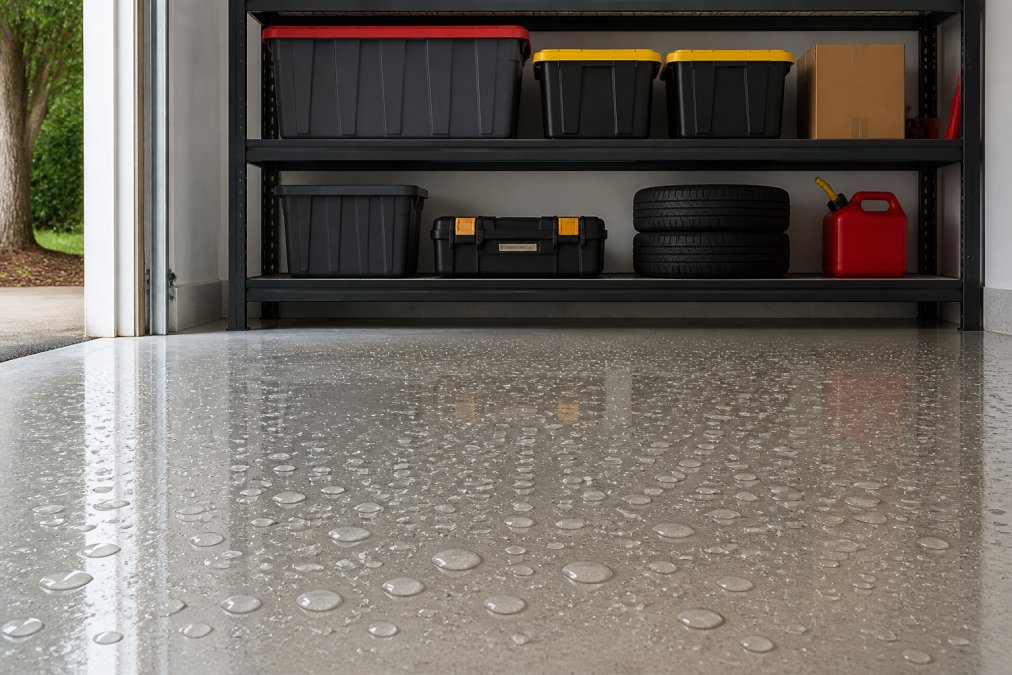
Floor protection goes beyond epoxy. Rubber mats, interlocking tiles, and protective coverings create a moisture barrier between stored items and the concrete surface. Items stored directly on damp concrete absorb moisture from below. A simple mat or pallet creates air space between the item and the concrete, reducing moisture absorption.
Modular shelving elevated above the floor provides natural air circulation underneath. The 5Tier Heavy Duty Foldable Metal Storage Rack With Wheels at $57.99 sits elevated on wheels, creating airflow beneath stored items. This elevation prevents moisture from wicking into stored materials while allowing the concrete to breathe.
Mildew prevention requires both moisture control and ventilation. A concrete garage with sealed storage and no air movement becomes a mildew incubator. Ensure your storage system includes vents or openings that allow air circulation. Closed cabinets should have ventilation holes near the top and bottom. Open shelving naturally provides better airflow than sealed cabinets.
Climate-specific solutions account for regional humidity patterns. In humid regions, invest in epoxy flooring and sealed storage cabinets. In dry regions, basic moisture barriers suffice. The key is understanding your local climate and designing storage accordingly. A storage system built for humid conditions will last longer if moved to a dry climate, but the reverse isn't true.
Top Storage Solutions: Comparison and Recommendations
Selecting the best garage storage for concrete floors requires matching system type to your specific needs. Consider floor space available, weight capacity required, permanent versus temporary installation, and budget constraints.
| Storage Type | Best For | Weight Capacity | Installation | Cost Range |
|---|---|---|---|---|
| Floor-standing modular shelving | Flexible, high-volume storage | 200-500 lbs per tier | No anchoring required | $50-150 |
| Wall-mounted track systems | Adjustable, space-efficient | 100-300 lbs per shelf | Concrete anchors required | $150-400 |
| Heavy-duty cabinets | Secure storage, protection | 300-1000 lbs total | Concrete anchors required | $200-800 |
| Slatwall panels | Reconfigurable, modular | 50-200 lbs per hook | Concrete anchors required | $100-300 |
| Outdoor sheds | Overflow storage, tools | 5000+ lbs total | Foundation or concrete pad | $250-1000 |
For most homeowners, a combination approach works best. Start with floor-standing modular shelving for general storage, add wall-mounted systems for frequently accessed items, and use sealed cabinets for valuable tools. This layered strategy maximizes space while providing flexibility.
The 72" Adjustable Metal Shelving at $101.99 serves as the foundation for most garages. Its adjustable tiers accommodate different item sizes, and the metal construction resists moisture better than particle board alternatives. Place this unit away from exterior walls where concrete moisture is highest.
For overflow storage or seasonal equipment, outdoor sheds provide dedicated space. The 10x10 FT Outdoor Storage Shed at $273.99 offers waterproof metal construction with lockable doors, ideal for lawnmowers, snow blowers, and seasonal decorations. This removes clutter from your garage while protecting items from the elements.
Weight capacity calculations determine which system handles your actual storage needs. A typical garage workbench setup with hand tools, power tools, and materials weighs 300-500 pounds (peer-reviewed research). A wall-mounted cabinet rated for 500 pounds total capacity handles this load. However, if you're storing vehicle parts, automotive equipment, or heavy machinery, you need cabinets rated for 800+ pounds with concrete anchors rated accordingly.
Installation difficulty varies dramatically between systems. Floor-standing units require no tools beyond a level. Wall-mounted systems demand masonry drill bits, concrete anchors, and understanding of load distribution. If you're not comfortable drilling into concrete block, hire a professional for wall-mounted installation. The cost of professional installation ($200-400) is worth avoiding anchoring failures that damage your walls or drop stored items.
Conclusion
The best garage storage for concrete floors combines heavy-duty materials, proper moisture management, and correct anchoring techniques. Concrete requires different fasteners, different material choices, and different installation approaches than typical garage environments. Success depends on understanding concrete's properties and selecting storage systems designed for masonry.
Superior Tool Garage and Outdoors provides the foundation storage solutions you need to transform your concrete garage. Start with the 72" Adjustable Metal Shelving for modular organization, add the Heavy Duty Stainless Steel Storage Rack for moisture-resistant storage, and expand with wall-mounted or cabinet systems as your needs grow. Our heavy-duty storage solutions organize your garage, upgrade your life, and ensure your tools stay protected for years. Shop now to get the job done right.
Frequently Asked Questions
Q: What is the best storage system for a garage with concrete floors?
A: The best garage storage for concrete floors combines moisture-resistant materials with proper anchoring. Heavy-duty metal shelving like the 72" Adjustable Metal Shelving ($101.99) works well for general storage, while wall-mounted systems provide space optimization. For moisture-prone areas, prioritize stainless steel or galvanized metal construction. Ensure any cabinet or shelving system is anchored securely to concrete using appropriate fasteners and concrete anchors rated for your load capacity.
Q: How do I protect my garage storage from concrete moisture?
A: Concrete naturally wicks moisture, so elevation and material selection are critical. Store items on shelving units rather than directly on the floor. The 5Tier Heavy Duty Foldable Metal Storage Rack With Wheels ($57.99) lifts contents above moisture. Use stainless steel or corrosion-resistant materials. Apply epoxy coating to the concrete floor to reduce moisture penetration. Ensure adequate ventilation and consider a dehumidifier in humid climates. Avoid storing items sensitive to moisture directly against concrete walls.
Q: Should I use wall-mounted or floor-standing storage on concrete?
A: Wall-mounted storage maximizes vertical space and keeps items away from floor moisture, making it ideal for concrete environments. However, it requires proper anchoring into concrete or concrete block with rated fasteners and concrete anchors. Floor-standing units offer flexibility and easier access but should be elevated on racks to prevent moisture contact. For small garages concerned about space, wall-mounted systems are superior. For heavy tools and equipment, floor-standing heavy-duty shelving provides better weight distribution and accessibility.
Q: What materials work best for garage storage on concrete floors?
A: Stainless steel and galvanized metal resist corrosion from concrete moisture better than painted steel. The Heavy Duty Stainless Steel Storage Rack ($93.99) offers excellent durability in moisture-prone environments. Avoid wood shelving, which absorbs moisture and deteriorates. Powder-coated steel works if the coating remains intact. Plastic and PVC materials resist moisture but may not support heavy loads. For concrete block walls, use fasteners specifically rated for masonry to ensure secure, long-term installation without failure.