


Table of Contents
- Quick Comparison: Best Tools for Home Improvement Projects
- Essential Power Tools for Beginners
- Hand Tools and Measuring Gear Every Kit Needs
- DIY Home Renovation Safety Gear
- Best Tool Storage Solutions for Garages
- Battery Platform Compatibility: Buy Once, Expand Later
- Rental vs. Buy: A Decision Matrix for Home Improvement Tools
- Tool Maintenance and Longevity: Make Your Kit Last
- Frequently Asked Questions
Last Updated: September 12, 2026
Quick Comparison: Best Tools for Home Improvement Projects
The best tools for home improvement projects are the ones you will actually use, not the ones with the longest feature list. At Superior Tool Garage and Outdoors, homeowners can find tools that meet their needs without wasting money on specialty gear they touch twice a year.
The shortlist below covers the core kit most projects demand.
| Tool | Typical Price | Best For | Why It Earns a Spot |
|---|---|---|---|
| 50 Piece General Household Toolbox | $33.99 | First-time homeowners | Covers assembly, repairs, and basic maintenance in one case |
| 12V Power Cordless Drill | $154.99 | Beginners and renters | Handles drilling, driving, and light torque work |
| Professional Screwdriver Set | $20.99 | Small electronics and fixtures | Precision tips from 0.6mm to 2.0mm |
| Torque Wrench Set | $65.99 | Auto and equipment work | Accurate tightening without stripping threads |
| Cordless Angle Grinder | $46.99 | Cutting, grinding, polishing | Compact enough for tight spaces |
Essential Power Tools for Beginners
A cordless drill is the only power tool you truly need on day one. Everything else is a convenience until your first big renovation.

The 12V Power Cordless Drill from Superior Tool Garage and Outdoors does the work of three tools: drilling pilot holes, driving screws, and light fastening. At $154.99, the difference shows up in the chuck and torque control.

Drills, Drivers, and What to Skip at First
Skip the circular saw, miter saw, and reciprocating saw until a project demands them. Most beginners buy a full set, use the drill, and let the rest collect dust.
What you actually need early:
- A drill with adjustable clutch settings
- A driver bit set that matches your screw heads
- Spare batteries, because a dead drill mid-project is the most common frustration
A common mistake is buying an impact driver before learning drill control; its high-torque bursts strip screw heads fast in untrained hands.
Hand Tools and Measuring Gear Every Kit Needs
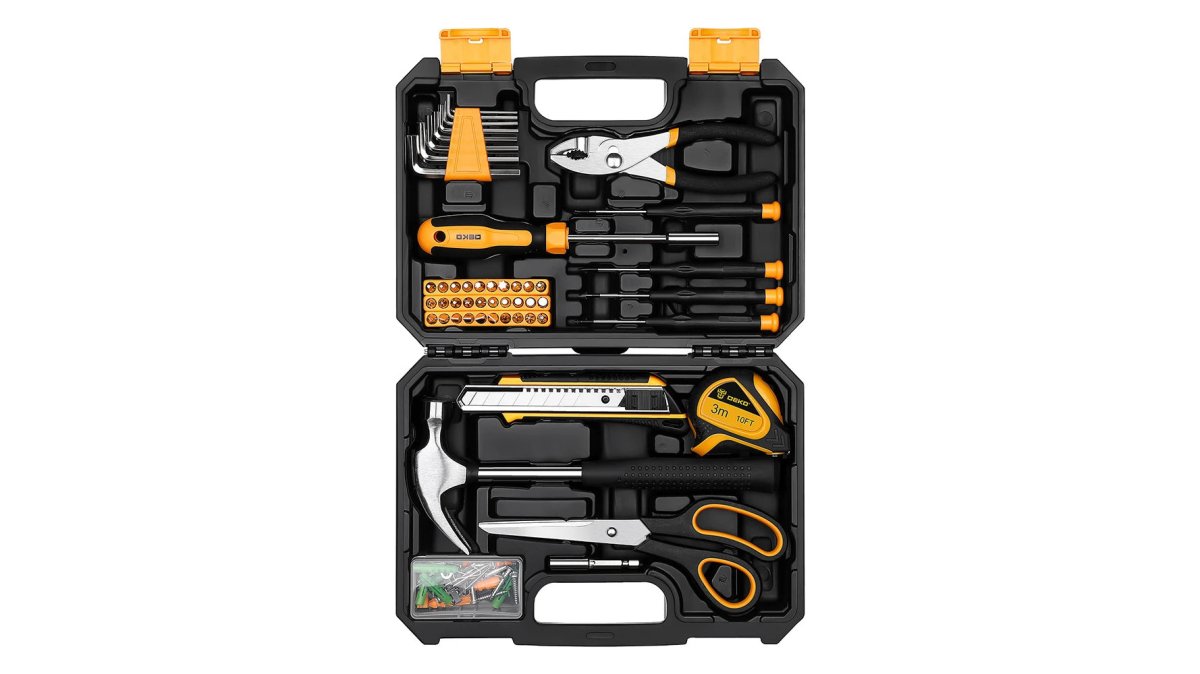
Hand tools handle jobs a drill cannot reach and never run out of battery. A claw hammer, tape measure, level, utility knife, and slip joint pliers cover most household repairs.
The 50 Piece General Household Toolbox bundles that set for $33.99, including 8 hex key wrenches, slip joint pliers, 30 bits, 4 precision screwdrivers, a utility cutter, box fasteners, a 3m measuring tape, scissors, a claw hammer, and a magnetic bits holder, a complete answer in one case for a first apartment or starter garage.
For finer work, the Professional Screwdriver Set adds 13 color-coded tips from 0.6mm to 2.0mm, sized for eyeglass frames, laptops, and small fixtures. At $20.99, it fills the gap between a bulky multi-bit driver and a jeweler's kit.

Precision matters: a screwdriver tip that is too large chews the screw head, turning a five-minute fix into an hour of drilling.
DIY Home Renovation Safety Gear
Safety gear is the one category where the cheapest correct answer beats the most expensive wrong one. Build your kit by task, not a generic bundle.
Eye protection. Safety glasses handle drilling, driving, and overhead work. Switch to sealed goggles or a face shield when you cut, grind, or work upside down, because cutting-wheel debris travels faster than a blink reflex. Look for lenses marked with the ANSI Z87.1 impact rating.
Respiratory protection. An N95 dust mask covers sanding and light demo. For insulation, drywall dust, paint fumes, or mold remediation, step up to a half-face respirator with replaceable cartridges rated for particulates, organic vapors, or both. Match the cartridge to the hazard.
Hearing protection. Anything above a normal conversation at arm's length warrants plugs or muffs, a circular saw, angle grinder, or gas chainsaw all cross that line. Foam plugs are cheap; over-ear muffs are easier to reuse. The 20-Inch Gas Chainsaw runs a two-stroke engine.
Hand protection. Nitrile-coated gloves grip lumber and demolition debris; leather palms resist abrasion on masonry and metal. Skip gloves when operating a drill press or any tool with a spinning chuck, because fabric can catch and pull a hand in.
Knee and back protection. Kneeling pads save your knees on tile, concrete, and flooring work. A back brace helps during long demo sessions, though the better fix is lifting with your legs.
Project-specific safety kits.
- Bathroom reno: safety glasses, N95 mask, nitrile gloves, knee pads. Add a respirator if you are removing old caulk, mold, or lead-paint-era finishes.
- Flooring install: knee pads, safety glasses, nitrile gloves, ear plugs for the saw. A dust mask matters once you start cutting engineered or laminate planks.
- Deck build: safety glasses, hearing protection, leather gloves, and a face shield for the circular saw. Sunscreen and a wide-brim hat count as PPE on a full-day outdoor job.
- Demo day: goggles (not glasses), N95 or better, heavy leather gloves, steel-toe boots, and hearing protection. Add a hard hat if you are pulling down ceiling or wall sections.
A common mistake is buying safety gear after the first injury. The Consumer Product Safety Commission guidance on home workshop safety treats eye protection as a baseline requirement for powered tool use, not a suggestion. Buy the kit before the tool arrives, and replace any damaged lens, cracked cup, or stretched strap immediately.
Best Tool Storage Solutions for Garages
Storage is not one decision; it is three. Match the storage method to how often you use the tool, how heavy it is, and how sensitive it is to moisture. Get that wrong and you either lose tools in clutter or ruin them in a damp corner.
Daily-use hand tools: wall systems. Pegboard, slatwall, and magnetic rails keep weekly tools at eye level and off the bench. Group by task (driving, cutting, measuring, fastening) rather than size, so you can see at a glance what is missing.
Heavy power tools: rolling cabinets and chests. A rolling cabinet keeps the drill, grinder, and circular saw near the workbench and lets you move the whole kit to the job. Look for ball-bearing drawer slides and a locking bar if children or renters share the space.
Overflow and outdoor equipment: sheds. A 10x10 FT Outdoor Storage Shed at $273.99 handles tools that should not live in the garage: lawn equipment, pressure washer, chainsaw, and seasonal gear. It is waterproof, rodent proof, and lockable. Place it on a level pad with a few inches of clearance under the floor to keep ground moisture away.
Moisture control is the real storage problem. Rust forms on exposed steel when humidity climbs and air cannot move. A few low-cost habits prevent most of it:
- Leave a gap between the wall and stored tools so air circulates.
- Use a rechargeable desiccant canister in closed cabinets and tool chests; recharge it in an oven when the indicator changes color.
- Keep a small fan moving air in a closed garage, especially in humid months.
- Wipe down tools with a light oil or a rust-preventive wipe before long storage.
Battery storage is separate from tool storage. Lithium-ion packs lose capacity in cold and age faster in sustained heat. Store them indoors at room temperature, at roughly half charge, and away from metal objects that can short the terminals.
Blade, bit, and accessory storage. Drill bits, saw blades, and grinding wheels last longer when they are not rattling together in a coffee can. A bit index or magnetic holder keeps edges from chipping, and a wall-mounted blade rack keeps the right blade visible.
A simple decision rule. If you use it weekly, put it on the wall. If you use it monthly, put it in a rolling cabinet. If you use it seasonally, put it in the shed. If it holds a charge, store it indoors.
Battery Platform Compatibility: Buy Once, Expand Later
Battery platform compatibility decides your long-term tool cost more than any single purchase. One battery system across your drill, grinder, and trimmer means one charger, one spare, and no dead-tool surprises.
Voltage is the first filter. A 12V platform suits drills, drivers, and light cutting. A 21V platform powers heavier outdoor equipment like the 3-in-1 Cordless Grass Trimmer, which runs a 200W brushless motor on its own battery.
Brushless motors run cooler and last longer than brushed equivalents, which is why the Cordless Angle Grinder pairs a 12V brushless motor with a 2000mAh battery and overheat protection.
Before you buy any cordless tool, answer three questions:
- What voltage does my existing kit use?
- Does the brand sell bare tools without batteries?
- How many batteries do I need to run two tools back to back?
If you are starting fresh, pick one voltage and stay in it. Mixing platforms is the fastest way to own six chargers and no working drill.
Rental vs. Buy: A Decision Matrix for Home Improvement Tools
Rent specialty tools you will use once; buy the tools you will reach for every year. That rule saves most homeowners more than any coupon.
| Situation | Rent | Buy |
|---|---|---|
| One-time job, tool over $400 | Yes | No |
| Used 2-3 times per year | Sometimes | Yes |
| Core kit: drill, hand tools, tape measure | No | Yes |
| Concrete saw, floor sander, trencher | Yes | Rarely |
| Auto work: torque wrench, sockets | No | Yes |
The Torque Wrench Set at $65.99 is a clear buy. It covers lug nuts, suspension work, and equipment fasteners, and earns its place the first time you avoid over-tightening a bolt.
Rentals make sense when the tool is large, expensive, and tied to a single project, a floor sander, trencher, or concrete saw. Buying one for a weekend job leaves you storing a machine you may never run again.
The middle ground is a pressure washer. A 3500 PSI Gas Pressure Washer at $468.99 pays for itself across driveways, decks, siding, and patio furniture over a few seasons, which is why many homeowners buy rather than rent.
Tool Maintenance and Longevity: Make Your Kit Last
Maintenance is the difference between a tool that lasts a decade and one that dies in two seasons. Most failures trace back to neglect, not defect.
Five habits extend the life of any kit:
- Wipe tools down after use and store them dry
- Oil moving parts on saws, grinders, and ratchets
- Keep drill bits and blades sharp; dull edges force the motor to work harder
- Charge batteries to roughly half before long storage
- Inspect cords, guards, and triggers before each use
The Occupational Safety and Health Administration guidance on hand and power tool safety is written for job sites, but the inspection logic applies in a home garage: check the tool before you start, not after it fails mid-cut.
Sharpening and lubrication cost almost nothing. Replacing a burned-out motor costs the price of a new tool.
For outdoor equipment, the maintenance schedule tightens. A gas chainsaw needs fresh fuel mix, a clean air filter, and a sharp chain to run reliably, and the American National Standards Institute standards for chainsaw safety exist because a neglected chain is a genuine hazard, not just a slow one.
Home improvement projects stall for one of two reasons: the wrong tool, or a tool that quit halfway through the job. Building a kit around a single battery platform, a solid hand tool core, and a maintenance routine solves both problems before they start. Superior Tool Garage and Outdoors stocks the premium garage tools, heavy-duty storage solutions, and outdoor equipment that hold up to real weekend work, from a $33.99 starter toolbox to a full 10x10 FT storage shed. Shop the collection at Superior Tool Garage and Outdoors and get the job done right the first time.
Frequently Asked Questions
What are the best tools for home renovations?
Start with a cordless drill, tape measure, level, claw hammer, and utility knife. Add a circular saw for cutting lumber and a stud finder for wall work. For plumbing or electrical jobs, a torque wrench set and screwdriver set cover most fastening needs. You do not need everything at once. Buy tools as projects demand them, and prioritize cordless models that share one battery platform so your collection grows without duplicate chargers.
What are the most useful tools for DIY projects?
A 50-piece household toolbox covers the basics: hex keys, pliers, screwdrivers, a utility cutter, and a claw hammer. Pair it with a 12V cordless drill for drilling and driving. For sanding, cutting, or polishing tight spots, a cordless angle grinder handles metal, tile, and grout. The most useful tools are the ones you reach for weekly, so build around drilling, fastening, measuring, and cutting before buying specialty equipment.
How do I choose the right power tools for home improvement?
Match the tool to the material and the job size. A 12V cordless drill covers most household drilling and driving. A circular saw or miter saw handles lumber cuts. An oscillating multi-tool reaches tight spaces a saw cannot. Check the battery platform first: if you standardize on one voltage system, every new tool shares batteries and chargers. Also check ergonomics and weight, since a tool you can hold comfortably for 30 minutes beats a heavier one that wears you out.
Do I need safety gear for DIY home renovation?
Yes. Safety glasses protect against flying debris when cutting, grinding, or drilling. A dust mask matters during demolition, sanding, and surface prep, especially in older homes. Work gloves improve grip and protect against cuts when handling lumber or metal. For loud tools like chainsaws or pressure washers, add hearing protection. Safety gear costs little compared to an injury, and it belongs in your kit before you start the first cut.
Should I rent or buy tools for a one-time project?
Rent tools you will use once or twice, like a gas pressure washer for a driveway or a chainsaw for storm cleanup. Buy tools you will reach for multiple times per year: drill, saw, level, tape measure, and hand tools. A simple rule: if the rental cost approaches half the purchase price and you expect a second use within a year, buy it. Storage space also matters, since rented tools go back but purchased tools need a home.