


Table of Contents
- Start With a Starter Kit: Essential Garage Organization Tools for Homeowners
- Garage Tool Storage: Boxes, Bins, and Drawers That Keep Tools in Place
- Garage Shelving Systems: Choosing Racks That Fit Your Space and Load
- Power Tool Storage Ideas for Cords, Batteries, and Chargers
- How to Organize Garage Tools: A Step-by-Step Plan
- Small Garages, Renters, and Safety: Practical Constraints
- Conclusion
- Frequently Asked Questions
Last Updated: October 19, 2026
Start With a Starter Kit: Essential Garage Organization Tools for Homeowners
The right essential garage organization tools for homeowners start with a simple principle: buy the tool set first, then buy the storage that holds it. At Superior Tool Garage and Outdoors, we see homeowners buy shelves before they know what goes on them, and the result is a garage full of empty racks and loose screwdrivers.
Garage organization tools are the combination of hand tools, power tools, and storage products that let you sort, contain, and reach your equipment without hunting. A 50-piece household kit covers most basic repairs. A cordless drill handles the rest.
Below, we break down what to buy first, what to store it in, and how to lay out a garage that stays organized past week two.
Garage Tool Storage: Boxes, Bins, and Drawers That Keep Tools in Place
Garage tool storage is the single most neglected part of the setup, and it is also where most homeowners overspend. A good box does three things: it holds tools secure, it opens flat so you can see everything, and it survives being dropped. Buy for those three traits, not for drawer count.
Match the Box to the Job
There are four storage formats, and each solves a different problem:
- Portable hand box, one lift handle, 16 to 20 inches wide, best for the household kit you carry to a repair. Light enough to move with one hand.
- Molded tool case, cut-foam or card slots that hold each tool in a fixed position. Best when you need to spot a missing piece at a glance.
- Drawer tool chest, ball-bearing slides, 26 to 41 inches wide, best for a permanent bench. Heavier and not meant to travel.
- Stackable bin or tote, open-top, best for bulky items like cords, rags, and sandpaper that do not need a molded home.
For most homeowners, a portable box is the right first buy. The 50 Piece General Household Toolbox at $33.99 includes hex key wrenches, slip joint pliers, 30 bits, precision screwdrivers, a utility cutter, a claw hammer, and a magnetic bits holder. It stores compactly in a locker or utility room and travels in a car trunk.
If you do vehicle work, step up to the Auto Repair Tool Kit at $111.99. Its molded case has tight card slots, so every tool has a designated place and you can see a missing piece at a glance.
What to Check Before You Buy
- Weight rating. A loaded hand box routinely runs 20 to 40 pounds. Check the handle and latch rating, not just the shell.
- Drawer slide rating. Ball-bearing slides are rated per drawer, often 50 to 100 pounds. Friction slides sag under heavy sockets.
- Footprint and depth. Measure the shelf or floor spot first. A 41-inch chest will not fit a 36-inch gap, and a deep box blocks the door swing.
- Weather and moisture. Concrete floors wick moisture. Keep steel boxes on a rubber mat or a low shelf, not directly on the slab.
- Locking. If children share the garage, a keyed or combination latch on the box holding cutting tools and chemicals is worth the small premium.
Label the outside of every box with its job, "plumbing," "electrical," "vehicle", not its contents. You will find the right box faster and stop emptying three of them to find one wrench.
Garage Shelving Systems: Choosing Racks That Fit Your Space and Load
Garage shelving systems fail for one reason: homeowners buy for height and ignore depth and load. Measure your floor footprint first, then check the weight rating per shelf.
Three options from our own catalog cover most garages:
| Product | Price | Best For | Key Detail |
|---|---|---|---|
| 5-Tier Foldable Rack with Wheels | $57.99 | Renters and small garages | Folds flat, rolls out of the way |
| 72" Adjustable Metal Shelving | $101.99 | Full wall runs | Adjustable heights, no-fuss install |
| Heavy Duty Stainless Steel Rack | $93.99 | Heavy bins and shop use | Three tiers, stainless steel 201 |
The foldable rack is the one we recommend for anyone who parks a car inside. It collapses when you need floor space back. If your garage is a permanent workshop, the 72-inch adjustable unit gives you the most usable wall length.


Power Tool Storage Ideas for Cords, Batteries, and Chargers
Power tool storage ideas usually focus on the drill and forget the batteries. That is backwards. Batteries are the expensive, fragile part, and they need a climate-controlled spot away from concrete floors. This is the section most garage guides skip, and it is where a little planning saves the most money.
The 21V Cordless Drill/Driver Kit at $44.99 is a reasonable first power tool for a homeowner. It is compact, has a 25+1 position clutch, and includes a battery.
Battery and Charger Rules That Actually Matter
- Charge on a shelf, never on a concrete floor. Concrete stays cold and wicks moisture, and both shorten battery life. A wall shelf at waist height keeps cells in a stable range.
- Store batteries at partial charge, not full. Most manufacturers recommend roughly 40 to 50 percent charge for long-term storage. A full battery left on a charger for months degrades faster than one stored cool and half-charged.
- Keep one dedicated charging shelf. Put every charger on the same shelf with a power strip, so you always know where they are and never hunt for a brick.
- Separate chargers from flammables. Chargers get warm. Keep them off the shelf that holds solvents, aerosols, and rags.
- Do not stack loose batteries in a drawer. Terminals can contact metal and short. Use a battery rack or the original case.
Cord and Cable Management
- Coil cords in a loose loop, not around the tool body. Wrapping a cord tight around a drill handle cracks the insulation at the strain relief.
- Use hook-and-loop straps or a cord reel on the wall for extension cords. A tangled cord is the most common reason a homeowner skips a quick job.
- Hang long-handled and corded tools on a wall rail or pegboard so the cord hangs free and does not kink at the plug.
For precision work, the Screwdriver Set Insulated Magnetic Screwdrivers 100 pcs at $53.99 covers electronics, car repair, and general garage use in one case.
72" Adjustable Metal Shelving →
How to Organize Garage Tools: A Step-by-Step Plan
Organizing garage tools takes one weekend for most homeowners. The process is sort, purge, group, then assign zones. Skipping the purge step is why garages re-clutter within a month.
Sort, Purge, and Group
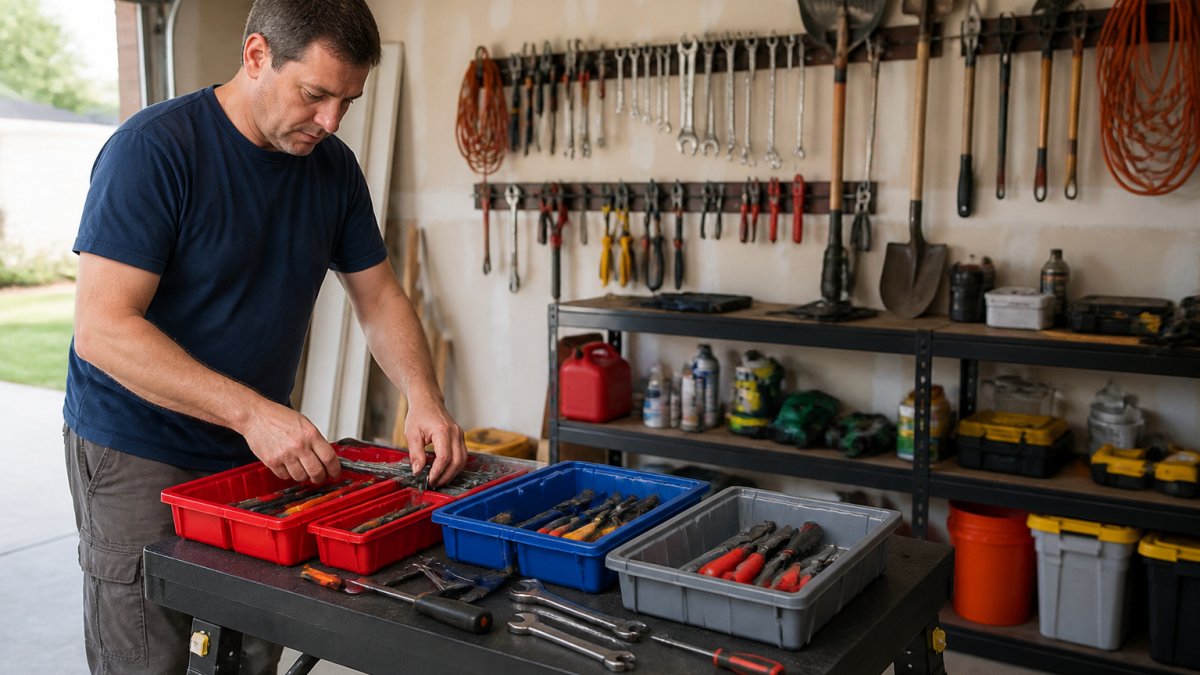
Empty one shelf or box at a time onto a workbench. Make three piles: keep, repair, and discard. Group the keep pile by task, not by tool type. Plumbing tools go together, electrical tools go together, and vehicle tools go together. This grouping is what makes the next step work.
Assign Zones and Hang What You Can
Give each group a zone based on how often you use it. Daily tools go at waist height near the door. Seasonal gear goes high or in the foldable rack. Then hang what you can: a Shaker rail or pegboard for screwdrivers, a magnetic tool holder for wrenches, and wall storage for long-handled items. Clearing the floor is the goal, because floor space is what you actually park on.
Small Garages, Renters, and Safety: Practical Constraints
Small garages and rentals need different answers, and most guides ignore them. If you cannot drill into the wall, a foldable rack with wheels and a portable workbench do the job without a single anchor.
Safety is the other constraint. Store solvents, fuel, and aerosols in a closed cabinet away from any heat source, and keep anything flammable off the floor where a car can roll into it. Lock up cutting tools if children use the garage.
The Torque Wrench Set at $65.99 belongs in a locked drawer rather than a pegboard, for the same reason. Precision tools lose calibration when they get knocked around.
Conclusion
Building a working garage comes down to sequence: tools first, storage second, zones last. Get that order right and the garage holds together through a full project season.
Superior Tool Garage and Outdoors stocks the heavy-duty storage and tool kits this plan depends on, from foldable racks to complete household toolboxes. Shop our collection and get the job done right.
Frequently Asked Questions
What should you have in your garage to stay organized?
Start with a basic set of garage organization tools: a portable toolbox for hand tools, a shelving unit for bulky items, and a wall rail or magnetic holder for frequently used tools. A 50-piece household toolbox covers screwdrivers, pliers, a claw hammer, hex keys, and a tape measure. Add a cordless drill for assembly and repairs. From there, add storage as your tool collection grows so everything has a designated place.
How do I organize tools in my garage without spending a lot?
Use vertical space first. A wall rail with hanging pegs and a magnetic tool holder cost little and clear floor space fast. Group tools by task, keep the ones you use weekly within arm's reach, and store seasonal or rarely used items on upper shelves. A foldable storage rack with wheels, like the 5-tier option at $57.99, gives you movable shelving without a permanent install.
What is the best way to store power tools in a garage?
Keep power tools off the floor and away from damp concrete. Store drills and drivers in a cabinet or on a shelf with chargers grouped at one outlet. Remove batteries from tools you will not use for a month, and keep them at room temperature. A dedicated charging station on a shelf near the workbench keeps cords untangled and makes it easy to grab a fresh battery mid-project.
Will tools rust in an unheated garage?
They can. Unheated garages swing in temperature and humidity, and bare steel tools pick up surface rust over time. Wipe tools with a light oil film after use, store them in closed boxes or drawers rather than open shelves, and keep them off concrete, which holds moisture. A simple dehumidifier or a sealed toolbox goes a long way toward protecting hand tools and mechanic tools through winter.
How much weight can garage shelving hold?
It depends on the rack. The Heavy Duty Stainless Steel Storage Rack lists a maximum load of 30 kg (about 66 lb) with a 50 kg (about 110 lb) figure noted for the three-shelf configuration. Check the listed capacity before loading paint cans, tires, or heavy power tools, and spread weight across shelves rather than stacking one shelf to its limit.