


Table of Contents
- Assessing Your Uneven Concrete: Structural vs. Cosmetic Issues
- Garage Floor Prep for Uneven Concrete
- Self-Leveling Compound for Garage Floor: When and How to Use It
- Flexible Garage Floor Tiles: Installation and Performance
- Other Garage Floor Covering Options for Uneven Surfaces
- Comparison Table: Flooring Solutions for Uneven Concrete
- Common Mistakes to Avoid When Covering Uneven Garage Floors
- Frequently Asked Questions
Last Updated: September 4, 2026
Uneven concrete is the single most common reason garage flooring projects fail. A garage floor covering for uneven concrete requires a different approach than a flat slab, and choosing the wrong material means cracked tiles, peeling coatings, or a surface that rocks underfoot. Before you buy anything, determine whether your floor has a cosmetic blemish or a structural problem, because that distinction decides which covering will actually last.
Assessing Your Uneven Concrete: Structural vs. Cosmetic Issues
Identify whether the issue is cosmetic or structural. Cosmetic issues include minor spalling, small cracks under 1/8 inch wide, and surface pores that cause dust. Structural issues are more serious: cracks wider than 1/4 inch, vertical displacement between slab sections, or a floor that slopes more than 1/4 inch over 10 feet.
To test the difference, use a straightedge and a level. Place the straightedge on the floor and measure the gap beneath it. Gaps under 1/4 inch are typically cosmetic and can be handled with patching compound. Larger gaps, or cracks that show signs of ongoing movement, indicate a structural concern. The Portland Cement Association's guide on concrete slab evaluation notes that active cracks, those that change width seasonally, signal problems that no surface covering will solve.
Garage Floor Prep for Uneven Concrete
Proper prep is the difference between a floor that lasts a decade and one that fails in a year. Start with a deep clean: oil stains, tire marks, and old sealers prevent adhesion. Grind or etch the surface to open the pores. A concrete grinder with a diamond cup wheel removes contaminants and creates the profile needed for bonding.
After grinding, fill low spots and cracks with a patching compound. For areas up to 1/4 inch deep, a standard concrete patch works. For deeper depressions, you will need a self-leveling compound. The surface must be dry before any patching material is applied. Test moisture by taping a 2-foot square of plastic sheeting to the floor and leaving it for 24 hours. If condensation forms under the plastic, the slab has a moisture problem that requires a vapor barrier before any covering goes down. The American Concrete Institute's guide on surface preparation emphasizes that moisture testing is a mandatory step, not optional, for any coating system.
Self-Leveling Compound for Garage Floor: When and How to Use It
Self-leveling compound is the go-to solution for a generally sound slab with low spots, shallow depressions, or a rough trowel finish. This cement-based mix flows to a perfectly flat, level surface before curing. It is not designed to fix structural cracks or major slope issues.
The application process is straightforward but unforgiving on timing. First, prime the cleaned concrete with a bonding primer. Then mix the compound according to the manufacturer's instructions, pour it onto the floor, and spread it with a gauge rake. Use a spiked roller to release air bubbles. Work in sections, because the material begins to set within 20 to 30 minutes. A common mistake is trying to level the entire garage at once; instead, divide the floor into manageable bays. Curing time varies, but most compounds accept foot traffic within a few hours and full floor coverings within 24 to 48 hours. Check the U.S. General Services Administration's guidance on cementitious leveling for best practices on material selection and thickness limits.
Flexible Garage Floor Tiles: Installation and Performance
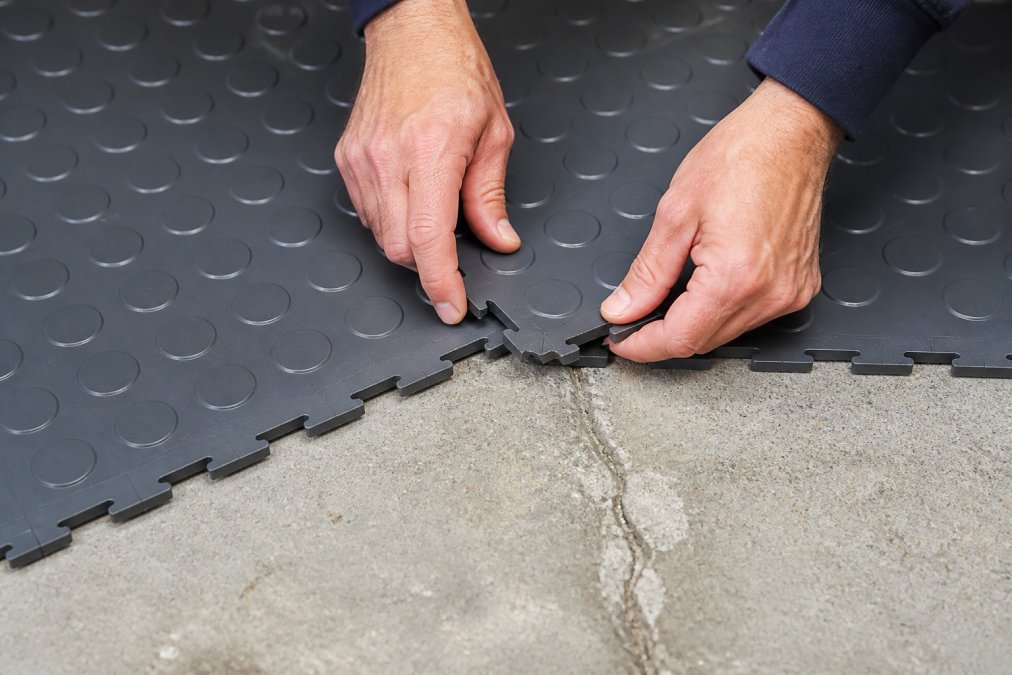
For slabs with minor unevenness or cracks up to 1/4 inch, flexible garage floor tiles are the most practical covering. Made from heavy-duty polypropylene or rubber with interlocking edges, they float over the concrete without relying on adhesive bonds that can fail when the slab moves. The material flexes to absorb minor surface irregularities.
Weight Capacity and Vehicle Support
Polypropylene tiles typically support 1,500 to 2,000 psi static load, sufficient for most passenger vehicles. Concentrated loads, such as a jack point, can cause localized buckling over time. Rubber tiles offer higher load ratings (2,500 to 3,500 psi) and better resistance to permanent set. For regular vehicle traffic or heavy equipment, choose tiles rated for at least 2,000 psi and verify load-duration data.
Chemical Resistance and Automotive Fluid Degradation
Garage floors face constant exposure to motor oil, transmission fluid, coolant, and road salt. Polypropylene tiles are moderately resistant to oil but can degrade under aggressive solvents. Rubber tiles are highly resistant to petroleum products but can soften under acetone or lacquer thinner. Virgin rubber and synthetic blends offer better chemical resistance. Before purchasing, request the manufacturer's chemical resistance chart and verify compatibility with the fluids you use. Look for tiles with ASTM or equivalent third-party chemical resistance ratings.
Installation and Surface Preparation
Installation is DIY-friendly. Clean the floor of loose debris and oil residue, then lay tiles from one corner outward. Tiles click together with a rubber mallet; no adhesive is required. The raised coin pattern offers slip resistance, and the hollow underside improves drainage. Large dips over 1/4 inch will still be visible and cause rocking; spot-level with patching compound before installation. Ensure the concrete is completely dry; moisture trapped under tiles promotes mold growth.
Other Garage Floor Covering Options for Uneven Surfaces
When tiles or leveling compound do not fit your situation, several other garage floor covering options for uneven surfaces deserve consideration, each with distinct trade-offs for handling unevenness, chemical exposure, and long-term durability.
Rubber Rolls and Mats
Rubber rolls are thick sheets (1/4 to 1/2 inch) that conform to minor surface variations and provide excellent impact resistance. They work well for workshop areas where you stand for long periods. However, rolls wider than 6 feet can trap air pockets under dips, creating soft spots and trapping moisture. Seams are vulnerable to separation if the concrete dips at the joint. Recycled rubber off-gases odors; virgin rubber or synthetic blends offer better chemical stability but cost 30-50 percent more. Rubber rolls work best when unevenness is gentle (under 1/8 inch over 10 feet) and the slab is dry. They do not support concentrated loads as well as tiles.
Epoxy and Urethane Coatings
Epoxy and urethane coatings are the least forgiving option for uneven concrete. These rigid, seamless finishes require a nearly perfect surface and will telegraph every imperfection. Prep costs often exceed coating costs. Both are impermeable; if your slab has moisture issues, the coating will blister and peel within months. Epoxy is more affordable ($3-$8 per square foot) but less flexible and prone to UV yellowing. Urethane is more durable but costs more. Neither is suitable for structurally uneven floors.
Acoustic and Thermal Properties
Polypropylene and rubber tiles dampen sound significantly, reducing echo and vehicle noise. Rubber and thick tiles provide modest thermal insulation, reducing foot fatigue in unheated garages. Epoxy and urethane coatings amplify sound and offer no thermal benefit. Acoustic and thermal comfort matter if your garage doubles as a workshop; they are secondary for vehicle storage.
Extreme Cases: Overlays and Floating Subfloors
For severely uneven floors (slopes exceeding 1/2 inch over 10 feet), a concrete overlay or floating subfloor system may be necessary. A concrete overlay is a thin layer (1/4 to 1/2 inch) of self-leveling concrete poured over the existing slab. This is effective but expensive and requires professional installation. A floating subfloor system uses pressure-treated 2×4s laid in a grid pattern with plywood sheets screwed on top, creating a level, insulated surface. The trade-off is cost, complexity, and moisture damage risk to the plywood.
Summary of Trade-Offs
Comparison Table: Flooring Solutions for Uneven Concrete
The table below summarizes the key trade-offs for each solution discussed. This is a decision tool, not a ranking, because the right choice depends on your specific concrete condition and how you use the garage.
| Solution | Best For | Prep Effort | Handles Unevenness | Durability |
|---|---|---|---|---|
| Self-Leveling Compound | Smoothing low spots before coating | High (grind, prime, pour) | Excellent (creates flat surface) | High (under coating) |
| Flexible Interlocking Tiles | Quick install over minor cracks | Low (clean only) | Good (bridges up to 1/4 in) | High (impact resistant) |
| Rubber Rolls/Mats | Workshop standing areas | Low (clean only) | Good (conforms to surface) | High (cushioned) |
| Epoxy/Urethane Coating | Seamless, glossy finish | Very High (must be perfectly level) | Poor (shows all defects) | High (if surface is perfect) |
| Plywood Subfloor | Severe unevenness | High (build framing) | Excellent (creates level base) | Medium (moisture risk) |
Common Mistakes to Avoid When Covering Uneven Garage Floors
The most frequent error is skipping the moisture test. High hydrostatic pressure will cause impermeable coverings like epoxy to blister and peel. Do not use rigid tiles on a floor that moves; cracked slabs with ongoing settlement will crack rigid tiles at the same joint. Failing to clean the floor properly is a silent adhesion killer. Ignoring the expansion gap is another mistake; all flooring materials need a gap around the perimeter to accommodate thermal expansion, or the floor will buckle in summer heat.
Do not assume a single product fixes everything. Many homeowners pour self-leveling compound over the entire floor when only a corner needed patching, wasting money and adding unnecessary weight. Assess first, patch locally, and choose a covering that matches the specific imperfections of your slab.
Uneven concrete does not sentence your garage to a lifetime of dust and cracked flooring. With an honest assessment of the slab and the right material choice, you can build a floor that handles vehicle weight, workshop abuse, and temperature swings. Whether you need patching compound, a self-leveling mix, or a heavy-duty tile system, Superior Tool Garage and Outdoors carries the tools and storage solutions to get the job done right. Pair your new floor with our heavy-duty shelving and tool organization to turn the space into a true workshop. Browse our garage collection and start your project with confidence.
Frequently Asked Questions
What is the best garage floor covering for uneven concrete?
The best choice depends on the severity of unevenness and your budget. Flexible garage floor tiles work well for minor to moderate unevenness (up to 1/4 inch variation) because they conform to the surface and are easy to install. For deeper valleys or cracked concrete, self-leveling compound applied before installing rigid flooring creates a stable base. Epoxy or urethane coatings hide minor imperfections but require smoother surfaces for proper adhesion. Rubber flooring rolls offer acoustic and thermal insulation benefits and tolerate some unevenness while providing durability for workshop use.
Do I need to use a self-leveling compound on my garage floor?
Self-leveling compound is necessary if your concrete has dips deeper than 1/4 inch, cracks, or if you plan to install rigid flooring like luxury vinyl planks or epoxy coatings. Flexible options like interlocking tiles and rubber mats can bridge minor unevenness without leveling. However, using a self-leveling compound improves load-bearing performance and prevents future floor deflection, especially in workshop spaces where heavy equipment sits. Always test moisture levels first, hydrostatic pressure and subfloor moisture can compromise compound adhesion and durability.
Can flexible garage floor tiles work on very uneven concrete?
Flexible garage floor tiles handle moderate unevenness well (up to 1/2 inch variation across the tile), but extremely uneven surfaces with deep cracks or large dips may cause tiles to sit unevenly or create tripping hazards. For severe unevenness, fill major gaps with self-leveling compound or patching compound first, then install tiles. Tiles also provide excellent impact resistance and slip resistance, making them ideal for garages used as workshops. Their interlocking design allows easy removal if you need future access to the concrete beneath.
How long does self-leveling compound take to cure before I can install flooring?
Most self-leveling compounds cure within 24 to 48 hours, though curing time varies by product and temperature. Check the manufacturer's specifications, some formulations cure faster in warmer conditions. Before installing flooring, verify that the surface has reached full compressive strength (typically 7 days for some products). Apply a concrete primer and moisture barrier after curing to improve surface adhesion and prevent hydrostatic pressure issues. Rushing installation before full cure can compromise durability and cause flooring to shift or separate.