


Table of Contents
- Assess Your Storage Needs and Garage Layout
- Understand Garage Storage Weight Capacity Requirements
- Wall-Mounted vs. Floor-Standing Storage Options
- Selecting the Best Heavy Duty Garage Storage Cabinets
- Budget and Installation Considerations
- Maximize Organization and Accessibility
- Frequently Asked Questions
Last Updated: September 18, 2026
Assess Your Storage Needs and Garage Layout
Before you buy a single storage unit, measure your space and understand what you're actually storing. This is where most people stumble. They pick attractive cabinets or shelving, get them home, and realize they don't fit the workflow or the actual dimensions of the garage.
Start by measuring your garage floor, wall heights, and ceiling clearance. Note any obstacles: electrical outlets, water heaters, HVAC units, or structural columns. Photograph the space from multiple angles. Then list everything you need to store: tools, seasonal items, automotive equipment, gardening supplies. Separate frequently accessed items from things you retrieve once a year.
Measure your space and identify usage patterns
Your garage layout determines what kind of garage storage systems will work. A 20-by-20-foot single-car garage has different constraints than a 24-by-24-foot two-car space. Measure the depth from the door inward, the width of each wall, and the height from floor to ceiling and to any overhead joists.
Next, map your workflow. Where do you park? Where do you work on projects? Which tools do you reach for weekly versus seasonally? Heavy items should stay low and close to where you use them. Lightweight, infrequently accessed boxes belong higher up or in the back. This simple logic prevents frustration and wasted motion.
Account for climate and environmental factors
Humidity, temperature swings, and moisture damage affect how long your storage holds up. Garages in humid climates, near coasts or in areas with high seasonal moisture, need storage with corrosion resistance and moisture barriers. Metal storage with powder-coated finishes resists rust better than bare steel or unfinished materials.
Temperature fluctuations can warp wood shelving and weaken adhesives over time. If your garage isn't climate-controlled, prioritize materials engineered for outdoor conditions. Metal sheds and steel cabinets tolerate temperature swings better than particleboard or thin plywood alternatives.
Understand Garage Storage Weight Capacity Requirements
Weight capacity isn't a suggestion, it's a safety issue. Overloaded shelves collapse. Improperly anchored wall units pull away from studs and crash down, potentially injuring someone or damaging equipment below.
Calculate total load and distribute weight safely
Start by estimating the weight of what you'll store. A full toolbox weighs 30-50 pounds. A car battery weighs 40-60 pounds. A box of books or automotive parts can easily exceed 40 pounds. Add these up shelf by shelf, then compare against the manufacturer's rated capacity.
Most heavy-duty garage storage systems list weight capacity per shelf. Multiply that by the number of shelves to understand total storage potential. Then be honest: you'll likely store more than you plan initially. Buy systems rated for 25-50% more than your current estimate.
Distribute weight evenly across shelves. Place heavier items in the center of the shelf, not at the edges. Avoid stacking all your weight on one or two shelves, spread it across the unit. This keeps the structure stable and prevents shelves from sagging over time.
Check anchoring hardware and installation safety
Wall-mounted systems must anchor into studs, not drywall alone. Drywall anchors fail under heavy loads. Use lag bolts or heavy-duty anchors that penetrate studs by at least 1.5 inches. If studs don't align with where you want to mount, consider floor-standing units instead.
For floor-standing cabinets, ensure they sit on level ground. Uneven floors cause racking (twisting of the frame), which stresses joints and eventually leads to failure. Use shims to level the unit, then anchor it to wall studs if the manufacturer recommends it. Many heavy-duty cabinets include anti-tip hardware, use it.
Check local building codes if you're storing hazardous materials or creating a workshop space. Some jurisdictions have requirements for ventilation, fire safety, or structural support that affect where and how you install storage.
Wall-Mounted vs. Floor-Standing Storage Options
The choice between wall-mounted and floor-standing systems shapes your entire garage organization. Each approach trades off space, accessibility, and installation complexity.
Wall-mounted systems for vertical space optimization
Wall-mounted storage uses vertical space that would otherwise sit empty. Slatwall panels, pegboards, and wall-mounted shelves pull storage off the floor, creating a clutter-free workspace underneath. This matters in smaller garages where floor space is precious.
Slatwall panels are durable, modular, and accept many hooks, shelves, and accessories. They distribute weight across multiple studs, handling heavy loads better than traditional drywall anchors. Pegboards are cheaper but less durable for heavy-duty use, hooks can slip under load, and the holes enlarge over time.
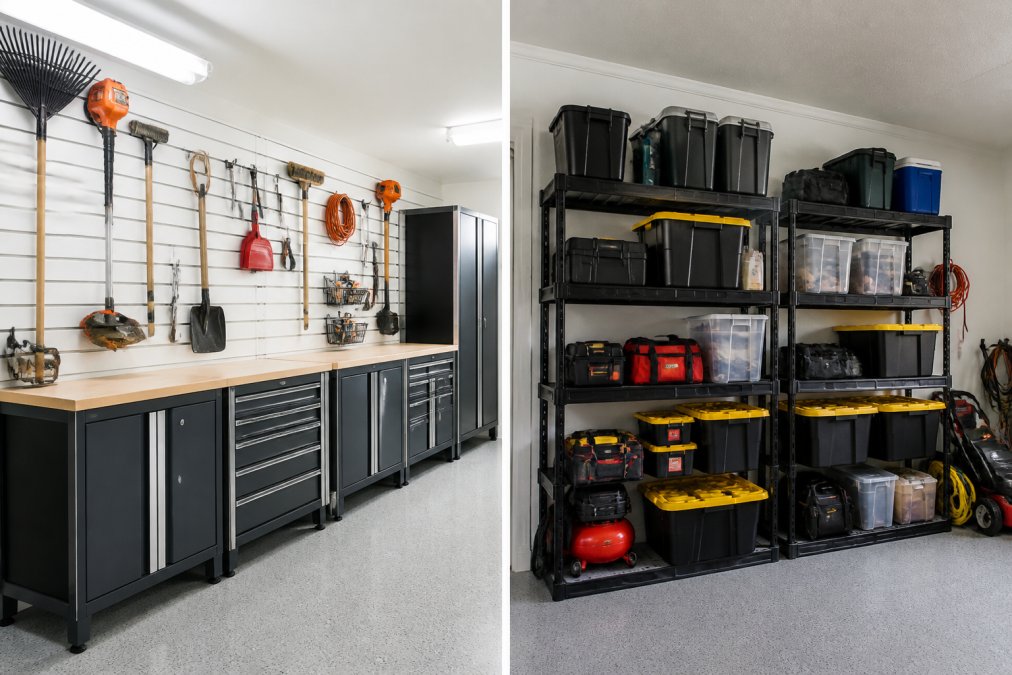
Wall-mounted systems require accurate stud location and proper anchoring. Installation takes longer than floor-standing units, but the payoff is reclaimed floor space and easy access to frequently used items.
Floor-standing cabinets for accessibility and flexibility
Floor-standing cabinets don't require wall anchoring, making them portable and flexible. You can rearrange them as your needs change. Drawer slides on quality cabinets operate smoothly even when fully loaded, and adjustable shelving lets you customize spacing for different item heights.
10x10 FT Outdoor Storage Shed →
Heavy-duty floor-standing cabinets with powder-coated steel frames tolerate temperature and humidity swings better than wood alternatives. They're also easier to clean and maintain. The trade-off is floor space: a large cabinet occupies real estate you might use for parking or working.
Floor-standing units work best when you have adequate floor space and need quick access to tools and equipment. They're ideal for workshops where you move items frequently or change your layout seasonally.
Selecting the Best Heavy Duty Garage Storage Cabinets
When you're looking for heavy duty garage storage cabinets that last, material quality and construction details separate mediocre options from reliable ones.
Material durability and powder-coated finishes
Powder-coated steel is the gold standard for garage storage. The coating bonds chemically to the metal, creating a barrier against rust and UV damage. It resists chipping better than paint and doesn't require touch-ups as often.
Look for cabinets with a full steel frame, not hollow-core construction. Solid steel handles impact and weight better, and it doesn't dent as easily. Cabinet thickness matters too, 18-gauge steel is thicker and stronger than 20-gauge, though heavier and more expensive.
Stainless steel resists corrosion in humid environments but costs significantly more. For most garages, powder-coated steel delivers durability at a reasonable price. Avoid bare metal or painted finishes if your garage experiences seasonal moisture.
Drawer slides, adjustable shelving, and customizable configurations
Smooth, ball-bearing drawer slides extend fully and support heavy loads without sticking or binding. Cheap slides jam under weight or don't extend far enough to access items in the back. Test drawer action before buying if you can, it's a reliable indicator of overall quality.
Adjustable shelving lets you configure storage for your specific items. Fixed shelves waste space and limit flexibility.
Budget and Installation Considerations
Storage costs range widely based on material, size, and features. Understanding the pricing breakdown helps you allocate budget strategically.
Pricing breakdown and cost-effective options
Basic wall-mounted shelving and pegboards start around $50-$150 per unit. Mid-range floor-standing cabinets run $200-$500. Heavy-duty modular systems with drawers and locking mechanisms cost $500-$2,000 or more.
Installation requirements and assembly complexity
Simple wall-mounted shelves take an afternoon to install if you have a stud finder and basic tools. Pegboards are faster. Slatwall panels require more precision but are still manageable for a homeowner with basic carpentry skills.
Maximize Organization and Accessibility
Once your storage structure is in place, the way you organize items determines whether your garage becomes a functional workspace or a cluttered mess.
Workbench integration and tool management systems
A dedicated workbench anchors your garage workflow. Mount it near your storage system so tools are within arm's reach. Use wall-mounted pegboards or slatwall panels above the bench to hang frequently used items: screwdrivers, wrenches, measuring tools.
Bin storage, utility hooks, and creating a clutter-free workspace
Transparent storage bins let you see contents without opening them. Use uniform bin sizes so they stack neatly and fit into shelving units. Label bins clearly so anyone in your household can find what they need.
| Storage Type | Best For | Weight Capacity | Installation Time |
|---|---|---|---|
| Wall-mounted shelving | Lightweight items, frequent access | 50-100 lbs per shelf | 2-4 hours |
| Slatwall panels | Heavy tools, modular setup | 75-150 lbs per hook | 3-6 hours |
| Floor-standing cabinets | Heavy equipment, organized drawers | 200-500 lbs per unit | 1-2 hours |
| Pegboards | Budget storage, light items | 25-50 lbs per hook | 1-2 hours |
| Overhead racks | Seasonal items, bulky boxes | 100-300 lbs total | 2-3 hours |
Frequently Asked Questions
What is the best garage storage system for small spaces?
Wall-mounted systems and overhead racks maximize vertical space in small garages without consuming floor area. Slatwall panels with utility hooks and adjustable shelving allow you to customize storage to fit your exact footprint. Vertical storage can double your usable capacity. For extremely tight spaces, modular designs let you add only what you need, expanding later as budget allows.
How do I determine the weight capacity I need for garage storage cabinets?
List all items you plan to store and estimate their total weight. Heavy-duty garage storage cabinets typically support 100-300 pounds per shelf depending on design. Distribute weight evenly across shelves and avoid overloading one section. Check the manufacturer's weight capacity specifications before purchasing. Anchoring hardware to wall studs significantly increases safe load-bearing capacity, especially for wall-mounted systems.
Should I choose wall-mounted or floor-standing garage storage?
Wall-mounted systems preserve floor space and are ideal for small garages or workshops where you need clearance for vehicles or work areas. Floor-standing cabinets offer easier accessibility, better weight capacity, and greater flexibility to relocate. Many homeowners use both: wall-mounted systems for frequently accessed tools and overhead storage for seasonal items, with floor-standing cabinets for heavy-duty equipment and bulk storage.
What materials offer the best durability for garage storage systems?
Heavy-duty steel with powder-coated finishes resists corrosion and moisture, making them ideal for garages with temperature fluctuations or humidity. Galvanized steel frames provide additional weatherproofing. Avoid uncoated metal in humid climates as it rusts quickly. Check product specifications for UV resistance if your garage receives direct sunlight. Quality drawer slides and load-bearing hardware also extend the system's lifespan significantly.