


Table of Contents
- What You'll Need: Tools and Supplies for Cleaning Garage Floor Tiles
- How to Clean Garage Floor Tiles: Daily and Weekly Maintenance
- Best Cleaner for Plastic Garage Floor Tiles
- How to Remove Oil Stains from Garage Tiles
- Deep Cleaning and Pressure Washing Your Modular Tiles
- Garage Floor Tile Maintenance Schedule for Year-Round Protection
- Repairing Damaged Tiles and Preventing Future Stains
- Frequently Asked Questions
Last Updated: September 30, 2026
What You'll Need: Tools and Supplies for Cleaning Garage Floor Tiles
Learning how to clean garage floor tiles properly requires a few key tools to work faster and more effectively.
Essential cleaning tools:
- Shop vacuum with a brush attachment
- Soft-bristle brush or deck brush
- Microfiber mop or cloth
- Bucket for water and cleaning solution
- Squeegee or water pusher
- Leaf blower for dry debris
Cleaning solutions to have ready:
- Mild detergent or pH-neutral cleaner
- Non-sudsing ammonia for grease
- Degreaser for stubborn oil stains
- Water (tap water works fine for most tasks)
For tougher jobs, a cordless pressure washer saves significant time. The Superior Tool Garage and Outdoors 21V Portable Cordless Pressure Washer delivers 970PSI with a 6-in-1 adjustable nozzle, making it ideal for deep cleaning modular tiles without damaging the interlocking system. It includes a rechargeable battery and comes with a 5-meter hose for easy maneuverability around your workspace.

How to Clean Garage Floor Tiles: Daily and Weekly Maintenance
Routine maintenance prevents dirt accumulation and keeps stains from setting in.
Daily maintenance takes just minutes:
- Sweep or use a leaf blower to remove surface debris and dust
- Wipe up spills immediately with a damp cloth
- Check for standing water or moisture buildup
Weekly cleaning routine (15-20 minutes):
- Sweep thoroughly to remove all grit and sand
- Fill a bucket with warm water and mild detergent
- Mop the entire floor with a soft-bristle brush or microfiber mop
- Rinse with clean water using a squeegee to push excess water toward a drain
- Allow the floor to air dry completely
This regular schedule prevents deep staining and eliminates the need for intensive deep cleaning.
Best Cleaner for Plastic Garage Floor Tiles
The right cleaner depends on your tile material. Most modular tiles are PVC (polyvinyl chloride) or polypropylene, each responding differently to cleaning agents.
Understanding your tile material:
PVC tiles tolerate stronger degreasers and ammonia-based cleaners; polypropylene tiles require gentler solutions to avoid discoloration or brittleness. Check your product documentation or tile underside for material identification.
Conventional cleaning solutions:
For regular cleaning: Use mild detergent mixed with water (1 tablespoon per gallon) for everyday dust and minor stains.
For grease and oil residue: Mix non-sudsing ammonia one part to four parts water. For stubborn buildup, use a commercial degreaser labeled "plastic-safe."
What to avoid: Never use bleach, abrasive cleaners, heavy-duty degreasers with xylene or toluene, or acetone-based products, they degrade plastic tiles.
Eco-friendly and non-toxic alternatives:
Vinegar and baking soda: Mix white vinegar 1:1 with water for light grease. Sprinkle baking soda on stubborn spots, spray with vinegar solution, let sit 10-15 minutes, scrub and rinse. Works best on light to moderate soiling.
Castile soap: Mix 1/4 cup plant-based castile soap with one gallon of warm water for weekly maintenance. Effective on dust and light dirt but not heavy oil.
Citrus-based degreasers: Products with d-limonene are non-toxic and effective on grease and oil stains. Apply directly, let sit 5-10 minutes, scrub, and rinse.
Hydrogen peroxide: A 3% solution works on organic stains and light discoloration. Spray, let sit 15-20 minutes, scrub gently, and rinse. Test first as it may lighten some tiles.
21V Portable Cordless Pressure Washer →
Apply any cleaner with a soft-bristle brush in circular motions to lift dirt from tile surfaces and gaps.
How to Remove Oil Stains from Garage Tiles
Oil stains are removable if you act quickly and use the right approach.
Fresh oil stains (same day):
- Blot the spill immediately with paper towels or cloth
- Sprinkle baking soda or cat litter on the wet spot to absorb remaining oil
- Let sit for 30 minutes to 2 hours
- Sweep up the absorbent material
- Wash the area with a degreaser and soft brush
- Rinse thoroughly and air dry
Set-in oil stains (days or weeks old):
- Apply a commercial degreaser directly to the stain
- Let it sit for 15-30 minutes to break down the oil
- Scrub with a soft-bristle brush using firm pressure
- Rinse with clean water
- Repeat if necessary for stubborn stains
Deep Cleaning and Pressure Washing Your Modular Tiles
Deep cleaning and pressure washing restore modular flooring to like-new condition, tackling ground-in dirt and stubborn stains.
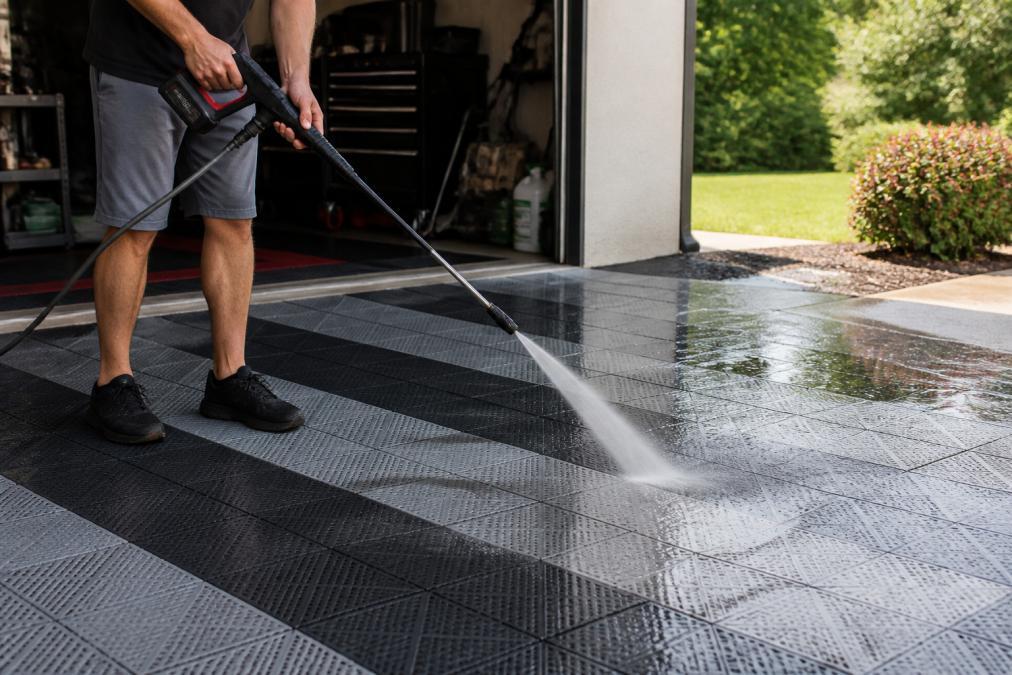
Deep cleaning steps:
- Clear the garage floor completely, remove vehicles, tools, and stored items
- Sweep thoroughly to remove all surface debris
- Apply a degreaser or all-purpose cleaner across the entire floor
- Let the solution sit for 20-30 minutes to break down embedded dirt
- Scrub with a stiff-bristled brush using firm, circular motions
- Pay special attention to the gaps between interlocking tiles where dirt accumulates
- Rinse completely with clean water
- Start at one end and work toward a drain
- Use the fan spray setting, not the concentrated jet
- Maintain 12-18 inches distance from the floor
- Work in overlapping passes for even cleaning
Garage Floor Tile Maintenance Schedule for Year-Round Protection
A consistent maintenance schedule keeps tiles fresh and extends lifespan. Adjust your routine seasonally.
Repairing Damaged Tiles and Preventing Future Stains
Individual tiles occasionally develop permanent stains, cracks, or damage. The modular design allows replacement of single tiles without affecting the entire floor.
When to clean versus when to replace:
Testing before replacement:
Identifying damaged tiles:
Look for:
- Cracks or splits in the tile surface
- Permanent discoloration that doesn't respond to cleaning
- Warping or cupping (edges lifting away from the sub-floor)
- Tiles that no longer sit flush with neighbors, creating a lip or gap
- Brittleness or degradation around the edges
- Tiles that shift or move when walked on
Replacing a single tile:
- Identify which tiles are damaged. Mark them clearly so you don't accidentally remove the wrong tile.
- Clear the area. Move vehicles, tools, and stored items away from the damaged tile.
- Carefully lift the damaged tile from the interlocking system. Most modular tiles simply lift out; some may require gentle prying with a flat tool at the edge. Do not force, if it resists, check that all interlocking edges are fully disengaged.
- Clean the sub-floor underneath. Remove any debris, moisture, or residue. Allow to dry completely.
- Place a new tile in the same position. Ensure it locks properly with surrounding tiles on all four sides. You should hear or feel a click when the interlocking edges engage.
- Test for stability before use. Walk on the new tile and check that it doesn't shift or rock. All edges should sit flush with neighbors.
Sourcing replacement tiles:
Stain prevention strategies:
- Apply protective sealant or coating annually. Many tile manufacturers offer UV-resistant topcoats that reduce staining and fading. Reapply every 12 months for maximum protection.
- Use absorbent mats under vehicles that leak. Catch drips before they contact the tile surface. Replace mats monthly during heavy-use seasons.
- Park consistently in the same area to distribute wear. Rotating parking spots prevents concentrated staining in one zone.
- Use drip pans for tools or equipment. Any item that might leak (lawnmowers, power tools, paint cans) should sit on a pan or mat.
- Wipe spills immediately before they set. The first 24 hours are critical for oil and chemical spills. Blot with absorbent material, then clean with appropriate cleaner.
- Avoid harsh de-icing chemicals in winter. Salt and chemical de-icers tracked into the garage can stain tiles. Use pet-safe alternatives or sweep frequently to remove salt residue.
Addressing persistent discoloration:
- Oxygen-based cleaners are your first option. They're gentler than chemical degreasers but more effective than mild soap. Test on an inconspicuous area first.
- Poultice treatments work on deep stains. Mix a powdered cleaner (like baking soda or diatomaceous earth) with water to form a paste, apply to the stain, cover with plastic to slow evaporation, and let sit 24-48 hours. The paste draws stain particles out of the tile. Rinse thoroughly and repeat if needed.
- Professional tile cleaning services use industrial equipment and specialized solvents. For valuable or irreplaceable tiles, professional cleaning may be worth the cost before considering replacement.
Frequently Asked Questions
Can I use a pressure washer to clean garage floor tiles?
Yes, pressure washing works well for garage floor tiles, especially to remove surface debris, grit, and stubborn stains. Use a 970 PSI pressure washer with adjustable nozzle settings, start at lower pressure (15-25 degrees) to avoid damaging the interlocking system. A cordless pressure washer like the 21V model gives you mobility without power cords and typically runs 45-60 minutes on a full charge. Always rinse thoroughly and allow tiles to air dry completely.
What is the best cleaner for plastic garage floor tiles?
Mild detergent mixed with water works best for plastic garage floor tiles. Use a pH-neutral cleaner to avoid degrading the tile material. For tougher stains, a non-sudsing ammonia solution diluted in water is effective. Avoid abrasive cleaners and harsh chemical solvents, which can scratch or discolor PVC and polypropylene tiles. Always test any cleaner on a hidden area first, then rinse thoroughly with clean water.
How do I remove oil stains from garage tiles?
Oil stains require a degreaser-based cleaner. Apply a commercial degreaser or a mixture of non-sudsing ammonia and water directly to the stain. Let it sit for 10-15 minutes to break down the oil, then scrub with a soft-bristle brush. For stubborn stains, use a pressure washer set to 25-40 degrees. Rinse multiple times with clean water and allow the tiles to air dry completely to prevent moisture buildup under the interlocking system.
How often should I deep clean my modular garage flooring?
Deep clean your modular garage tiles every 3-6 months, depending on usage and climate. High-traffic garages or those in dusty areas may need quarterly deep cleaning. Perform weekly spot cleaning and daily surface debris removal with a shop vacuum or leaf blower. Seasonal maintenance is important: increase cleaning frequency in spring (pollen and dirt) and fall (leaves and grit). Regular preventative maintenance extends floor longevity and reduces stain accumulation.