


Table of Contents
- Assess Your Workspace and Tool Inventory
- Best Workbench Tool Storage Solutions
- DIY Workbench Organization Ideas for Your Shop
- Organizing Small Workshop Space Efficiently
- Optimize Tool Accessibility and Workflow
- Maintenance-Focused Organization for Long-Term Durability
- Common Mistakes to Avoid When Organizing Your Workbench
- Frequently Asked Questions
Last Updated: September 21, 2026
Assess Your Workspace and Tool Inventory
Before buying storage systems, assess what you have and where you work, this determines whether your approach to how to organize hand tools on a workbench will function or become clutter in a new arrangement.
List every hand tool you own and lay them out. Most homeowners discover duplicates or forgotten tools, you might find three hammers when you thought you had one.
Measure your workspace: workbench dimensions, wall space, floor area, and obstacles like windows or electrical outlets.
Ask yourself these questions:
- Which tools do you use weekly?
- Which ones sit untouched for months?
- Do you work on the bench itself, or is it mainly storage?
- How much floor space can you spare for mobile carts or shelving?
- What's your budget for storage solutions?
This 30-minute assessment prevents costly mistakes, a pegboard looks great in photos but won't help if your bench faces a glaring window.
Best Workbench Tool Storage Solutions
Effective workbench setups combine multiple storage methods: vertical storage for frequent tools, drawers for small items, and mobile access for seasonal gear.
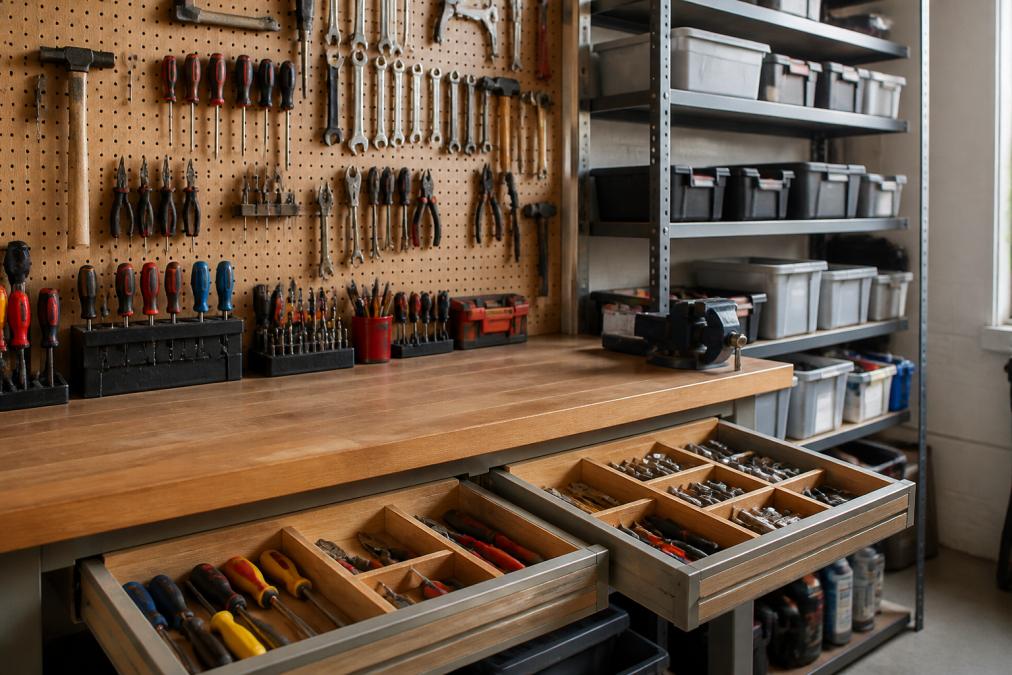
Pegboard Systems for Vertical Storage
Pegboards put your most-used items at eye level and within arm's reach, freeing your bench surface for actual work.
Metal pegboards outperform plastic ones and won't sag under weight. A 4-foot by 8-foot pegboard costs $40-$100.
Install your pegboard so your eyes are level with the middle section when standing at your bench, this prevents neck strain and makes tool grabbing natural.
Use hooks sized for your tool weight and color-code them by tool type for faster scanning.
Avoid installing pegboards too high or low, using cheap hooks, overcrowding the board, or placing it where sunlight creates glare.
Drawer Organization and Liners
Drawers protect small tools and fasteners from dust and moisture, though you lose visibility unless you open them.
Foam liners with pre-cut slots work best for hand tools, giving each tool its own spot. Buy custom organizers or cut your own from craft foam.
Organize drawers by function: one for screwdrivers, one for wrenches, one for bits and fasteners.
Label each drawer on the outside. Use a label maker or tape. When you're in a hurry, labeled drawers save time.
Mobile Carts for Flexible Access
A mobile cart with wheels lets you roll it to your project, then move it out of the way, ideal for shared garage spaces or small workshops.
Heavy-duty foldable metal storage racks with wheels are ideal for this purpose. Superior Tool Garage and Outdoors offers a 5Tier Heavy Duty Foldable Metal Storage Rack With Wheels for $57.99 that combines portability with sturdy construction. The five tiers give you multiple levels to organize different tool categories.

Stock your cart with tools you use for specific projects. Keep one cart for woodworking tools, another for automotive work. When you're done with a project, roll the cart back to storage.
DIY Workbench Organization Ideas for Your Shop
Custom-built organization systems fit your exact needs and budget, often costing less than pre-made systems.
Shadow Boarding and Tool Outlines
Shadow boarding is a professional shop technique that works perfectly for workbenches. You paint tool silhouettes on a board, then arrange your tools inside the outlines. At a glance, you see which tool is missing.
To build a shadow board: arrange tools on plywood, trace outlines, paint with bright colors, and mount on your wall. Shadow boards take 2-3 hours but last for years and instantly show which tools are missing.
Labeling and Color-Coding Systems
Labels and color codes eliminate confusion and speed up tool finding.
Use a label maker for drawers, shelves, and pegboard sections to prevent the "where does this wrench go?" problem.
Assign a color to each tool category (red for power tools, blue for wrenches, green for screwdrivers, yellow for measuring tools) and paint stripes on handles, color registers faster than reading labels.
Organizing Small Workshop Space Efficiently
Small workspaces demand ruthless prioritization, store only what matters most at arm's reach.
Use every inch of wall with pegboards, wall-mounted shelves, and hanging organizers to multiply storage without eating floor space.
The 72" Adjustable Metal Shelving from Superior Tool Garage and Outdoors ($101.99) fits perfectly in tight spaces. Its adjustable shelves let you customize spacing for different tool sizes and heights.

Use a foldable cart that takes up almost no room when pushed against a wall.
50 Piece General Household Toolbox →
Store seasonal tools elsewhere to keep your active workspace lean.
Optimize Tool Accessibility and Workflow
The best organization system is the one you'll actually use.
Frequency-Based Placement Strategy
Place most-used tools at the easiest-to-reach spots: daily tools on pegboards at eye level, monthly tools in accessible drawers, seasonal tools on high shelves.
Track what you grab for your next five projects, those tools go in your prime real estate.
Ergonomic Workflow Optimization
Place tools in the order you use them, if you always grab a hammer before a screwdriver, put the hammer closer to your starting position.
Keep frequently-used tools between waist and shoulder height to minimize strain.
Face your tools while working, don't twist your body to reach storage.
Maintenance-Focused Organization for Long-Term Durability
How you store tools affects how long they last. The best organization systems integrate maintenance into the workflow.
Environmental Control: Storage Conditions Matter
Tools degrade fastest in humid, dusty, or temperature-unstable environments.
Moisture control: Store metal tools in drawers or cabinets in humid environments (above 60% humidity). Add silica gel packets or a dehumidifier to enclosed storage, replacing silica gel every 3-6 months. For pegboard tools, apply machine oil every 3 months and wipe off excess.
Temperature stability: Store valuable or frequently-used tools indoors where temperature stays between 60°F and 75°F to prevent handle cracking or joint loosening.
Dust protection: Use enclosed storage (drawers, cabinets, tool cases) to protect tools from dust. If using pegboards, cover them when your workshop is idle for more than a week.
Integrated Cleaning Stations
Integrate a small cleaning station into your workbench organization so maintenance happens naturally.
Designate a corner for a maintenance kit: rag, machine oil, brass brush, compressed air, and rust-preventative spray. Place it within arm's reach and spend 30 seconds wiping tools before storing them.
For tools with moving parts, apply a tiny drop of oil to pivot points monthly and wipe away excess.
Storage Methods That Prevent Damage
Power tools: Store in original cases or padded bags to protect from dust and impact. Wooden-handled tools: Store handles down to prevent water pooling. Cutting tools: Use blade guards and magnetic strips. Wrenches and pliers: Use drawer dividers or individual hooks to prevent impact damage. Measuring tools: Store flat or vertically, never bent, in foam-lined drawers.
Monthly Inspection Routine
Set aside 15 minutes once a month to inspect your tools. This catches small problems before they become big ones.
Check for:
- Rust spots on metal surfaces (wipe with oil immediately)
- Loose handles or heads (tighten or replace)
- Cracked or worn grips (wrap with tape or replace)
- Dull cutting edges (sharpen or replace blades)
- Bent or warped tools (repair or retire)
- Missing or broken hooks on pegboards (replace immediately)
Keep a simple log: date, tool name, issue found, action taken.
Organization Layout for Maintenance Access
Design your storage system so maintenance tools and supplies are visible and accessible. If your cleaning kit is buried in a drawer, you won't use it.
Seasonal Storage for Dormant Tools
Tools you use seasonally (snow shovels, garden tools, seasonal power tools) need special care when stored for months.
Before storing seasonal tools:
- Clean them thoroughly
- Dry them completely
- Apply a light coat of oil to metal parts
- Store in a cool, dry place (not a damp basement or hot attic)
- Check them once per season to ensure no rust has started
Tool Replacement and Retirement
Organization isn't just about storage, it's about knowing when to retire a tool. A broken or severely damaged tool takes up space and creates frustration.
Common Mistakes to Avoid When Organizing Your Workbench
Learning from others' mistakes saves time and frustration.
Mistake 1: Buying storage before assessing your needs. You end up with systems that don't fit your space or tools. Assess first. Buy second.
Frequently Asked Questions
What is the best way to organize hand tools on a workbench?
Start by grouping similar tools together and placing frequently used items at eye level or within arm's reach. Use pegboards for vertical storage of hammers, wrenches, and screwdrivers; reserve drawers for smaller fasteners and bits. Keep tools you use daily closest to your work area, and store specialty items toward the back. A 50 Piece General Household Toolbox ($33.99) provides a compact foundation for basic hand tools, while adjustable metal shelving lets you customize storage height and depth as your collection grows.
How do I organize a small workshop space without taking up too much room?
Maximize vertical space with wall-mounted pegboards and shelving instead of spreading tools across benchtop. A 5 Tier Heavy Duty Foldable Metal Storage Rack With Wheels ($57.99) offers mobile flexibility, roll it where you need it and fold it away when space is tight. Use drawer dividers and organizer trays to stack tools efficiently, and consider shadow boarding on your pegboard so you instantly spot missing tools. For apartment workbenches, focus on multi-purpose storage that doubles as mobile carts.
What storage system works best for hand tools I use frequently versus occasionally?
Organize by frequency of use. Place your most-used hand tools, screwdrivers, pliers, adjustable wrenches, in the top drawer or on the most accessible pegboard hooks. Keep specialty tools and items you reach for monthly in secondary storage, like a 72" Adjustable Metal Shelving unit ($101.99) positioned slightly higher or further back. This frequency-based approach cuts down wasted motion and keeps your workspace clutter-free by hiding tools you rarely need.
How do I prevent rust and maintain hand tools in my workbench storage?
Store tools in a dry, ventilated workspace away from moisture and humidity. Use drawer liners to prevent metal-on-metal contact, which can cause corrosion. Regularly wipe down hand tools before storing, especially after use in damp conditions. Keep fasteners and small metal items in sealed containers or compartments. If your workshop is in a humid garage, consider a dehumidifier or silica gel packets in storage drawers. Proper organization also makes maintenance easier, you'll spot rust or damage faster when tools are clearly visible and labeled.