


Table of Contents
- Is a Metal Workbench Worth It for Woodworking?
- Durability and Longevity of Metal Workbenches
- Surface Material Comparison: Metal vs. Wood Workbench Pros and Cons
- Stability, Weight, and Structural Integrity
- Attaching Woodworking Vise to Metal Bench: Workholding Solutions
- Cost Analysis: Metal Workbench vs. Building Your Own
- Maintenance, Cleaning, and Long-Term Care
- Is a Metal Workbench Right for Your Shop?
- Frequently Asked Questions
Last Updated: September 23, 2026
Is a Metal Workbench Worth It for Woodworking?
The answer depends entirely on your workflow, space, and budget. A metal workbench woodworking setup isn't universally "worth it", it's a trade-off between durability and surface properties that affect specific tasks. For some woodworkers, it's the perfect solution. For others, it's overkill or even counterproductive.
The metal workbench question comes up constantly because the choice fundamentally changes how you work. Before investing, you need to understand what a metal workbench actually delivers and what it sacrifices.
Metal offers durability, stability, and longevity that wood struggles to match, but metal surfaces don't forgive mistakes the way wood does. A metal workbench is worth it if you prioritize structural integrity and long-term durability. It's not worth it if you do precision hand-planing, need acoustic dampening, or prefer a surface that absorbs vibration.
Durability and Longevity of Metal Workbenches
Metal workbenches last decades with minimal maintenance. A steel or stainless steel frame won't rot, warp, or develop structural weakness from humidity changes, maintaining load-bearing capacity indefinitely.

The trade-off: steel tops develop surface corrosion over time, especially in humid shops. Stainless steel resists corrosion better but costs more. Both can be dinged and scratched, creating rough spots that can snag wood or catch tools.
A hardwood workbench develops character through use, with dents becoming part of the surface. After ten years, a wood bench looks lived-in but remains functional, while a metal bench shows surface rust and paint chips.
For longevity measured in decades without replacement, metal wins decisively. If you're building something you expect to pass to your kids, metal's structural integrity is compelling.
Surface Material Comparison: Metal vs. Wood Workbench Pros and Cons
| Aspect | Metal Workbench | Wood Workbench |
|---|---|---|
| Structural Integrity | Rigid, no flex or sag | Can warp, sag over time |
| Surface Durability | Resists dents, scratches visible | Absorbs minor impacts, less visible wear |
| Vibration Damping | Transmits vibration readily | Absorbs vibration naturally |
| Heat Conductivity | Conducts heat quickly | Minimal heat transfer |
| Marring & Abrasion Resistance | Excellent, hard to damage | Softer, dents and marks easily |
| Workholding Compatibility | Requires T-slot or clamp-specific setup | Holdfasts, bench dogs fit naturally |
| Maintenance | Regular cleaning, rust prevention | Periodic oiling, surface conditioning |
| Cost | Higher initial investment | Lower initial cost |
| Acoustic Impact | Rings and resonates | Dampens noise naturally |
Hand-planing on a metal bench is frustrating, the plane sole chatters against the hard surface and vibration transfers to your hands. On a wood bench, the plane glides smoothly and the surface absorbs vibration.
Precision layout work benefits from metal's flatness, metal surfaces maintain flatness better than wood over years of use. For metalwork and welding, metal is the obvious choice, as welding spatter sticks to wood and burns it.
Stability, Weight, and Structural Integrity
A metal workbench doesn't move. The structural integrity of a welded steel frame resists twisting, racking, and flex under heavy load, keeping the bench stable during clamping or aggressive tool work.
A heavy metal bench (300+ pounds) stays stable during aggressive work, while a lighter wood bench might shift or bounce.
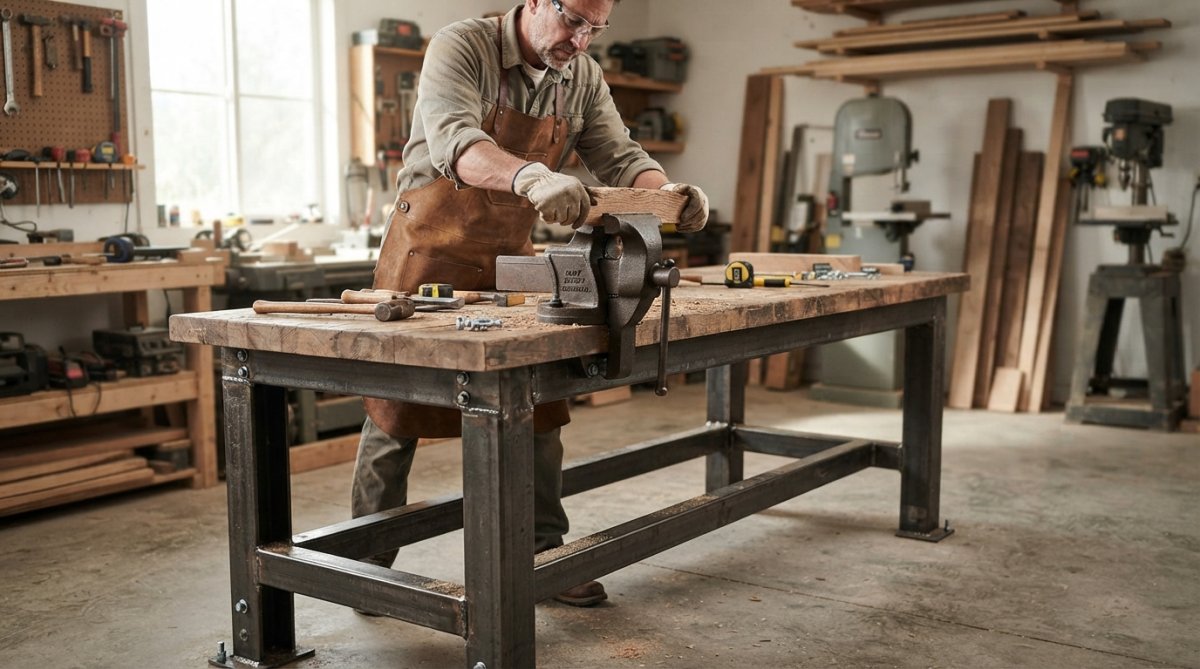
Metal's tensile strength allows thinner, lighter frames to maintain rigidity, a 250-pound metal frame can be stiffer than a 400-pound wood frame, useful if you need to move your bench occasionally.
The Acoustic Problem: Metal Benches Are Loud
Metal benches are notoriously loud. When using power tools, striking chisels, or clamping stock, a steel or aluminum top resonates like a drum, amplifying sound through the frame. For home workshops near living spaces, this is a genuine drawback.
Vibration travels through your hands and arms, causing fatigue over a full day of hand-tool work. A wood bench absorbs that energy naturally, reducing hand and arm stress.
Practical noise-dampening techniques for metal benches:
- Rubber isolation pads: Place 1/2-inch rubber pads under bench feet to decouple the frame from the floor ($20-$50).
- Top surface damping: Glue 1/4-inch to 1/2-inch rubber or foam to the metal top to absorb impact energy ($30-$80).
- Wooden top overlay: Bolt a 2-inch hardwood top (maple or oak) to the metal frame for structural rigidity with acoustic and tactile properties of wood.
- Strategic mass: Adding weight to the frame reduces resonance frequency but is impractical for most home shops.
For hand-planing or detailed layout work in noise-sensitive environments, a bare metal top is frustrating. For metalwork or welding, the acoustic issue is minor.
Thermal Comfort and Hand-Tool Work
Metal conducts heat and cold efficiently. In winter, a metal bench top is cold to the touch, reducing hand dexterity and increasing fatigue. In summer, direct sunlight heats it uncomfortably.
Wood maintains a neutral temperature and feels more comfortable during long sessions, a real ergonomic advantage.
Attaching Woodworking Vise to Metal Bench: Workholding Solutions
Metal workbench woodworking setups show their biggest limitation in workholding compatibility. A traditional woodworking vise with a wood screw mounts easily to a wood bench, while bench dogs and holdfasts work naturally with wood surfaces. On a metal bench, you need different solutions.
Most metal benches use T-slot framing or pre-drilled holes. A woodworking vise can be bolted to a metal bench, but setup takes longer than a simple wood screw mount. Holdfasts and bench dogs don't work on metal, you need T-slot nuts and clamps instead.
Workholding options for metal benches:
- T-slot vise mounting: Slide a vise into T-slot channels and tighten, allowing repositioning but requiring T-slot compatible vises ($30-$100 extra).
- Bolted vise: Drill holes and bolt a traditional vise directly, permanent but works with any vise.
- Clamp-based workholding: Use bar clamps with T-slot nuts, flexible but slower than bench dogs for repetitive work.
- Magnetic workholding: Magnetic clamps work on steel tops but don't work for wood and are expensive ($100-$300).
For precision work requiring multiple clamping points, T-slot is superior. For traditional hand tool work, metal requires adaptation.
If you're accustomed to wood bench workholding, switching to metal means learning a new system and potentially buying new clamping accessories.
The Hybrid Solution: Metal Frame + Wood Top
Competitors don't discuss this, but it's the practical answer to the metal vs. wood dilemma: a metal frame with a replaceable wooden top. This design gives you the structural integrity and longevity of metal with the workholding, acoustic, thermal, and tactile properties of wood.
How it works:
Advantages:
- Structural rigidity: Metal frame doesn't sag or twist.
- Workholding compatibility: Traditional vises, holdfasts, and bench dogs work naturally on the wood surface.
- Acoustic damping: Wood absorbs vibration and noise.
- Thermal comfort: Wood feels warm and comfortable under your hands.
- Repairability: Replace the top when needed (typically every 10-15 years of heavy use) rather than replacing the entire bench.
- Flexibility: You can customize the top thickness, wood species, and surface finish to your needs.
Drawbacks:
- Higher initial cost: A quality hardwood top adds $200-$600 to the bench cost.
- Maintenance: The wood top requires oiling and periodic conditioning, same as a traditional wood bench.
- Weight: A 2-inch maple top adds 100-150 pounds, making the bench heavier overall.
Building a hybrid bench:
Cost Analysis: Metal Workbench vs. Building Your Own
A quality metal workbench costs between $400 and $1,500 depending on size and material. A basic wood workbench built from dimensional lumber costs $150 to $400 in materials. If you have woodworking skills, the build-it-yourself wood option is dramatically cheaper.
Maintenance, Cleaning, and Long-Term Care
Metal benches need regular cleaning to prevent surface corrosion. Dust and moisture sitting on the surface accelerate rust formation. A quick wipe-down after each session keeps a metal bench in good shape. Every few months, apply a light oil or rust-preventive coating.
Is a Metal Workbench Right for Your Shop?
Choose a metal workbench if you do metalwork, automotive repair, or projects requiring heavy clamping pressure. Choose it if you need maximum structural integrity and don't do hand-planing or precision layout work. Choose it if you have limited space and need a bench that's stable and compact.
Frequently Asked Questions
Can you use a metal workbench for woodworking projects?
Yes, metal workbenches work well for woodworking, especially heavy-duty assembly and metalwork. However, they differ from traditional wood benches. Metal surfaces can mar wood pieces more easily, and you'll need to add padding or a protective top layer if you're doing fine woodworking. The rigid structure and excellent workholding compatibility make metal benches popular for precision layout and mechanical work where stability matters most.
What are the main disadvantages of a metal workbench for woodworkers?
Metal workbenches present several trade-offs. The hard surface can damage delicate wood finishes and hand-planed edges. They conduct heat and cold, making them uncomfortable in unheated shops during winter. Metal also reflects sound, creating acoustic issues in tight workshop spaces. Additionally, attaching woodworking vises to metal requires drilling and tapping, which takes more effort than securing them to a wood top with traditional holdfasts or bench dogs.
Is it cheaper to build a custom wooden workbench or buy a metal one?
Building a wooden workbench typically costs $300-$800 in materials if you source quality hardwood and fasteners yourself. A ready-made metal workbench ranges from $400 to $2,000 depending on size and features. Building offers customization but requires time and woodworking skill. Buying metal saves assembly time and guarantees structural integrity, though you sacrifice the ability to tailor dimensions to your exact space and workflow.
What makes a metal workbench better for heavy-duty work than precision woodworking?
Metal workbenches excel at heavy-duty tasks because their tensile strength and load-bearing capacity handle repeated impact and clamping pressure without flex. The rigid frame resists vibration damping issues that plague lighter benches. However, their hard, unforgiving surface causes marring and abrasion to fine woodwork. For precision joinery, hand-planing, and detailed finishing, a wood top or protective surface layer becomes necessary to prevent tool marks and material damage.
A metal workbench is worth it if your work demands structural integrity, stability, and durability over the next decade or more. It's not worth it if you prioritize vibration damping, traditional workholding, or a surface that improves with age. The best choice depends on what you actually build and how you like to work. Take an honest look at your projects, your space, and your budget. The answer becomes clear once you know what matters most to your workflow.