


Table of Contents
- How Poor Garage Lighting Creates Trip Hazards and Accident Risks
- Garage Lighting Lumen Requirements: What You Actually Need
- Best Garage Lighting for Workshops and Task Areas
- How to Calculate Garage Lighting Needs for Your Space
- Smart Lighting Integration and Motion Sensors for Garage Safety
- Emergency Lighting and Aging Population Considerations
- Conclusion: Why Garage Lighting Safety Should Be Your Next Upgrade
- Frequently Asked Questions
Last Updated: September 16, 2026
How Poor Garage Lighting Creates Trip Hazards and Accident Risks
Why proper garage lighting matters for safety more than almost any other upgrade is a question worth answering first. Because a garage is the one room in the house where stored tools, cords, and clutter meet foot traffic every single day. Because a garage is the one room in the house where stored tools, cords, and clutter meet foot traffic every single day.
The physics is simple. Dim light flattens depth perception, so a hose coiled on the floor and a shadow look identical. Add a step down to the driveway or a toolbox left near the walkway, and the risk compounds. The Consumer Product Safety Commission tracks falls as a leading cause of home injury, and garages concentrate the conditions that produce them: hard concrete, sharp tools, and poor visibility.
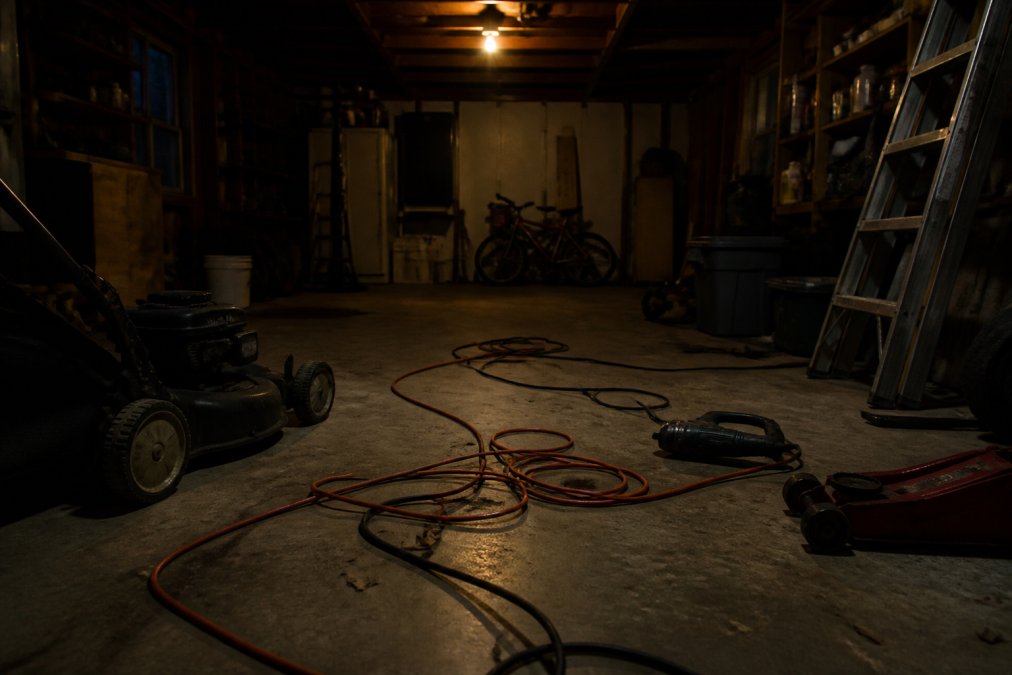
The fix starts with understanding what "enough light" actually means.
Garage Lighting Lumen Requirements: What You Actually Need
Most garages run at roughly half the brightness they need. The general rule for a working garage is about 50 lumens per square foot, with task areas such as a workbench pushed to 100 lumens per square foot or more. But "enough light" is not a single number, it depends on what the space is used for, who uses it, and how the light is distributed.
Lumens measure total light output; wattage only tells you energy draw. That distinction matters because modern LED fixtures deliver far more lumens per watt than the old fluorescent tubes many garages still use. A typical 4-foot LED shop light produces around 4,000-5,000 lumens while drawing roughly 40-50 watts, whereas an equivalent fluorescent tube of the same length draws closer to 80-100 watts for less usable output. Color temperature, measured in Kelvin, is the second lever: 4000K to 5000K reads as clean, neutral daylight and helps you distinguish wire colors and tool edges. Lower Kelvin values look warmer but muddy detail.
Uniformity matters as much as raw output. A single bright fixture in the center of a two-car garage leaves dark corners along the walls and behind parked vehicles, which is exactly where people reach for stored items. The Illuminating Engineering Society publishes recommended illuminance targets that many lighting designers use as a baseline; for garages and general storage, those recommendations commonly land in the 30-50 foot-candle range for ambient coverage, with higher targets over active work zones. Foot-candles and lumens per square foot are not identical units, but for practical planning purposes they track closely enough that a 50-lumens-per-square-foot target is a reasonable proxy.
A few variables change the target:
- Ceiling height. A 12-foot ceiling needs more fixture output than an 8-foot ceiling to hit the same floor-level brightness, because light intensity falls off with distance.
- Wall and floor color. Dark walls and sealed concrete absorb light; light-colored walls and an epoxy floor reflect it, effectively raising perceived brightness without adding fixtures.
- Vehicle presence. A parked car blocks light from reaching the floor on the far side, so plan fixtures on both sides of the parking bay, not just down the center.
- Task vs. ambient. Ambient light lets you see the room; task light lets you see the work. They are separate budgets.
Best Garage Lighting for Workshops and Task Areas
The best garage lighting for workshops combines broad overhead illumination with focused task lighting, because no single fixture solves both jobs. Getting the layout right is what separates a garage that feels bright from one that actually is.
For ambient coverage, linear LED shop lights mounted parallel to the garage door give even foot-candles across the floor. The reason parallel-to-door mounting works is that it aligns the long axis of the fixture with the long axis of the parking bay, so light spreads evenly rather than pooling in the center. Mount fixtures 8-10 feet apart and roughly 2-3 feet off the side walls to reduce shadowing behind parked vehicles.
For bench work, adjustable task lamps reduce glare and put light exactly where your hands are. A high CRI (Color Rendering Index) rating, ideally 90 or above, keeps colors true, which matters when you are matching paint or reading wiring. Position task lights slightly behind and above your shoulder line so the light falls on the work surface, not into your eyes.
What most guides miss is glare. A bare high-output fixture at eye level bounces light off a car hood or a glossy work surface straight into your eyes, and glare is a safety problem, not just an annoyance. Diffusers and correct fixture placement solve it. Look for fixtures with frosted lenses or prismatic diffusers, and avoid aiming high-output fixtures directly at reflective surfaces.
Remote Control RGB LED Strobe Light →
The emergency lighting angle most guides skip
Here is the piece almost no garage lighting guide covers: what happens when the power goes out. A garage with no battery-backed or motion-triggered light during an outage becomes a pitch-black room with tools, cords, and steps in it, and the garage is often the first room you enter when you come home after dark or the last room you leave when you head out.
A few practical options exist:
- Battery-backed LED fixtures. These run on internal batteries when line power drops and switch on automatically, similar in principle to the emergency lighting required in commercial occupancies.
- Plug-in emergency lights. Inexpensive units plug into a standard outlet, charge continuously, and illuminate when power is lost.
- Motion-triggered battery lights. Mounted near the house-to-garage door, these turn on the instant someone enters, even in an outage.
- Rechargeable portable work lights. Useful as a stopgap, but they require remembering to keep them charged.
For households with older adults, this matters more, not less. Reduced contrast sensitivity and slower pupil response mean a sudden transition from a lit house into a dark garage is a genuine fall risk. Prioritize lighting the path from the car to the interior door first, then expand outward.
How to Calculate Garage Lighting Needs for Your Space
You can size a garage lighting layout in under five minutes with one formula.
- Measure the floor area. Multiply length by width in feet. A 20x20 garage is 400 square feet.
- Multiply by your target lumens per square foot. Use 50 for general use, 100 for a workshop. That gives 20,000 lumens for the example garage.
- Divide by the output of your chosen fixture. If each LED shop light produces 5,000 lumens, you need four fixtures.
- Map the placement. Space fixtures evenly, roughly one every 8-10 feet, and add task lighting at benches.
- Check uniformity. Walk the space at night and look for dark corners; add a fixture or reposition one if you find them.
| Space Type | Lumens per Sq Ft | Color Temperature | Typical Fixture Count (400 sq ft) |
|---|---|---|---|
| General parking/storage | 50 | 4000K | 4 |
| Workshop or hobby area | 100 | 5000K | 8 |
| Task bench only | 150 | 5000K | Add 1-2 task lamps |
| Aging-in-place retrofit | 75 | 4000K-5000K | 6 |
Smart Lighting Integration and Motion Sensors for Garage Safety
Motion sensors and dusk-to-dawn sensors turn lighting from a manual chore into automatic protection. Occupancy sensors switch lights on the moment someone enters and off when the garage empties, which removes the "I'll just leave it dark" habit that causes most accidents.
Emergency Lighting and Aging Population Considerations
Emergency lighting requirements are the piece most homeowners never think about, and they matter most for households with older adults. A garage with no battery-backed or motion-triggered light during a power failure becomes a pitch-black room with tools and steps in it.
Conclusion: Why Garage Lighting Safety Should Be Your Next Upgrade
Understanding why proper garage lighting matters for safety is one of those upgrades that pays back twice: fewer accidents now, and a workspace you actually want to use. The math is not complicated. Measure your square footage, target 50 lumens per square foot for general use and 100 for work areas, choose 4000K-5000K LED fixtures, and add motion sensors so the light is always on when you need it.
Frequently Asked Questions
What are the safety considerations for garage lighting?
Proper garage lighting safety requires eliminating trip hazards, reducing glare, and ensuring uniform illumination. Key considerations include fixture placement to avoid dark corners, using motion sensors for hands-free operation, and maintaining at least 50 foot-candles for task areas. LED fixtures with high CRI improve visibility for detail work. Emergency lighting and dusk-to-dawn sensors add security and safety for human-entry doors.
What is the 5'7" lighting rule?
The 5'7" rule refers to mounting light fixtures at least 5 feet 7 inches above the floor in garages to prevent head injuries and keep lights out of the way of vehicles and storage. This height also ensures proper light distribution without glare. For overhead lighting, higher mounting may be needed based on ceiling height and fixture type.
Is 4000 lumens bright enough for a garage?
For a standard one-car garage, 4000 lumens can provide adequate ambient illumination, but two-car garages typically need 8000-10000 lumens. Task areas like workbenches require additional lighting at 50-100 foot-candles. Consider LED efficiency and fixture placement to achieve uniform light without dark corners. Motion sensors can help manage energy consumption.
How does poor lighting contribute to garage accidents?
Poor lighting creates shadows that hide trip hazards like tools, cords, and uneven floors. It reduces visibility for tasks, increasing the risk of cuts and injuries. Dark corners also deter security and make it harder to spot pests or damage. Proper garage lighting safety reduces these risks by providing uniform, glare-free illumination.