


Table of Contents
- Understanding Workbench Height for Sitting Work
- The Elbow Height Rule: Your Starting Point
- How to Calculate Your Ergonomic Workbench Height
- Choosing the Best Chair Height for Your Workbench
- Adjustable Height Workbench Benefits for Different Tasks
- Critical Ergonomic Factors: Knee Clearance and Eye Level
- Multi-User and Custom Workbench Solutions
- Frequently Asked Questions
Last Updated: October 3, 2026
Understanding Workbench Height for Sitting Work
The ideal workbench height sitting position depends on your body measurements, the chair you use, and the type of work you do. Get this wrong and you'll spend hours fighting fatigue, poor posture, and strain. Get it right and your workspace becomes genuinely comfortable.
The foundation of any good seated workspace is height. Too high and your shoulders creep toward your ears. Too low and you hunch forward. Neither feels good after an hour of focused work.
The basic principle is simple: your work surface should position your forearms parallel to the floor when you're seated with proper posture. But achieving that requires understanding a few key measurements and how they interact with your specific setup.
The Elbow Height Rule: Your Starting Point
Your elbows are your measurement reference point. When seated with good posture, your elbows should bend at approximately 90 degrees when your forearms rest on the work surface. This angle keeps your shoulders relaxed and your back neutral. If your workbench is too high, you'll raise your shoulders and strain your neck and upper back. If it's too low, you'll lean forward and round your spine. The 90-degree elbow angle prevents both problems.
Your elbow height when seated is typically 8 to 10 inches below your shoulder, varying by arm length and posture. Taller people have higher elbow heights; shorter people have lower ones. This is why a one-size-fits-all workbench height doesn't work for everyone. The elbow height rule applies across all work types, jewelry making, assembly, repairs, because it aligns your spine, shoulders, and arms in a neutral position.
Measure your elbow height while seated in the chair you'll actually use at your workbench. Wear the shoes you typically wear when working. Small details like footwear change your seated height by an inch or more.
How to Calculate Your Ergonomic Workbench Height
Start with these four measurements. You'll need a tape measure and the chair you plan to use.
Step 1: Measure your elbow height. Sit in your work chair with your feet flat on the floor, back against the chair, shoulders relaxed. Measure from the floor to the top of your elbow.
Step 2: Determine your ideal workbench height. Your workbench surface should be at or 0 to 1 inch below your elbow height. This small drop prevents your forearms from tilting upward and straining your wrists. For example, if your elbow height is 42 inches, your workbench should be between 41 and 42 inches tall.
Step 3: Account for the work surface thickness. If you're building a workbench or adding a top, remember that the surface material adds height. A 1.5-inch wooden top raises the effective height by 1.5 inches. Measure from the floor to the top of whatever material you'll actually rest your work on, not just the frame.
Step 4: Test before finalizing. Mock up your workbench height using a temporary surface. Sit and work for 20 to 30 minutes. Your elbows should feel relaxed, shoulders down and loose, back neutral. This testing step saves you from building a permanent setup that doesn't fit your body.
Choosing the Best Chair Height for Your Workbench
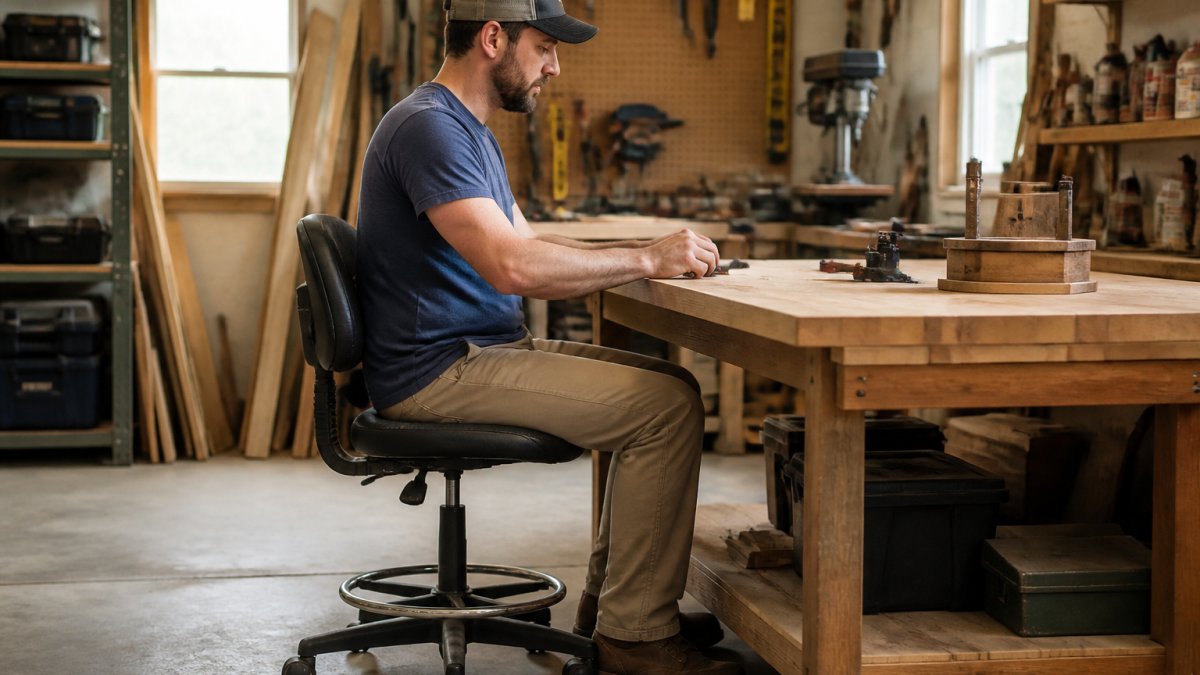
Your chair height is just as critical as your workbench height sitting setup. Your chair seat should be high enough that your feet rest flat on the floor with your knees at roughly 90 degrees. When your feet dangle, you lose support and your legs fatigue. When your knees are too high, your thighs press into the seat edge and restrict blood flow.
Once your chair is at the right height, measure your elbow height from there. That measurement becomes your target for workbench height. Many people set their workbench height first, then pick whatever chair fits underneath, backward. Set your chair height first based on your body, then adjust your workbench to match your resulting elbow height.
If your workbench height is fixed and your chair height doesn't align, a footrest helps if your chair is too high, an adjustable-height chair solves it if your budget allows, or a cushion on the seat raises your height by 2 to 4 inches.
Adjustable Height Workbench Benefits for Different Tasks
A fixed workbench height works fine for one type of work. Most home workshops handle multiple tasks, each benefiting from a slightly different height.
Task-Specific Height Preferences
Precision work (jewelry, model building, detailed assembly, electronics repair) benefits from a slightly higher surface.
Heavy assembly, pounding, or force work works better at a lower height. A lower surface lets you position your body more effectively and apply force more efficiently, like a blacksmith's anvil positioned lower than a jeweler's bench.
General repair and finishing sits right at your elbow height. This middle ground works for most tasks most people do, soldering, painting, assembly without heavy force, tool maintenance.
Woodworking and hand tool work varies. Hand planing and chiseling often benefit from a slightly lower height (1 to 2 inches below elbow height) to give you better control and leverage.
How to Implement Adjustability
Adjustable-height workbenches come in several forms, each with different trade-offs:
Manual crank systems: A hand crank raises or lowers the work surface via a screw mechanism. These are affordable ($200-$600), reliable, and require no electricity. Adjusting takes 30 seconds to a minute, so they work best if you have two or three primary tasks that need different heights.
Pneumatic or spring-assisted systems: Gas cylinders or springs help lift the surface. These are more expensive ($400-$1,000+) but faster to adjust, 10-15 seconds, making it practical to change height between tasks.
6 or 8 FT Portable Folding Table →
Motorized electric systems: A button or foot pedal raises and lowers the surface in 5-10 seconds. Most expensive ($800-$2,500+) and require electrical power, but ideal for professional workshops or serious hobbyists who switch tasks frequently.
Supplemental surfaces and risers: Keep your main bench at a fixed height and add adjustable or modular work surfaces on top.
When Adjustability Pays Off
The Middle Ground: Hybrid Approaches
Many serious hobbyists use a hybrid approach: a fixed main workbench at their primary task height, plus a supplemental adjustable surface for secondary tasks.
If you're building a custom workbench, start with a fixed height optimized for your primary task. Add adjustability only if you regularly do secondary tasks that need a different height. This saves money and complexity while still addressing your real needs.
Critical Ergonomic Factors: Knee Clearance and Eye Level
Two factors beyond elbow height fundamentally shape seated workbench comfort and precision: knee clearance and visual focal distance. These determine whether your carefully calculated elbow height actually works in practice.
Knee Clearance and Leg Support
Your knees need room to fit under the workbench without forcing you to sit further back. When your knees hit the underside, you either scoot backward (breaking elbow-height alignment) or tuck your legs awkwardly (creating asymmetrical lower back and hip strain).
Measure the distance from the floor to the underside of your work surface. Most seated workbenches need a minimum of 15 to 18 inches of clearance for average-sized people; taller individuals may need 19 to 22 inches.
Your feet also need support. When your feet dangle, your leg muscles fatigue and your lower back rounds forward. Your feet should rest flat on the floor or a footrest, with your knees at roughly 90 degrees.
If standard workbench heights feel too low, raising your chair may create a footrest gap. A dedicated footrest platform prevents your legs from dangling and supports proper posture for hours of work.
Visual Focal Distance and Task-Specific Height Adjustments
Your eyes dictate workbench height as much as your elbows do. The ideal viewing distance for detailed work is 12 to 16 inches from your eyes to the work surface. Focal distance varies by task:
- Precision work (jewelry making, watch repair, model building, detailed assembly): Requires closer focal distance, often 10 to 14 inches. Many jewelers position benches 2 to 4 inches higher than the elbow-height rule suggests to reduce eye and neck strain during magnified work.
- General repair and assembly: Works at standard elbow height (12 to 16 inches focal distance).
- Heavy assembly or power work: Benefits from a lower height where you can use your body weight and leverage.
If your workbench is too low, you'll lean forward, rounding your spine and straining your neck and shoulders. If too high, you'll tilt your head back, creating neck strain. The right height maintains a neutral head and neck position while keeping your work at a comfortable viewing distance.
Testing the Three-Factor Alignment
Elbow angle, knee clearance, and eye distance work together as a system.
Multi-User and Custom Workbench Solutions
If multiple people use the same workbench, a fixed height becomes problematic. A motorized adjustable-height table lets each user raise or lower the surface to their ideal height in seconds. Alternatively, build the base at a standard height that works for most users and add adjustable-height work surfaces on top for specific tasks. For a permanent solution, calculate the average elbow height of regular users, build the main surface at that height, and add supplemental surfaces or risers for people who need different heights.
Superior Tool Garage and Outdoors offers the 6 or 8 FT Portable Folding Table at 29 inches high as a supplemental work surface for tasks requiring a different height than your main bench. When building a custom workbench, consider who'll use it: a solo hobbyist can optimize for one person, a shared family workshop needs flexibility, and a business workspace needs to accommodate different body types safely.

Getting your workbench height right transforms your workspace from tiring to genuinely comfortable. The elbow height rule gives you a starting point. Testing your setup before finalizing it prevents costly mistakes. Understanding how knee clearance and eye level factor in ensures your workspace supports both comfort and precision. Superior Tool Garage and Outdoors helps you build workspaces that work for you. Shop our collection today to find everything you need to tackle projects with confidence.
Frequently Asked Questions
How do I calculate the correct workbench height for my chair?
Start with your chair height: measure from the floor to the seat surface. Add 10-12 inches to account for your forearm and hand thickness above the seat. This gives you your ideal work surface height. Alternatively, sit in your chair with your arms at a 90-degree angle, your work surface should align with your elbows. Test this by placing your hands flat on the surface; your forearms should be parallel to the floor with no strain in your shoulders or wrists.
Does workbench height affect back pain during long projects?
Yes. Incorrect workbench height forces your spine into awkward postures and strains your lumbar support system. Too-high surfaces cause shoulder fatigue and neck strain; too-low surfaces create slouching and lower back pain. Proper ergonomic alignment, where your elbows rest at 90 degrees and your eyes focus naturally on the work, reduces repetitive strain and allows your back muscles to stay neutral for hours without fatigue.
What is the standard height for a sitting-only workbench?
For most adults, a sitting workbench ranges from 28 to 36 inches high, depending on chair height and individual proportions. The average person sitting in a standard chair (18 inches) works comfortably at a 30-32 inch surface. However, this is a starting point, not a rule. Your ideal height depends on your body measurements and the specific tasks you perform, precision work may require different positioning than heavy assembly.
Should a sitting workbench be lower than a standing one?
Yes, typically 6-12 inches lower. Standing workbenches are usually 34-36 inches to allow your arms to hang naturally. Sitting workbenches range from 28-32 inches because you're already elevated by your chair. The key difference is biomechanics: when standing, your entire body weight distributes through your legs and feet; when sitting, your chair supports your torso, so the work surface needs to be closer to your seated elbow height to maintain proper ergonomic alignment.