


Table of Contents
- Quick Comparison: Best Garage Wall Cabinets for Small Spaces
- What to Look For in Small Garage Storage Cabinets
- Garage Cabinet Dimensions and Fit: Measuring Before You Buy
- Weight Limits and Safe Wall Installation
- Locking Garage Wall Cabinets: Security and Construction
- Garage Wall Storage Ideas for Tight Layouts
- Total Cost of Ownership: What You'll Actually Spend
- Conclusion
- Frequently Asked Questions
Last Updated: October 21, 2026
Quick Comparison: Best Garage Wall Cabinets for Small Spaces
Garage wall cabinets are shallow, wall-mounted storage units designed to hold tools and supplies without eating floor space, and they matter most in single-car garages where every square foot counts. At Superior Tool Garage and Outdoors, we see the same mistake repeatedly: homeowners buy deep cabinets first and measure second. The result is a wall of boxes that blocks the car door.
Below, we break down the dimensions, weight ratings, and cost math that decide whether a cabinet set actually works in a tight garage. We also recommend our own shelving and rack options where they fit the job better than a cabinet would.
| Option | Price | Best For | Key Spec |
|---|---|---|---|
| 5-Tier Foldable Metal Storage Rack with Wheels | $57.99 | Renters and flexible layouts | Folds flat, stainless steel, rolls |
| Heavy Duty Stainless Steel Storage Rack | $93.99 | Wet or humid garages | Stainless steel 201, three tiers |
| 72" Adjustable Metal Shelving | $101.99 | Full-wall vertical storage | Iron frame, adjustable, 72 inches tall |
| Modular Office File Cabinet | $907.99 | Locked, enclosed storage | Metal frame, 29.1 in high |
What to Look For in Small Garage Storage Cabinets
Start with depth, not width. A cabinet that stands 12 inches off the wall leaves walking room in front of the car; one that stands 24 inches deep turns a two-foot aisle into a squeeze. Width and height matter next, because they determine how much wall you cover and how high you can stack.

Construction comes third. Steel and metal frames hold their shape under load and resist the dents that hollow-core units collect. Look for adjustable shelves so the interior can change as your tools change. Locking hardware matters if chemicals, power tools, or bikes live in the garage.
Shallow Cabinet Trade-Offs
Shallow cabinets trade capacity for access, and that trade is usually worth it in a small garage. A 12-inch-deep cabinet holds paint cans, hand tools, and boxed supplies fine. It will not hold a chainsaw case or a large tool chest.
The honest limitation: shallow units force you into vertical storage. You gain floor space and lose the ability to store bulky items inside the cabinet itself. Plan a separate rack for the oversized gear.
Garage Cabinet Dimensions and Fit: Measuring Before You Buy
Most fit failures happen before checkout, not after delivery. The fix is a five-minute measuring routine you run once per wall, written down on paper or taped to the wall itself. Do it in this order and you will catch the problems that return shipping cannot fix.
Step 1: Measure usable wall width, not total wall width. Run the tape along the wall at the height where the cabinet will hang.
Step 2: Measure usable height. Measure from the floor to the ceiling, then subtract the garage door's travel path when it is open. A standard overhead door panel sits roughly 7 feet off the floor when raised, so a cabinet hung above that line needs to clear the door's arc, not just the ceiling.
Step 3: Measure depth and the clearance in front of the wall. This is the number people skip. Measure from the wall out to the widest point of the parked vehicle, including the open door.
Step 4: Do the width math with gaps included. Cabinet widths are nominal, and doors need room to swing. Two 30-inch cabinets plus a 2-inch gap equal 62 inches of wall, not 60. Leave 2 to 4 inches between units so doors open without scraping, and add end clearance if a cabinet sits against a side wall or the garage door frame.
Step 5: Sketch the wall to scale. A simple elevation sketch, wall width across the bottom, height up the side, obstacles marked as boxes, exposes conflicts before you order. Mark the car's footprint on the floor with painter's tape and stand in the remaining aisle.
Layout examples for tight garages
- Narrow one-car garage (roughly 10 to 12 feet wide): Hang shallow cabinets (10 to 12 inches deep) on the wall opposite the car doors, above a workbench, and keep the wall beside the driver's door clear for swing. Reserve the back wall for a tall adjustable shelving unit rather than deep cabinets.
- Shared parking and storage zone: Put lockable, enclosed cabinets at eye level on the wall between the two bays, keep the floor line along each car's path completely clear, and move bulky seasonal gear to ceiling-height racks over the hood area where nothing walks.
- Single wall with a workbench: Mount cabinets above the bench at a height that clears the tallest benchtop item, and use the wall above the garage door (if the door is not an overhead type) for shallow, rarely accessed storage.
Write the five numbers down, usable width, usable height, depth limit, front clearance, and gap allowance, and take the list to the product page. Any cabinet whose dimensions exceed those numbers is the wrong cabinet, no matter how good the price looks.
Weight Limits and Safe Wall Installation
Wall cabinets fail for one reason: the wall, not the cabinet. Drywall alone holds very little hanging weight. Mounting hardware must reach the studs, and studs sit 16 or 24 inches apart in most homes.
Find the studs with a stud finder, mark them, and drill pilot holes. Use lag bolts rated for the load rather than drywall anchors. Spread the load across at least two studs per cabinet. If a cabinet must hang where no stud exists, add a plywood backer board spanning two studs and mount into that.
Locking Garage Wall Cabinets: Security and Construction
Locking cabinets solve a specific problem: keeping hazardous or expensive items out of reach. Paint, solvents, and power tools are the usual candidates. A lock also keeps kids and visitors out of chemical storage.
Construction decides whether the lock means anything. A lock on a thin metal door stops casual access, not a determined one. Steel bodies with welded seams and reinforced doors hold up better. Check that hinges sit inside the frame, since exposed hinges can be unscrewed from outside.
For open shelving that still needs some protection, a lockable cabinet paired with open racks works well. Keep the locked unit for chemicals and small valuables, and leave the racks for bulky gear.
72" Adjustable Metal Shelving →
Garage Wall Storage Ideas for Tight Layouts
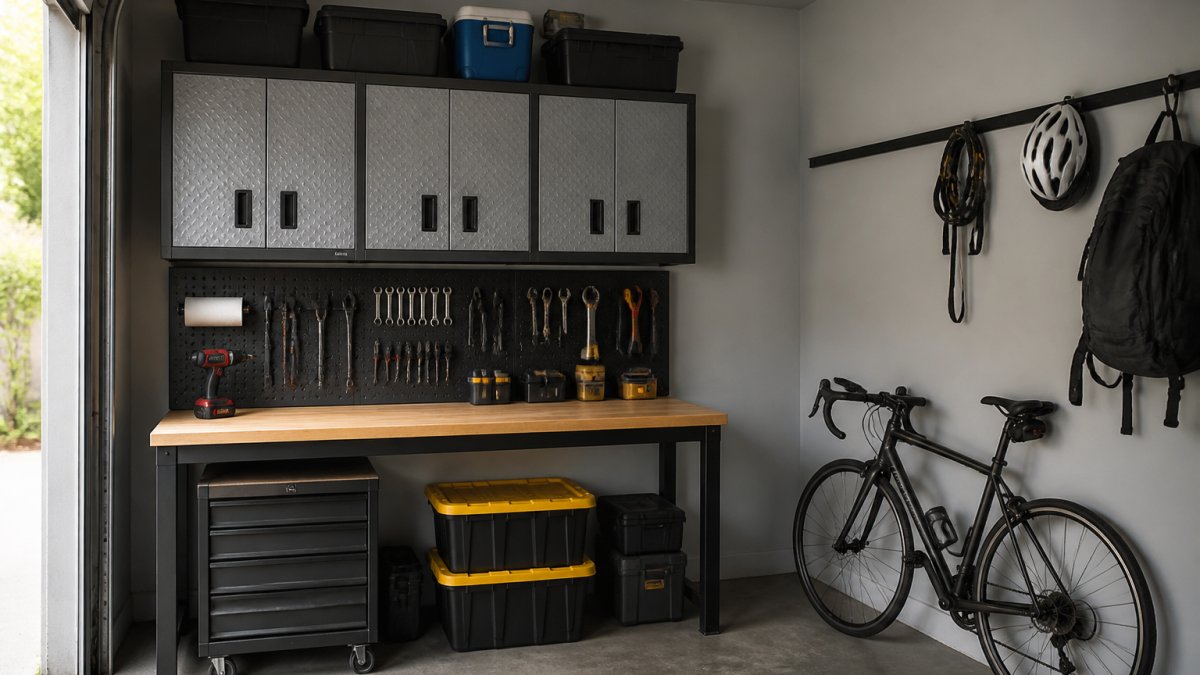
Build storage in zones and the layout solves itself. A work zone holds the bench and hand tools. A chemical zone holds a locked cabinet at eye level. A bulk zone holds racks for seasonal gear near the ceiling.
Vertical storage is the lever in a small garage. Our 72" Adjustable Metal Shelving runs 72 inches tall on an iron frame with adjustable levels, so one narrow footprint covers a full wall of storage. For a layout that needs to move, the 5-Tier Foldable Metal Storage Rack with Wheels folds flat and rolls out of the way when the car comes in.

Keep the floor clear along the car's path. Everything else can stack.
Total Cost of Ownership: What You'll Actually Spend
The sticker price is the smallest line in the budget. A wall cabinet purchase has four cost layers, the unit, the mounting hardware, the installation time or labor, and the cost of getting it wrong, and small-garage buyers routinely budget only the first.
Layer 1: The unit itself. Our storage options run from $57.99 for the foldable rolling rack to $101.99 for the 72-inch adjustable shelving, with the stainless steel rack at $93.99. The Modular Office File Cabinet at $907.99 sits in a different tier, built for enclosed, lockable storage rather than open shelving.

Layer 2: Mounting hardware. Budget for lag bolts or structural screws rated for the load, washers, a stud finder if you do not own one, a level, and, if no studs line up with the cabinet's mounting points, a plywood backer board to span two studs.
Layer 3: Installation time or labor. Hanging a single cabinet into exposed studs is a do-it-yourself afternoon with a helper. A full wall of cabinets, a cabinet that must clear a garage door track, or a unit that needs a backer board is a longer job.
Layer 4: Delivery and assembly. Flat-pack and modular units may arrive unassembled; factor in assembly time and the tools it requires. Oversized or heavy units may carry delivery surcharges or require a two-person lift. Confirm before ordering whether the price includes delivery to the garage or only to the curb.
Layer 5: The cost of getting it wrong. A cabinet that does not fit gets returned, resold at a loss, or abandoned in the corner. A wall that fails takes the contents with it.
A simple way to compare options: divide total cost (unit plus hardware plus your time or labor) by usable storage volume. The foldable rack at $57.99 may win on cost per cubic foot for bulky gear, while a lockable cabinet earns its price on security for chemicals and power tools.
Conclusion
The hard part of outfitting a small garage isn't finding cabinets. It's fitting them around a car, a door swing, and a wall full of studs without losing the floor you started with. Get the measurements right and the rest follows.
Superior Tool Garage and Outdoors stocks heavy-duty shelving and racks built for exactly this job, including adjustable metal shelving, foldable rolling racks, and stainless steel units that hold up in humid garages. Start with your wall measurements, then shop our storage collection and build the layout around what actually fits.
Frequently Asked Questions
How deep should garage wall cabinets be for a small space?
For a small garage, aim for 12 to 16 inches of depth. Standard base cabinets run 24 inches deep, which eats into walkway and parking clearance. Shallow wall cabinets at 12 inches hold tools, paint, and supplies while leaving roughly a foot more floor clearance. Measure your car door swing and walkway before ordering. If you park inside, keep at least 30 inches between the cabinet face and the vehicle.
Are wall-mounted garage cabinets better than freestanding cabinets?
Wall-mounted cabinets free up floor space, which matters most in a small garage. They also keep items off the ground, away from moisture and pests. Freestanding racks and shelving still have a place for bulky items like coolers and tires. Many small garages work best with a mix: wall cabinets for tools and supplies, plus a folding or wheeled rack for overflow that can be tucked away when not in use.
How much weight can a garage wall cabinet hold?
Load capacity depends on the cabinet and, more importantly, on what it is anchored to. A wall cabinet must be fastened into wall studs, not just drywall, to carry real weight. Drywall anchors alone are not rated for loaded cabinets. Check the manufacturer's weight rating and add up what you plan to store. Heavy items like toolboxes and paint cans belong on lower shelves or a floor rack, not the top shelf of a wall unit.
How do you install garage wall cabinets on drywall?
Locate the studs with a stud finder and mark them. Drive lag screws or structural screws through the cabinet's mounting rail into the studs, not the drywall alone. Use shims to level the cabinet before final tightening. For a full-wall run, install a cleat or French cleat system first so cabinets hang straight and share the load. If your walls are masonry, use the appropriate anchors and follow the cabinet's instructions.
How do you organize a small garage with limited wall space?
Go vertical and use shallow depths. Mount cabinets high for seasonal items and lower for daily tools. Add a pegboard or slatwall between cabinets for hand tools. Use overhead space for long, light items like lumber and pipe. Keep a clear floor zone for the car or workbench, and choose foldable or wheeled racks for overflow so they can be moved out of the way. Measure everything before buying to avoid wasted space.