


Table of Contents
- Measure First: The Numbers That Decide Your One Car Garage Workspace
- Declutter and Zone: A Step-by-Step Process for a Small Garage Workshop Layout
- Garage Wall Storage Ideas That Free Up Floor Space
- Overhead Garage Storage: Using the Ceiling Without Losing Clearance
- Garage Workbench Ideas for Tight Spaces
- Safety, Load Limits, and Installation Basics
- Budget, Climate, and Flexible Storage Choices
- Frequently Asked Questions
Last Updated: October 7, 2026
Measure First: The Numbers That Decide Your One Car Garage Workspace
A one-car garage gives you roughly 12 feet of width and 20 feet of depth, the standard size across most American homes, and the key fact for how to maximize workspace in a one car garage.
A typical sedan needs about 8 feet of width and 16 feet of length, leaving roughly 4 feet of side clearance and 4 feet at the front. That leftover strip is your workshop.
Parking Clearance and Walkway Widths
The ADA guidelines for accessible routes recommend a minimum 36-inch clear path for wheelchair access, and that number works well as a general walkway standard in a garage too. Give yourself at least 30 inches between your car and any wall storage.
Measure these three distances before you buy a single shelf:
- Wall to car door: minimum 30 inches
- Front bumper to back wall: minimum 24 inches
- Side wall to side wall: full garage width minus 6 inches
Write the numbers down. Tape them to the wall. Every storage product you consider has to fit inside them.
Ceiling Height and Door Swing Zones
Most one-car garages have an 8-foot ceiling, though some run to 10 or 12 feet. The trap is the door: it travels back along ceiling tracks that eat up 12 to 16 inches of overhead depth, and that zone is off-limits for storage.
Watch the door open and mark where the tracks end: everything above that line is usable ceiling space.
Declutter and Zone: A Step-by-Step Process for a Small Garage Workshop Layout
A small garage workshop layout works only when everything has a job and a home. Most garages fail not from lack of space, but because they hold weekly items, yearly items, and things that should have been thrown out years ago.
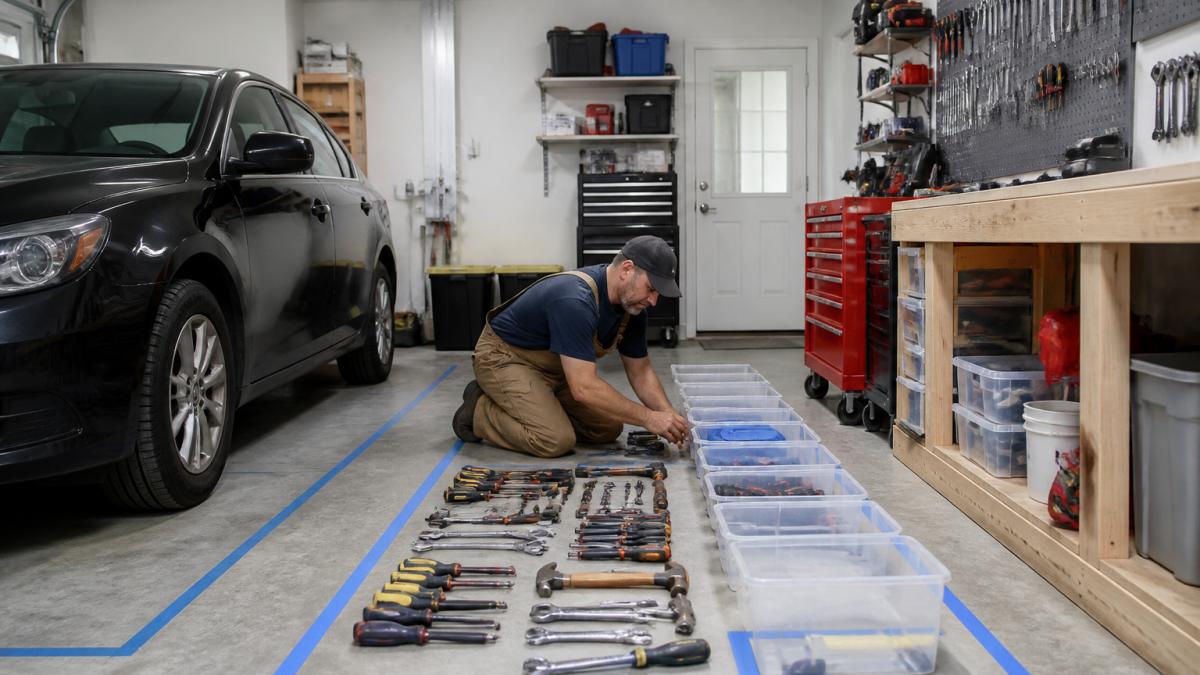
The fix is a zoning process. It takes a weekend and costs nothing but time.
Sort, Keep, Store, or Remove
Pull everything onto the driveway and sort each item into one of four piles:
- Keep, used at least once a month
- Store, used seasonally, like holiday decorations or camping gear
- Remove, broken, duplicated, or unused for two years
- Decide, the hard pile; give yourself one week to sort it
Be honest with pile four. If you have not touched it in two years, you will not touch it next year either.
Mapping Dedicated Work Zones
A dedicated work zone is a defined area for one type of activity, with its own tools and surface. In a one-car garage you can usually fit three zones:
- The bench zone, a workbench for cutting, assembly, and repair
- The storage zone, shelves and racks holding tools and supplies
- The parking zone, the car's footprint, kept clear
Mark each zone with tape on the floor; once zones are visible, tools stop migrating and the car stops getting boxed in.
Garage Wall Storage Ideas That Free Up Floor Space
Wall storage is the highest-return move in a small garage: every rack that moves tools off the floor buys back square footage for the car or a work surface.
Pegboards, Hooks, and Magnetic Boards
A pegboard is a flat panel with evenly spaced holes that accepts hooks, bins, and holders in any arrangement, the cheapest way to get tools off a bench and onto a wall.
Mount a 4-by-4-foot panel above your workbench. Add:
- Adjustable pegs for wrenches and pliers
- Hooks and hangers for cords and hoses
- Small bins for screws, nuts, and bolts
The adjustable part matters. You will rearrange it three times in the first month as you learn what you actually reach for.
Vertical Shelving and Floor-to-Ceiling Racks
When wall space runs out, go up.
Our 72" Adjustable Metal Shelving(https://superiortoolgarageandoutdoors.com/products/72-adjustable-metal-shelving) is built for exactly this job. It stands 72 inches tall, installs without fuss, and works in a garage, carport, or shop.

If you need something you can move, the 5-Tier Heavy Duty Foldable Metal Storage Rack with Wheels(https://superiortoolgarageandoutdoors.com/products/5tier-heavy-duty-foldable-metal-storage-rack-with-wheels) folds flat and rolls out of the way when the car comes home.

For heavier loads in a tight corner, the Heavy Duty Stainless Steel Storage Rack(https://superiortoolgarageandoutdoors.com/products/heavy-duty-stainless-steel-storage-rack) is a three-tier unit with a 50 kg maximum load. It is $93.99.

| Storage Type | Best For | Footprint | Price |
|---|---|---|---|
| 72" Adjustable Metal Shelving | Full-wall tool and bin storage | ~2 ft depth | $101.99 |
| 5-Tier Foldable Rack with Wheels | Flexible, movable storage | Folds flat | $57.99 |
| Heavy Duty Stainless Steel Rack | Heavy items, corner use | Compact | $93.99 |
Overhead Garage Storage: Using the Ceiling Without Losing Clearance
Overhead garage storage takes the area most people waste: the space above the car. Done right, it holds seasonal gear, luggage, and long items without touching the floor.
The rule is simple: keep the bottom of any suspended rack at or above 7 feet and out of the door's travel path. That leaves the car its full height and keeps your head clear.
The Ceiling Math Before You Drill
Most one-car garages have an 8-foot ceiling, though some run to 10 or 12 feet. That sounds like plenty until you subtract the door: a standard sectional door consumes 12 to 16 inches of overhead depth, and the opener rail and motor hang lower still, often 6 to 7 feet off the floor at the center of the bay.
Measure three things before you buy a rack:
- Finished ceiling height, floor to the lowest obstruction
- Door track depth, from the wall to the end of the horizontal track
- Opener rail height, the lowest point of the rail or motor housing
Write those numbers down. A rack that fits in the back third of the garage may not fit over the car at all.
What Overhead Racks Actually Hold
Ceiling racks are rated by total distributed load, not by what fits. A typical two-panel steel rack is rated 250 to 600 pounds when anchored correctly into ceiling joists or a header, with weight spread evenly.
72" Adjustable Metal Shelving →
A few practical limits:
- Keep the load under the rating, and treat the rating as a ceiling, not a target
- Spread weight evenly across the rack; a single heavy box in one corner stresses the anchors
- Skip anything that leaks, including paint, solvents, and propane cylinders
Good candidates for ceiling racks:
- Holiday decorations in sealed bins
- Camping and sporting gear
- Ladders and long pipe or trim
Anchoring Overhead Storage Safely
Overhead storage fails at the anchor, not the rack. Follow these rules:
- Anchor into ceiling joists or a structural header, never into drywall or a bare furring strip
- Use the lag bolts or hardware the manufacturer supplies; do not substitute shorter or thinner fasteners
- Locate joists with a stud finder and mark them before you drill
If you are not certain a joist can carry the load, or the ceiling is finished with no accessible framing, a wall-mounted overhead rack that transfers load to a ledger board bolted into wall studs is often safer. When in doubt, have a licensed contractor confirm the framing first.
Garage Workbench Ideas for Tight Spaces
A workbench is the heart of any garage workspace, but a fixed 6-foot bench eats floor space you may not have. The answer is a bench that disappears when you are done or rolls out of the way when the car comes home.
Bench Dimensions That Actually Work
Before you pick a style, get the dimensions right. A bench that is too tall or too shallow will sit unused.
- Height: around 36 inches suits most standing work; if you are tall, 38 to 40 inches saves your back
- Depth: 20 to 24 inches is the sweet spot; deeper benches eat walkway clearance you cannot spare
- Width: 4 to 6 feet covers most projects without blocking the car door
Measure your walkway first: a 6-foot bench against a side wall in a 12-foot-wide garage leaves roughly 6 feet for the car and walkway combined, so a 4-foot bench is often the better call.
Folding and Wall-Mounted Options
A folding workbench mounts to the wall and drops flat when not in use, giving you a full work surface for the project and your parking spot back by dinner.
Look for these features:
- A steel frame that will not sag under load
- A locking hinge so the bench stays put while you work
- A wall-mount bracket rated for the weight you plan to put on it
Mount the bracket into wall studs, not drywall alone. A bench that pulls out of the wall mid-cut is worse than no bench at all.
Mobile and Portable Benches
If you cannot commit wall space, a rolling bench or heavy-duty folding table gives you a movable surface. A rolling bench with locking casters doubles as a tool cart; a portable folding table sets up in seconds and stores flat.
Our 6 or 8 FT Portable Folding Table(https://superiortoolgarageandoutdoors.com/products/6-or-8-ft-portable-folding-table) is a practical stand-in for a built-in bench. It sets up in seconds, has a frame lock and non-slip feet, and folds to a compact size for storage.
Matching the Bench to the Job
Not every bench needs to be a full woodworking station. Match the surface to what you actually do:
- Assembly and repair: a folding bench or portable table is enough
- Cutting and clamping: a wall-mounted bench with a vise bolted through the top
- Painting and finishing: a portable table you can move outside for ventilation
Safety, Load Limits, and Installation Basics
Storage fails when it is overloaded or badly anchored. Both are preventable and both start with reading the label.
Every shelf and rack has a maximum load. The Heavy Duty Stainless Steel Storage Rack lists 50 kg, about 110 pounds, or roughly 36 pounds per shelf across three tiers.
Follow these rules for a safe install:
- Anchor wall units into studs, not drywall alone
- Use the hardware the manufacturer supplies; do not substitute
- Keep the heaviest items on the lowest shelf
A stud finder costs less than a replacement shelf. Use one every time.
Budget, Climate, and Flexible Storage Choices
You can organize a one-car garage for a few hundred dollars or a few thousand.
A practical starter budget looks like this:
- One tall shelving unit: around $100
- One folding rack with wheels: around $58
- One folding work surface: around $120
That covers wall storage, floor storage, and a work surface for roughly the price of one custom cabinet.
Climate matters too. In humid regions, choose stainless steel or powder-coated finishes and sealed plastic bins instead of cardboard, which softens.
Every one-car garage has a workshop hiding inside it.
At Superior Tool Garage and Outdoors, we stock the heavy-duty storage and folding surfaces that make a small garage work. Our adjustable metal shelving, foldable racks with wheels, and portable folding tables are built to fit tight spaces and last through real projects.
Frequently Asked Questions
How can I fit a workbench and a car in a one-car garage?
Measure your garage first. A typical one-car garage gives you roughly 9 to 10 feet of width and 18 to 20 feet of depth. Park the car against one wall, leaving a walkway of at least 30 inches. A wall-mounted or folding workbench, like the 6 or 8 ft Portable Folding Table from Superior Tool Garage and Outdoors at $119.99, folds flat against the wall when not in use, so the car still fits. Keep the bench depth under 24 inches to protect parking clearance.
What is the best layout for a small garage workshop?
Use a vertical layout. Put wall storage, pegboards, and shelving on the back and side walls, and keep the center bay clear for the vehicle. Zone your space into three areas: parking, work, and storage. Place the workbench near the garage door for light and ventilation. Overhead storage holds seasonal items that you rarely need. This arrangement keeps your available floor space usable and your tools within reach.
How do I maximize storage in a one-car garage without losing parking space?
Go vertical and overhead. Wall-mounted racks, pegboards, and floor-to-ceiling shelving keep items off the floor. The 72 inch Adjustable Metal Shelving from Superior Tool Garage and Outdoors ($101.99) uses a small footprint while holding heavy items, and the 5 Tier Foldable Metal Storage Rack with Wheels ($57.99) rolls out of the way when you need room. Use ceiling-mounted racks for bulky seasonal gear. Always anchor shelves to wall studs and check load limits before stacking.
Do I need a permit to convert my garage into a workspace?
It depends on your local building codes and what changes you make. Adding electrical outlets, insulation, or a permanent heating system usually requires a permit. Simple storage additions like shelves and pegboards typically do not. Check with your local building department before starting any structural or electrical work. If you plan to use the space as a home office, some areas also have zoning rules about converting a garage from vehicle storage.