


Last Updated: October 24, 2026
Quick Summary
The best canopy lighting for evenings layers three tiers: warm white string lights draped in zigzags across the frame for overhead glow, battery lanterns and small pendants at table level so faces are lit, and downward-aimed spotlights for paths and serving areas. Hang everything from the metal frame, never the fabric, and keep every layer warm white to avoid a clinical look.
- Hang string lights from the metal truss legs and crossbars, never the fabric roof panel.
- Run strands in a zigzag diagonal pattern rather than straight lines for better atmosphere.
- Estimate solar runtime by dividing battery watt-hours by fixture wattage, then plan for two-thirds.
- Place solar panels outside the canopy frame, angled toward the southern sky for best charging.
- A single 15-amp outdoor circuit comfortably handles several LED strands and a few small fixtures.
Table of Contents
- Why Canopy Lighting Changes an Evening
- String Lights for a Warm Overhead Glow
- Solar Powered Canopy Lights: Where They Work and Where They Don't
- Lanterns, Pendants and Portable Lights for Table-Level Light
- Spotlights and Floodlights for Task and Safety Lighting
- Brightness, Color Temperature and Glare: Getting the Mood Right
- Power Planning, Weather Safety and Layering Your Light Sources
- Build Your Canopy Lighting Kit at Superior Tool Garage and Outdoors
- Frequently Asked Questions
Why Canopy Lighting Changes an Evening
Canopy lighting is the layered use of overhead, table-level, and task lights under a pop-up tent or party canopy to extend usable hours after sunset.
That is the whole argument for planning light before you plan anything else. A canopy without lights is a daytime structure. With the right mix of warm overhead glow, low table light, and a few focused beams, it becomes the room your guests gravitate toward.
Here is how we would build it, layer by layer.
String Lights for a Warm Overhead Glow
String lights are the fastest way to make a canopy feel intentional rather than improvised.
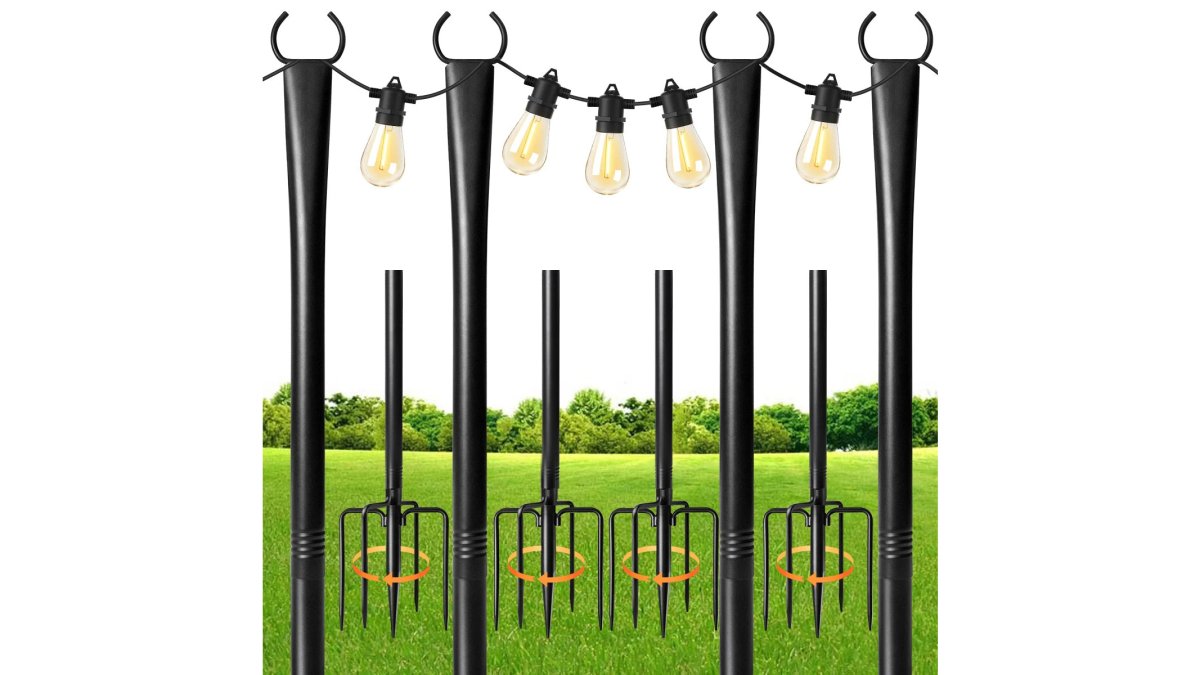
Two practical notes from experience. First, run the strands in a zigzag rather than straight lines; straight runs read as a grid, zigzags read as atmosphere. Second, keep the bulbs off the fabric itself.

If you want a ready-made setup rather than piecing together strands and supports, our patio string lights and poles are built for exactly this kind of canopy and deck run.
How to Hang String Lights on a Canopy Without Damaging the Fabric
The safe method is to hang from the frame, never from the fabric. Fabric under the weight of a light strand will stretch, sag, and eventually tear at the attachment point.
- Set the canopy to its final height first, so your strand lengths are correct.
- Attach clips or hooks to the metal truss legs and crossbars, not the roof panel.
- Run the first strand in a diagonal from one top corner to the opposite corner.
- Mirror the diagonal with a second strand to create the zigzag pattern.
- Leave slack between clips so wind can move the strand instead of pulling the clip loose.
- Check every connection by hand before dark, and keep all outdoor connections off the ground.
Watch out: never staple or screw into the canopy top. One small puncture becomes a leak point, and the fabric will tear from there in the first strong gust.
Solar Powered Canopy Lights: Where They Work and Where They Don't
Solar powered canopy lights work well when the panel gets direct sun for most of the day and the light only needs to run a few hours after dark. They fall short when the canopy sits in shade, when the panel is mounted under the roof fabric, or when you need consistent brightness for a long evening. The difference between a solar setup that disappoints and one that works is almost entirely about matching panel size, battery capacity, and expected runtime before you buy.
What the Numbers Actually Mean
Solar light packaging usually lists three figures that matter: panel wattage, battery capacity in watt-hours (Wh) or milliamp-hours (mAh), and claimed runtime. A common pattern is a small panel in the 1 to 5 watt range paired with a battery in the 1,000 to 4,000 mAh range, which typically delivers a few hours of usable light at moderate brightness after a full day of direct sun. Larger panels and batteries scale up from there.
A simple runtime estimate: divide battery watt-hours by fixture wattage. A 10 Wh battery running a 2 W fixture gives roughly five hours of light at full output, less if the fixture is brighter or the battery is cold or aging.
Charging time matters too. A panel that receives four to six hours of direct sun is the realistic target for a full charge in most of the country during summer; in winter or under partial shade, expect a partial charge and a shorter evening run.
Panel Placement That Actually Charges
The panel placement is the whole game. Clip the panel to the outside of the canopy frame or on a stake beside it, angled toward the sun. A panel tucked under the roof will charge weakly and dim early.
If the canopy is under trees or on a shaded patio, solar is the wrong tool. A battery or plug-in option will outperform it every evening.
Matching Solar to the Evening
- Short backyard dinner (2 to 4 hours): a small solar string or stake light is enough, provided the panel sees sun.
- Long gathering past midnight: solar alone usually will not hold brightness; pair it with battery lanterns or a plug-in strand.
- Remote spot with no outlet: solar is the practical choice, but buy more panel and battery than you think you need.
Best for: quick backyard setups, remote spots with no outlet nearby, and anyone who wants zero cords. Skip if: you need steady light past midnight, your canopy is under trees for most of the day, or you want consistent brightness without babysitting the charge.
Lanterns, Pendants and Portable Lights for Table-Level Light
Overhead light alone leaves faces in shadow. Table-level light fills that gap and does more for conversation than any strand overhead.
Hang small pendant lights from the frame's crossbars so they drop to roughly head height above the table. For a portable accent that moves with the party, our remote control RGB LED strobe light runs on a USB charge, offers eight colors and ten modes.

Keep the bright, color-shifting stuff away from the dining table and let it handle the edges of the space.
Patio String Lights and Poles →
Spotlights and Floodlights for Task and Safety Lighting
Spotlights and floodlights are not mood lighting, and treating them as mood lighting is the most common mistake we see.
Aim a spotlight at the walkway from the house to the canopy. Put another on the food and drink station so nobody is guessing what they are spooning.
Best for: driveways, walkways, serving tables, and the dark side of the canopy. Skip if: you want ambience. Use string lights and lanterns for that.
Brightness, Color Temperature and Glare: Getting the Mood Right
Color temperature decides whether a canopy feels cozy or clinical.
Brightness is about contrast, not raw output. A space with one blazing light source and dark corners feels worse than a space with several moderate sources spread evenly.
Glare is the quiet killer. The same brightness principles that govern safe, comfortable garage lighting apply under a canopy: light the surface, not the eye.
Getting the mood right comes down to three settings you can control on almost any fixture.
| Factor | What to aim for | Why it matters |
|---|---|---|
| Color temperature | Warm white in the lower range | Reads as inviting and flattering, not clinical |
| Cool white | Avoid for evening gatherings | Reads as a parking lot |
| Brightness | Several moderate sources spread evenly | Contrast beats one blazing light source |
| Glare | Shield, raise or move visible bulbs | Any bulb seen from a seated position annoys someone |
| Lighting target | Light the surface, not the eye | Same principle as comfortable garage lighting |
Power Planning, Weather Safety and Layering Your Light Sources
Layering means three tiers working together: overhead strands for ambience, table-level lights for faces and detail, and focused beams for paths and tasks. For practical setup and safety guidance when installing lights on a canopy, see our commercial canopy installation tips. Build in that order and the space works at every brightness level.
Power Planning: Do the Math Before Dark
Power is where plans fall apart. Add up the draw of every strand and fixture before the event, then confirm your outdoor circuit and extension cords can carry it.
A practical sequence:
- List every light and its wattage (or amperage) from the label.
- Total the load and compare it to the circuit rating; leave headroom for a charger or a speaker.
- Use cords rated for outdoor use, and match cord gauge to run length so voltage drop does not dim the far end.
- Keep connections elevated off wet ground and use cord covers or stakes where cords cross walkways.
- Never daisy-chain more strands than the manufacturer allows; the label on the strand states the maximum.
Battery and solar options remove the cord problem entirely, which is why we recommend them for anything beyond a simple two-strand setup. For a longer evening, compare runtime honestly: a rechargeable lantern in the 2,000 to 5,000 mAh range typically runs several hours at moderate brightness, while a plug-in strand runs until you unplug it.
Weather and Electrical Safety
Weather is the other variable. Look for fixtures and cords rated for outdoor use, and treat any connection that sits on the ground as a rain risk.
Open flames are a separate hazard. Candles and oil lanterns under a fabric canopy are a fire risk and should be replaced with battery or LED alternatives. Keep any heat-producing fixture away from the fabric, and never staple or screw into the canopy top.
Build Your Canopy Lighting Kit at Superior Tool Garage and Outdoors
A canopy lighting plan is a short list: overhead strands, a few table lanterns, one or two focused beams, and a power plan that matches. Get those four right and the evening takes care of itself.
If you are starting from scratch, the canopy itself matters as much as the lights. Our 10x15 heavy duty pop up canopy with mosquito netting walls gives you a sturdy frame to hang from, three adjustable heights, and netting that keeps the bugs off while the lights do their work.

We stock the frame, the strands, the poles, and the portable lights in one place, so you are not cobbling a setup together from three different orders. Shop now and get the whole kit sorted before your next evening outside.
Frequently Asked Questions
What are the best types of lights for an outdoor canopy?
Most canopy setups work best with a mix of three types. String lights give you overhead ambient lighting and a warm glow. Battery-powered lanterns or pendant lights put light on the table where people eat and talk. A spotlight or floodlight aimed at the entrance handles nighttime visibility and task lighting. Layering these three means no single source has to carry the whole space, and you can dim or switch off one layer as the evening winds down.
How do you hang lights on a canopy without damaging the fabric?
Clip the lights to the metal frame, not the top fabric. Spring clamps, carabiner clips and plastic S-hooks grip the truss tubes and spread the weight across the frame instead of pulling on a seam. Run the strand in gentle swags with a little slack so wind does not snap the wire. If you must cross the fabric, use adhesive-backed cable clips rated for outdoor use, and never poke holes in a waterproof top, since a pin hole lets water through the coating.
Are LED string lights safe for outdoor canopy use?
LED string lights run cooler than incandescent bulbs, which matters under a fabric roof where heat buildup is a real concern. Look for a waterproof or weather-resistant rating on the product label and plug into a GFCI-protected outlet. Keep extension cord connections off the ground and out of puddles, and unplug everything before storms. A 10x15 pop-up canopy like the one in our catalog gives you a metal frame to clip to, which keeps the wiring off the fabric entirely.
How can I power outdoor canopy lights without an outlet nearby?
Battery and USB-rechargeable lights solve most no-outlet situations. A rechargeable RGB strobe light, for example, can cover a full evening and then some. For longer events, a portable power station with a GFCI outlet lets you run string lights and a spotlight together. Plan your runtime before the party: add up the hours you need, then pick lights rated well above that number.
Can I use solar-powered lights for my outdoor canopy?
Yes, with one caveat: the solar panel needs direct sun, and a canopy roof blocks it. Mount the panel on top of the canopy or on a stake outside the shaded footprint, then run the light strand underneath. Solar powered canopy lights work well for ambient string lighting and path markers, but they dim as the battery drains and give you no control over brightness. Pair them with a plug-in or battery layer for the light you actually need at the table.
