


Last Updated: October 27, 2026
Quick Summary
The best outdoor canopy side walls for privacy are opaque coated fabric panels that block sightlines, attach firmly to the frame, and still allow airflow. Use three solid panels plus one mesh or open side so you get privacy without trapping heat. Dark colors like navy, gray, and black hold opacity better than light colors.
- Hold a panel to light before buying; if you can read through it, it is not a privacy wall.
- Measure leg-to-leg spacing, not the roof span, so panels fit without corner gaps.
- Run silhouette, detail, and backlight tests from 10 to 20 feet away in daylight and at night.
- Attach panels from the top rail down and leave a small gap at bottom corners for runoff.
- Anchor every leg with stakes or sandbags before adding the second wall.
Table of Contents
- What to Look for in Canopy Side Walls for Privacy
- Solid, Mesh, and Windowed Sidewall Panels Compared
- Sizing Your 10x10 Canopy Sidewalls and Larger Frames
- Waterproof Canopy Sidewalls: Fabric, Coatings, and Rain Performance
- Canopy Sidewalls With Zipper Doors and Detachable Panels
- How to Attach Canopy Sidewalls Without Damaging the Frame
- Wind Safety, Heat Buildup, and Care for Enclosed Canopies
- Shop Canopy Side Walls at Superior Tool Garage and Outdoors
- Frequently Asked Questions
What to Look for in Canopy Side Walls for Privacy
The best outdoor canopy side walls for privacy are opaque fabric panels that block sightlines from every angle, attach firmly to your frame, and still let hot air escape.
Most shoppers buy on color and price. That is the wrong order. A dark panel that hangs loose at the corners gives you shade, not privacy. A tight panel with no airflow turns a pleasant afternoon under the canopy into a sauna.
Opacity, Fit, and Airflow: The Three Tests That Matter
Opacity is how much of you the neighbors can see. Hold a panel up to a window or a bright sky before you commit.
Fit is whether the panel meets the frame at the top rail and both legs. Gaps at the corners are where privacy fails first.
Airflow is the trade-off nobody warns you about. Fully enclosed canopies trap heat, and a solid wall on all four sides can push interior temperatures well above the outside air.
| Test | What to Check | Why It Matters |
|---|---|---|
| Opacity | Hold panel to light | Determines actual privacy |
| Fit | Measure leg-to-leg spacing | Prevents corner gaps |
| Airflow | Count open or mesh sides | Controls heat buildup |
Solid, Mesh, and Windowed Sidewall Panels Compared
Solid panels deliver full privacy; mesh panels trade privacy for airflow; windowed panels split the difference with clear plastic sections. Each type solves a different problem, and the right pick depends on whether you are blocking neighbors, mosquitoes, or afternoon sun. But "full privacy" and "limited privacy" are marketing phrases, not measurements. Use the practical test below to rate any panel before you buy.
A Practical Privacy Test You Can Run in Five Minutes
Set the panel up on the frame, stand outside it at the distance a neighbor or passerby would be, roughly 10 to 20 feet, and evaluate three things in daylight:
- Silhouette test. Can you tell a person is inside? Can you tell whether they are standing, sitting, or changing clothes? Rate: no silhouette / shape only / clear silhouette.
- Detail test. Can you make out clothing color, a phone screen, or a face? Rate: none / color only / recognizable.
- Backlight test. Repeat with the sun behind the panel. Backlighting is where most "opaque" fabrics fail, a panel that looks solid in shade can turn translucent at midday.
Run the same three checks at night with a light on inside the enclosure. A panel that passes in daylight can fail badly after dark, which matters for backyard evening use and campsite privacy.
How the Three Panel Types Rate
| Panel Type | Silhouette | Detail | Backlit | Night With Interior Light |
|---|---|---|---|---|
| Solid coated fabric (dark color) | None | None | Usually none | Usually none |
| Solid coated fabric (light color) | Shape only | None | Possible | Possible |
| Mesh / netting | Clear | Clear | Clear | Clear |
| Windowed (opaque fabric + clear window) | None at eye level | None at eye level | Window may show | Window shows |
Solid walls are the privacy standard. A coated polyester panel blocks sightlines completely and doubles as a wind and sun barrier.
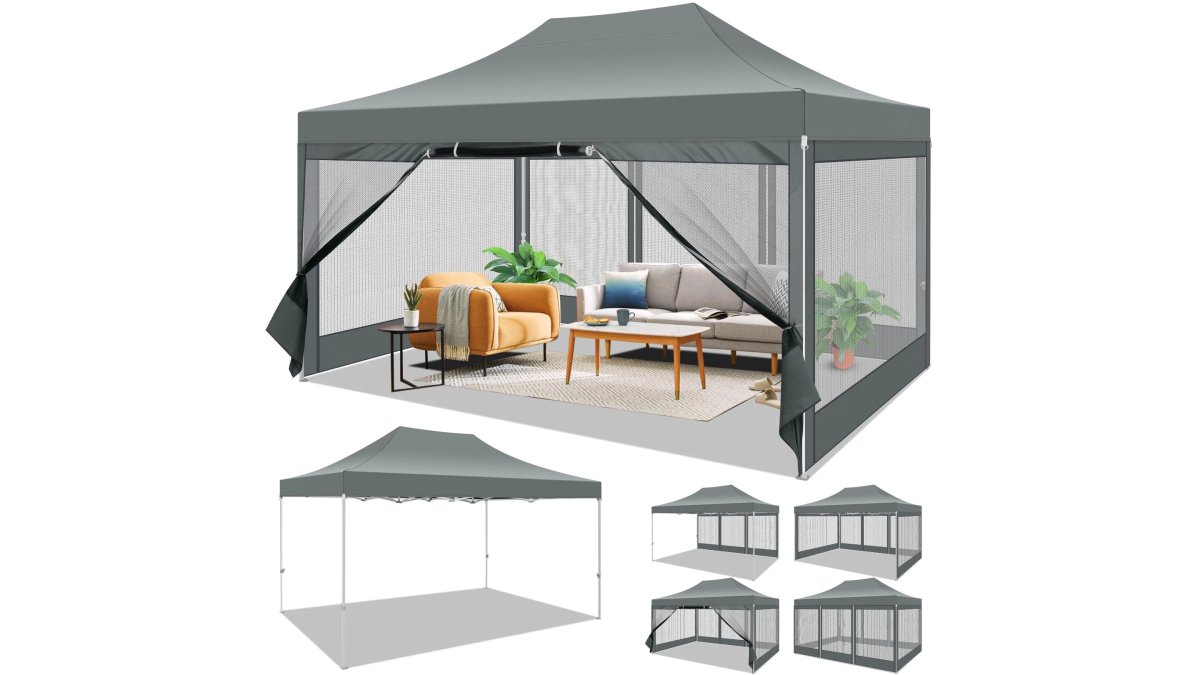
Mesh panels keep the view and the breeze while stopping insects. Our 10x15 FT Heavy Duty Pop Up Canopy with Mosquito Netting Walls has four removable netting sidewalls.

Windowed panels use clear plastic or cathedral-style windows set into opaque fabric. You get privacy at eye level and daylight above it.
Sizing Your 10x10 Canopy Sidewalls and Larger Frames
Measure the frame, not the roof.
Standard sizes you will encounter include 8x8, 10x10, 10x15, and 10x20. Height matters too. Most pop-up frames offer adjustable leg heights, so confirm which setting the panel was cut for before ordering.
For larger frames, match the sidewall to the structure's own dimensions. Our Heavy Duty 12'x20' Carport Canopy has a triple-layer PE cover that blocks 99% of UV rays.

Waterproof Canopy Sidewalls: Fabric, Coatings, and Rain Performance
Waterproof canopy sidewalls rely on a coated fabric, usually polyester with a polyurethane backing or a PVC coating. The coating is what stops water; the fabric weight determines how long it survives.
Look for 150D to 210D polyester as a light-duty baseline and heavier weaves for regular use. A PU lining or silver coating adds water resistance and reflects heat.
Watch the seams.
Canopy Sidewalls With Zipper Doors and Detachable Panels
Canopy sidewalls with zipper doors solve the access problem. Without a door, every entry means lifting or unfastening a panel, which quickly loosens the attachment points.
10x15 FT Heavy Duty Pop Up Canopy with Mosquito Netting Walls →
Detachable panels add flexibility. Hook-and-loop fasteners along the top rail and legs let you strip one wall for airflow and keep the other three closed for privacy.
Check zipper quality before you buy. Plastic zippers on cheap panels bind and split within a season.
How to Attach Canopy Sidewalls Without Damaging the Frame
Attach canopy sidewalls using the fasteners the panel was built with, working from the top rail down so the fabric hangs square. Most panels use hook-and-loop straps, bungee cords, or clips, and forcing the wrong fastener onto a frame is how legs get bent.
- Set the canopy to its final height and lock all legs.
- Drape the panel over the top rail and secure the top attachments first.
- Work down each leg, pulling gently to remove slack without stretching the fabric.
- Fasten the bottom corners last, leaving a small gap for water runoff.
- Anchor the frame with stakes or sandbags before adding the second and third walls.
Watch out: overtightening a panel on a windy day puts constant tension on the frame joints, and pop-up legs are the weakest point in the system. Snug is enough.
Wind Safety, Heat Buildup, and Care for Enclosed Canopies
Adding walls changes the physics of a canopy. An open frame lets wind pass through; a walled frame catches it like a sail. That single change drives the three risks below, wind load, heat buildup, and fabric degradation, and each has a specific way to manage it.
Wind Load: Why Walls Turn a Canopy Into a Sail
A sidewall adds surface area that wind pushes against, and that force transfers to the frame legs, joints, and anchors. The more walls you add, the more load the frame carries. A canopy rated for occasional use in a breeze can become unsafe with three or four solid walls in the same conditions.
A common pattern among experienced users:
- Anchor before you wall. Set stakes or sandbags on every leg before attaching the second wall. Weighted sandbags on hard surfaces and angled stakes on grass are the baseline.
- Watch the forecast, not the moment. Take walls down when sustained wind picks up or gusts are forecast. Most manufacturers advise against leaving a canopy up overnight or in bad weather, and walls make that advice more urgent, not less.
- Leave a pressure gap. Fasten bottom corners with a small gap so wind can spill under the panel rather than ballooning it. A panel that inflates like a pillow is transferring maximum load to the frame.
Heat Buildup: The Ventilation Trade-Off
Solid walls on all four sides block the cross breeze, and interior temperatures climb fast in direct sun. The mechanism is simple: sunlight heats the roof and walls, hot air rises, and with no low opening to draw cooler air in, the enclosure becomes a heat trap. The fix is a deliberate ventilation path, one mesh or open side for cross flow, and if you need privacy on that side, a windowed panel with the window cracked open.
Plan around the sun, too. A canopy that is comfortable at 9 a.m. can be oppressive by 2 p.m. because the sun angle changes what reaches the interior. If you will use the enclosure through midday, keep at least one side mesh or open and consider lighting if you plan to use it after dark. Our guide to outdoor canopy lighting ideas for evenings covers options that work inside a walled setup.
Care, Cleaning, and Storage by Material
Fabric care extends the life of every panel, and the steps differ by material:
- Coated polyester (PU or PVC backing): Brush off loose dirt, wash with mild soap and water, rinse, and air-dry fully before folding. Never store wet, trapped moisture is the leading cause of mildew and coating breakdown.
- Mesh and netting: Shake out debris, rinse, and hang to dry. Avoid scrubbing the weave, which stretches it and opens gaps.
- Clear plastic windows: Wipe with a soft cloth and mild soap only. Abrasive cleaners and paper towels scratch the plastic and turn it cloudy, which quietly destroys the privacy value of a windowed panel.
Store panels folded loosely in a dry bin rather than compressed in a tight bag, and inspect seams and attachment points at the start of each season. If a panel or cover does tear, our walkthrough on how to repair a torn canopy cover covers patching before the damage spreads.
Shop Canopy Side Walls at Superior Tool Garage and Outdoors
Privacy comes down to opacity, fit, and airflow, and no single panel type wins on all three. Decide which matters most for your setup, then buy the panel that matches your frame dimensions exactly.
Our catalog includes a pop-up canopy with removable netting walls and party tents with sidewalls.
Get started with Superior Tool Garage and Outdoors.
Frequently Asked Questions
Which canopy sidewall material provides the most privacy?
Solid polyester panels block the most sightlines because there are no gaps or mesh openings. A 150D or 210D polyester panel with a PU or silver coating on the inside stops people from seeing through in daylight. Mesh panels trade privacy for airflow and visibility, so they work better as bug screens than as privacy walls. Windowed panels sit in the middle: the fabric blocks views, but the plastic windows let light in and let people see through specific spots.
Can you add side walls to any pop-up canopy?
Most pop-up canopies accept sidewalls, but the attachment method decides whether a third-party panel will fit. Check whether your frame has hook-and-loop strips, zippers, or bare legs with no attachment points. Frames with bare legs usually need panels that wrap around the leg and secure with ties or hook-and-loop straps. Measure the leg spacing and the eave height before buying, because a panel cut for a 10x10 frame will not fit a 10x15 frame cleanly.
How do I choose the right sidewall size for my canopy?
Match the panel to the frame's footprint, not the roof's peak height. A 10x10 canopy needs four panels roughly 10 feet wide, while a 10x15 needs two 10-foot panels and two 15-foot panels. Measure the distance between leg centers and the height from the ground to the eave, then compare those numbers to the panel listing. Panels that are too short leave a gap at the bottom that defeats the privacy purpose.
Can canopy side walls withstand wind and rain?
In the 20x40FT Party Tent listing, the manufacturer advises taking precautions once wind speeds reach 25 mph or higher.
Can you use canopy side walls for privacy without blocking airflow?
Yes, if you mix panel types instead of enclosing all four sides with solid fabric. Put solid panels on the sides facing neighbors or the street and leave mesh or windowed panels on the sides you want open to breezes. Leaving one side fully open also helps hot air escape. A fully sealed canopy traps heat fast in summer, so plan at least one breathable or open side for any setup you will sit under for hours.
