


Table of Contents
- Choosing a Dust Collection Approach for Your Small Workshop
- Types of Dust Collection Systems and What Works in a Small Shop
- Small Shop Dust Collection System Design: Layout and Sizing Basics
- Dust Collector Ductwork for Woodworking: Pipe Sizing and Materials
- Dust Collection for Woodworking Tools: Matching Capture to Each Machine
- DIY Shop Air Cleaner: Filtering the Dust Your Collector Misses
- Step-by-Step DIY Build: Assembling Your System
- Testing, Troubleshooting, and Maintenance
- Frequently Asked Questions
Last Updated: October 9, 2026
Choosing a Dust Collection Approach for Your Small Workshop
A dust collection system captures wood dust at the machine before it reaches your lungs or settles across the shop.
Wood dust is not just a mess: fine particles stay airborne for hours and settle deep in your lungs, which is why source capture at the tool matters more than sweeping up afterward.
The first decision is the one most people rush: collector or vacuum?
Dust Collector vs. Shop Vacuum: Which Fits Your Space?
A dust collector moves high air volume at low pressure, which wide dust ports and long hose runs need. A shop vacuum moves low volume at high pressure, so it suits small ports and short bursts.
Here is the practical split:
- Shop vacuum: Best for sanders, routers, and quick cleanup. Portable and cheap to start.
- Dust collector: Best for table saws, jointers, and planers that produce chips fast.
- House vacuum: Never use one. It clogs, overheats, and blows fine dust back into the air.
Most small shops end up with both. A vacuum handles the small tools; a collector handles the big ones.
Types of Dust Collection Systems and What Works in a Small Shop
Dust collection systems fall into two families: portable units you roll to the machine, and fixed systems with permanent ductwork. Shop size and machine count decide which fits.
Portable vs. Fixed Systems
Portable systems win in garages that double as parking spots: wheel the unit to each machine and connect a short hose. Fixed systems win when machines stay put, run pipe once, then open a blast gate at whichever tool you are using.
| System Type | Best For | Main Trade-Off |
|---|---|---|
| Portable collector | 1-3 machines, shared space | Short hose runs only |
| Fixed ducted system | 4+ machines, dedicated shop | Higher upfront work |
| Shop vacuum | Sanders, routers, cleanup | Low airflow for big tools |
| Cyclone + collector | Heavy chip producers | Takes floor space |
Cyclone Separators and Pre-Separators
A cyclone separator spins incoming air so heavy chips drop into a bin before reaching the filter; a pre-separator does the same job as a first stage ahead of your main collector. Filters clog fast when chips hit them directly, so a separator keeps the filter breathing and cuts how often you clean it. Many woodworkers pair a cyclone with a shop vacuum or small collector and notice the filter lasts far longer.
Small Shop Dust Collection System Design: Layout and Sizing Basics
Good small shop dust collection system design starts with airflow math, not hardware. Every machine needs enough air volume, measured in cubic feet per minute (CFM), moving fast enough to carry chips and fine dust through the pipe without letting them settle.
Three numbers drive the whole design:
- CFM (cubic feet per minute): How much air volume moves past a point. Wide ports, long runs, and multiple open gates all demand more CFM.
- Static pressure (inches of water column, " w.c.): Resistance from hose, pipe, bends, blast gates, and filters. Every foot of pipe and every fitting adds resistance, so less real airflow reaches the tool even if the collector's free-air CFM rating looks impressive.
- Transport velocity (feet per minute, FPM): How fast air moves inside the duct. For wood dust and chips, aim for roughly 3,500-4,000 FPM in the main run; below that, chips drop out of the airstream and build up in horizontal pipe.
How CFM, Duct Diameter, and Velocity Relate
Velocity depends on CFM and duct cross-section. A 4-inch duct has about 12.6 square inches of area; a 6-inch duct has about 28.3, roughly 2.25 times the area. Push the same CFM through a 6-inch pipe and velocity drops by more than half, which is why stepping up pipe size without adding airflow causes chips to settle.
Typical Airflow Demands by Tool
Commonly cited ballpark figures for capture at the source, not guarantees:
- Table saw (cabinet or contractor): 350-500 CFM at the blade guard and below-table port combined.
- Jointer (6-8 inch): 400-600 CFM.
- Planer (13-inch benchtop): 400-600 CFM; larger floor planers want more.
Add these up only if you run tools simultaneously. In a one-person shop you usually run one machine at a time, so size for the largest single demand plus a margin for duct losses.
Estimating Static Pressure Losses
You do not need engineering software to get close. Add up resistance from each component:
- Straight smooth pipe: roughly 0.1-0.2 " w.c. per 10 feet, depending on diameter and velocity.
- 90-degree elbow: equivalent to roughly 5-10 feet of straight pipe.
- 45-degree elbow: roughly half the resistance of a 90.
If your total estimated static pressure exceeds what your collector's fan curve can handle at the CFM you need, you will not hit target velocity no matter how big the motor is.
A Practical Sizing Workflow
- List the tools you will connect and the CFM each needs.
- Identify the largest single demand (usually the planer or jointer).
- Sketch the longest run to that tool and count fittings.
- Estimate static pressure for that path.
- Compare against the collector's published fan curve, not its free-air CFM number.
- Choose duct diameter that keeps velocity in the 3,500-4,000 FPM range at your available CFM.
- Keep the collector as close as practical to the highest-demand tools.
OSHA guidance on wood dust hazards notes that wood dust exposure is a recognized respiratory concern, which is why capture at the source beats cleanup later.
Dust Collector Ductwork for Woodworking: Pipe Sizing and Materials
Dust collector ductwork for woodworking should be smooth inside and sized to keep air speed up; rough or undersized pipe kills airflow and lets dust settle in the line.
Material options:
- PVC pipe: Smooth, cheap, easy to cut. Common sizes are 4-inch and 6-inch.
- SDR 35 pipe: A thin-wall sewer pipe many woodworkers use for main runs.
- Metal duct: Durable and fire-resistant, but costs more and needs grounding.
Pipe diameter matters more than most people think: a 4-inch main handles one machine at a time in a small shop, while a 6-inch main suits several tools or a long trunk line.
Dust Collection for Woodworking Tools: Matching Capture to Each Machine
Dust collection for woodworking tools works best when each machine gets the right port size and airflow. One collector cannot serve every tool equally, so match capture to what each machine throws off.
- Table saw: Needs strong capture at the blade guard and below the table. A 4-inch port is common.
- Miter saw: Hard to capture. A hood behind the saw plus a shop vacuum helps most.
- Planer: Makes chips fast. Use a collector, not a vacuum, and empty the bin often.
The takeaway: big chip makers want the collector, fine-dust tools want strong filtration.
DIY Shop Air Cleaner: Filtering the Dust Your Collector Misses
A DIY shop air cleaner catches the fine dust that escapes your collector and stays suspended in the air. Even a well-designed source-capture system leaves some particles floating, and those reach deep into your lungs.
Why Source Capture Alone Is Not Enough
Wood dust spans a wide size range. Chips and shavings are visible and heavy, they fall fast and are easy to collect at the tool. The hazardous fraction is much smaller: particles under roughly 10 microns (PM10) penetrate the nose and upper airway, particles under about 2.5 microns (PM2.5) reach the deep lung, and the finest fraction stays airborne for hours after you stop cutting.
Filter Ratings That Actually Matter
Filter performance is rated in different ways depending on the filter type:
- MERV (Minimum Efficiency Reporting Value): A 1-16 scale for general HVAC-style filters. MERV 13 captures a substantial share of 1-3 micron particles; MERV 14-16 captures more. Standard furnace filters are often MERV 6-8, not enough for fine wood dust.
- HEPA (High-Efficiency Particulate Air): Rated to capture at least 99.97% of particles at 0.3 microns, the benchmark for fine-dust control. True HEPA filters cost more and create more airflow resistance, so the blower must be sized for them.
- Nominal vs. actual efficiency: A filter marketed as "HEPA-like" or "HEPA-grade" is not the same as a certified HEPA filter. Look for the rating, not the adjective.
For a shop air cleaner, MERV 13 is a reasonable minimum for fine-dust reduction; HEPA is better if you can move enough air through it. A common DIY pattern is a two-stage setup: a cheaper MERV 8 pre-filter to catch larger debris, followed by a MERV 13 or HEPA final filter.
A Realistic DIY Build
The classic box-fan build works, but only if you respect its limits:
- Box fan + single filter: Cheap and easy, but a typical box fan moves far less air than its label suggests once loaded with a restrictive filter. Expect modest air exchange, not whole-shop cleaning.
- Box fan + two filters (V-shape): More filter surface area means less resistance and better real airflow, a meaningful upgrade over a single flat filter.
- Furnace blower + filter box: A salvaged or new furnace blower moves substantially more air and is the better choice for real air exchange. Build a simple plywood box with a pre-filter slot and a final-filter slot.
Sizing Air Exchange
Air cleaners are rated in CFM, and the useful metric is how many times per hour the unit turns over your shop's air volume. A common target for woodworking shops is roughly 6-10 air changes per hour during active cutting. To estimate: multiply shop length x width x height in feet for cubic feet, multiply by your target air changes per hour, then divide by 60 for the CFM you need.
Placement and Operation
- Hang the unit near the ceiling, away from your main work zone, so it circulates air rather than blowing dust at you.
- Position the intake to draw from general shop air, not directly from a tool's exhaust stream.
- Run it during work and for a while after, since fine dust lingers long after the saw stops.
Respirators and the Limits of Filtration
Even a good air cleaner does not eliminate the need for respiratory protection during dusty operations. A NIOSH-approved N95 or P100 respirator suits many woodworking tasks, and a P100 is better for extended sanding or species known to be sensitizers.
EPA indoor air quality resources explain how fine particles affect indoor air, which is the same reason shop filtration matters.
Step-by-Step DIY Build: Assembling Your System
Total Time: 4-6 hours Difficulty: Beginner to intermediate
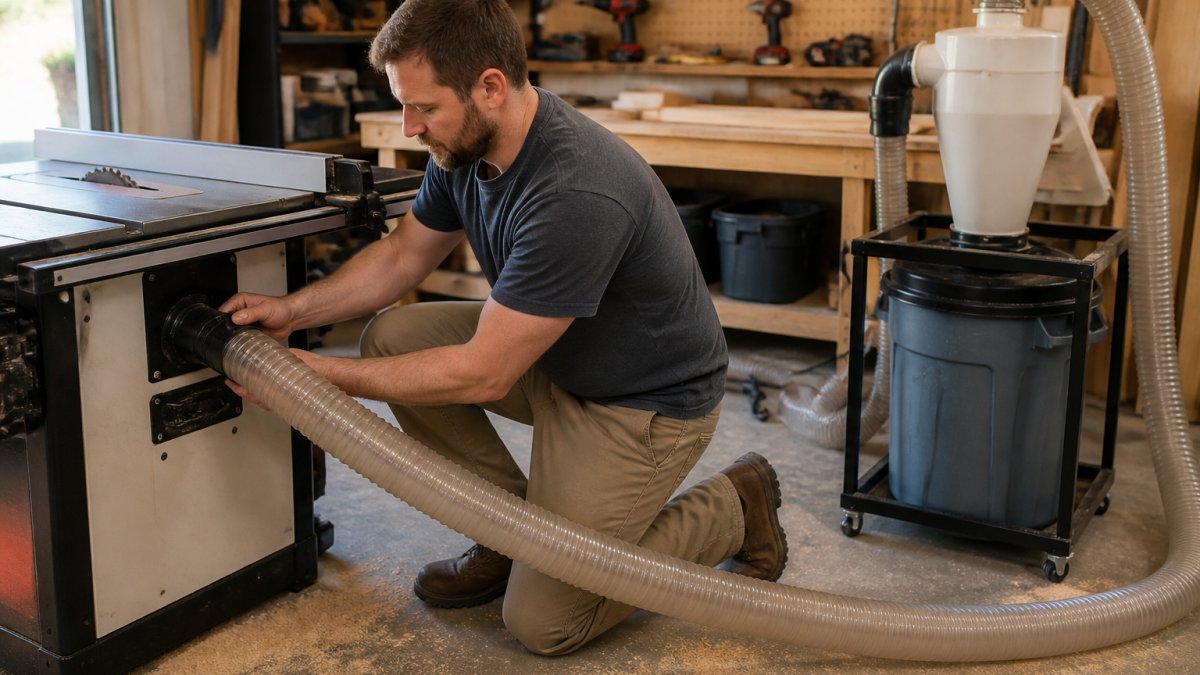
What You'll Need:
- Dust collector or shop vacuum
- Cyclone separator and collection bin
- Flexible hose and hose clamps
Step 1: Pick the collector location. Put the unit near your dustiest machines.
Step 3: Run the main duct. Use the largest pipe you can afford.
Step 4: Add blast gates. Install one at each branch.
Step 6: Ground the system. Bond metal duct and components to reduce static buildup.
Expected Result: Strong suction at each machine and far less dust settling on surfaces.
Testing, Troubleshooting, and Maintenance
Test the system the day you finish it, not months later. Weak suction usually traces back to a few common problems.
- Clogged filter: Clean or replace it. This is the number one cause of lost airflow.
- Open blast gates: Close every gate except the one in use.
- Leaky joints: Seal gaps in pipe and hose connections.
For maintenance, check the filter, empty the bin, and inspect hose and pipe joints regularly. Small habits keep airflow strong.
Frequently Asked Questions
What size dust collector do I need for a small workshop?
For a small workshop running one tool at a time, look for a unit that moves at least 350 to 500 CFM at the tool. Most benchtop collectors in that range handle a table saw, miter saw, or planer when the hose run is short. If you plan to run fixed ductwork across the shop, step up to a larger impeller so static pressure losses through the pipes don't starve the tool. Check the CFM rating at the actual static pressure you expect, not just the free-air number on the box.
What duct size should I use for a small-shop dust collection system?
A 4-inch main line is the common starting point for small shops running one machine at a time. Branch lines to individual tools can drop to 2.5 or 3 inches if the tool's dust port is that size. Avoid necking down a 4-inch main to a 2-inch hose right at the tool unless the port forces it, because that restriction cuts airflow sharply. Keep runs as short and straight as possible, and use smooth-wall pipe like PVC rather than corrugated hose for the main trunk.
How do I improve dust collection at individual woodworking tools?
Start by matching the hose diameter to the tool's dust port and keeping the hose run under 6 feet where you can. Add a dedicated hood or shroud at the point of dust generation, especially on table saws, router tables, and miter saws where the factory port misses a lot of the stream. For sanders and smaller tools, a shop vacuum with a HEPA filter often captures more than a central collector because it delivers higher suction at low volume. Seal gaps around the port with tape or foam to stop leakage.
Is a shop vacuum or a dust collector better for a small workshop?
A shop vacuum wins on suction for small ports and handheld tools, so it's the better pick for sanders, routers, and cleanup. A dust collector moves far more air volume, which is what you need for a table saw, jointer, or planer that produces a wide, fast stream of chips. Many small shops run both: a collector on the big machines and a shop vacuum with a HEPA filter for everything else. Neither replaces a shop air cleaner for the fine dust that escapes into the air.
Dust control in a small shop is a project, not a purchase. Superior Tool Garage and Outdoors carries the heavy-duty storage, hoses, and shop gear that keep your workspace organized while you build. Our premium garage tools and durable storage solutions help you get the job done right, from the first pipe run to the final filter change. Shop now and turn your garage into a shop that works.