


Table of Contents
- Why Garage Tools Rust: Causes You Can Actually Control
- Garage Humidity Control for Tools: Measure It Before You Fight It
- Step 3: Clean and Degrease Tools Before Storage
- Step 4: Pick the Best Rust Inhibitor for Tools and Apply It Right
- Step 5: Store Tools in a Dry, Sealed Environment
- How to Remove Rust From Hand Tools That Already Rusted
- Climate-Specific and Material-Specific Rust Strategies
- Preventative Maintenance Routines That Keep Tools Rust-Free
- Frequently Asked Questions
Last Updated: September 11, 2026
Why Garage Tools Rust: Causes You Can Actually Control
To prevent rust on garage tools, control three factors: airborne moisture, condensation from temperature swings, and contaminated surfaces. Learning how to prevent rust on garage tools starts with accepting you cannot stop oxidation, only slow it.
Ferrous metal, the carbon steel in most wrenches, sockets, and hand tools, reacts with oxygen and water to form iron oxide. That reaction accelerates when humidity climbs, when the dew point nears your tools' surface temperature, and when dust, sweat, or wood sap gives moisture a place to cling. Humid-climate customers who store tools in unsealed chests often see this constantly.
Garage Humidity Control for Tools: Measure It Before You Fight It
Garage humidity control for tools begins with measurement, not guesswork. Most garages hold humidity differently than the house attached to them.
Step 1: Track Dew Point and Humidity With a Hygrometer
A hygrometer measures relative humidity and temperature (weather.gov). Place one at tool-chest height, not on a high shelf, and check it daily for a week.
Watch two numbers: relative humidity above roughly half, and a gap of less than a few degrees between air temperature and dew point. When they converge, condensation forms on cold steel overnight, the condition that starts surface rust on a chrome-plated wrench.
Step 2: Run a Dehumidifier and Improve Air Circulation
Once you know your baseline, run a dehumidifier sized to the space and keep air moving with a small fan. Stagnant corners hold moisture longer than open floor. A cheap box fan pointed across your tool chest does more than most people expect.
Step 3: Clean and Degrease Tools Before Storage
Dirt, oil residue, and fingerprints trap moisture against metal. Wipe every tool down before it goes back in the chest, a rag and light degreaser handle most jobs.
For tools used on wet jobs, dry them thoroughly first. Water left in a socket recess or ratchet mechanism rusts from the inside out, and you will not see it until the tool seizes. Pay attention to joints, teeth, and any spot where two surfaces meet.
Step 4: Pick the Best Rust Inhibitor for Tools and Apply It Right
The best rust inhibitor for tools is matched to how often you use the tool and how long it sits. What separates a coating that holds for months from one that fails in a week is how you apply it, not which bottle you buy.
Vapor Corrosion Inhibitors (VCI) and How They Work
A vapor corrosion inhibitor releases a protective vapor inside an enclosed space, coating metal at a molecular level. The vapor diffuses through the container and deposits on any ferrous surface it reaches, including the inside of a socket recess or the teeth of a ratchet where a wipe-down never lands.
VCI works best in sealed containers: drawers, cases, and cabinets. It does nothing in open air, because the vapor disperses before reaching effective concentration. Two rules govern whether it works:
- The container must be reasonably sealed. A drawer with a half-inch gap around the lid leaks vapor faster than the emitter can replace it. Weatherstripping or a gasketed case makes the difference.
- The emitter must be sized to the volume. A single emitter rated for a small handgun case will not protect a full 40-inch tool chest. Match the emitter to the cubic feet of the enclosed space, and add one more than the minimum if the chest is opened daily.
Lubricants, Oils, and Protective Barriers Compared
| Protection Type | Best For | Reapply | Works in Open Air? |
|---|---|---|---|
| Light machine oil | Frequently used hand tools | Monthly | Yes |
| Penetrating oil | Removing existing rust | As needed | Yes |
| Paste wax | Long-term stored tools | Every 6 months | Yes |
| VCI emitters | Sealed drawers and cases | Every 3-6 months | No |
Paste wax outperforms thin oils for tools stored for months: it goes on thicker, resists wiping, and does not attract dust the way oil does. The trade-off is a tacky film that picks up grit, so it suits tools that sit rather than tools you grab daily.
How to Apply Each One So It Actually Holds
Application mechanics decide whether a coating survives the workbench:
- Degrease and dry first. Oil and wax will not bond to a surface that still carries cutting fluid, WD-40 residue, or fingerprints. Wipe with a solvent, then let the tool air-dry completely.
- Warm the metal slightly. A tool warmed to room temperature or a little above lets wax flow into pits and seams instead of sitting on top. Cold steel makes wax drag and leaves thin spots.
- Apply thin, then buff. A thick, gloppy coat of wax traps moisture underneath and flakes off in sheets. Two thin coats with a buff between them outlast one heavy coat.
- Coat the hidden surfaces. The inside of a box-end wrench, the pivot of pliers, and the underside of a plane iron rust first because they never get wiped. A cotton swab or pipe cleaner reaches them.
- Reapply on a schedule, not on sight. By the time you see rust, the coating already failed. Put reapplication on the calendar.
What Makes a Coating Fail
Most rust-inhibitor failures trace to four causes: the tool was not fully dry before coating, the coating went on too thin in a high-wear spot, the container leaked vapor faster than the emitter could replace it, or the tool sat on bare concrete and pulled ground moisture up through the coating. Fix the cause, not the symptom.
Lubricants That Double as Protection
Some products do two jobs. A light machine oil such as general-purpose spindle oil protects and lubricates moving parts. A dry-film lubricant leaves a wax-like film that does not attract dust, suiting precision tools and measuring instruments. Penetrating oils break rust loose but are not long-term protection, their solvent carrier evaporates and leaves only a thin residue.
Choose one primary protectant per tool and stick with it. Layering incompatible products, such as wax over oil, creates a gummy film that traps moisture and defeats both.
Step 5: Store Tools in a Dry, Sealed Environment
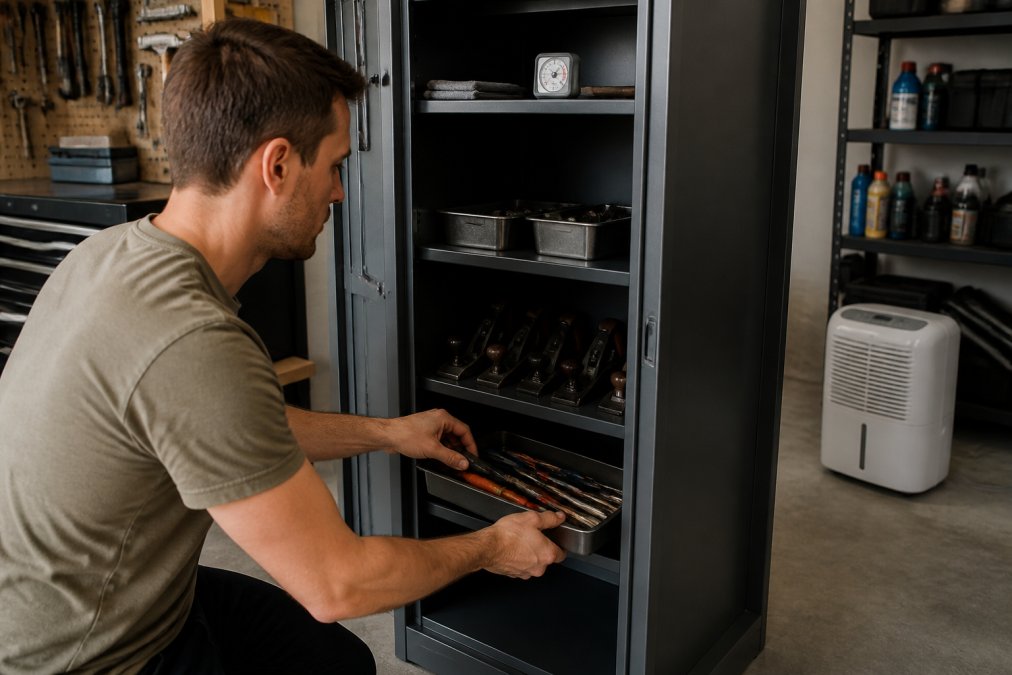
Storage decides whether all your earlier work holds. A sealed, dry environment keeps treated tools stable; an open shelf in a damp corner undoes a fresh coat of oil in days.
Drawer Liners, Tool Chests, and Desiccant Packs
Drawer liners do more than stop tools from sliding. A liner treated with a corrosion inhibitor adds passive protection every time the drawer closes. Pair it with a desiccant pack, usually silica gel, and you have two defenses at once.
Silica gel absorbs moisture inside a closed space until it saturates, then stops working silently (PubMed). Replace or recharge desiccant packs on a schedule rather than waiting for rust to tell you they failed.
DIY Desiccant Solutions for Small Garages
You do not need to buy desiccant. Plain white rice in a breathable cloth bag pulls modest moisture in a small drawer; sun-dried charcoal briquettes do the same on a larger scale. Recharge both by drying them periodically.
For a bigger space, a metal storage shed keeps bulk equipment and seasonal tools out of the damp garage entirely. The 10x8FT Steel Garden Storage Shed uses galvanized steel panels and breathable vents that support airflow, which matters more than most people realize for keeping a storage space dry.

How to Remove Rust From Hand Tools That Already Rusted
Removing rust from hand tools follows a simple order: mechanical removal first, chemical help second, protection last. Start with the least aggressive method and escalate only if needed.
- Scrub light surface rust with a wire brush or fine abrasive pad.
- Apply penetrating oil to seized joints and let it sit before forcing movement.
- For heavier oxidation, use a commercial rust remover and follow its directions exactly.
- Rinse, dry completely, then buff the surface with a buffing cloth.
- Apply a protective barrier immediately, before flash rust forms.
Buffing smooths the surface so moisture has fewer places to cling, and reveals whether pitting has started. Deep pitting means the metal is permanently weakened, and no coating will fully restore it.
Climate-Specific and Material-Specific Rust Strategies
Rust prevention is not one-size-fits-all. Coastal air carries salt that accelerates oxidation far beyond inland humidity, and wide day-night temperature swings cause more condensation than steady humidity. Match your strategy to your actual conditions, not a generic checklist.
Coastal and High-Humidity Climates
Salt is the accelerant. Airborne chloride deposits on tool surfaces and holds moisture against the metal even after the air dries, so a tool that survives a week inland can flash-rust overnight near the coast. The protocol shifts:
- Rinse and dry after every use. Salt residue from sweat and sea air must come off, not just get wiped. A damp rag spreads chloride; a dry rag removes it.
- Move to wax, not oil. Oil films break down faster under salt load. Paste wax or a dry-film lubricant holds up longer.
- Seal the container. In coastal air, an open shelf is a losing battle. A gasketed chest with a VCI emitter is the baseline, not the upgrade.
- Rinse the chest itself. Salt accumulates on drawer liners and cabinet walls. Wipe them down monthly.
Dry Desert and Low-Humidity Climates
Low humidity is not immunity. Desert garages swing from 100°F days to 40°F nights, and that drop pushes the dew point past the surface temperature of cold steel. Condensation forms even though the air feels bone-dry.
- Watch the dew point, not the humidity percentage. A 20% relative humidity reading can still produce condensation if the overnight temperature drop is steep enough.
- Insulate or enclose. A sealed chest slows the temperature swing on the tools inside, which keeps them above the dew point.
- Skip the dehumidifier. It does little in dry air. Spend the effort on temperature stability instead.
- Dust is the enemy here. Desert dust is abrasive and hygroscopic. A covered chest beats an open shelf.
Four-Season and Freeze-Thaw Climates
Where winters drop below freezing and summers climb, the garage sees the widest temperature swings of any climate. Condensation peaks in spring and fall, when warm daytime air meets tools still cold from the night. The fix is temperature stability: insulate the chest, keep it off the floor, and avoid opening it during the warmest part of a cold morning.
Material-Specific Care
Different metals fail differently, and the same coating does not serve all of them equally.
Bare carbon steel is the most vulnerable. With no alloying element to slow oxidation, it needs a coating on every exposed surface, including the inside of sockets and the pivot of pliers. This is the metal that rewards wax and punishes neglect.
Stainless steel resists rust through a chromium oxide layer, but that layer breaks down under chloride exposure and in crevices where oxygen cannot reach. Stainless tools stored near the coast or used on saltwater jobs still rust, just more slowly. Do not assume stainless means maintenance-free.
Chrome-plated tools resist rust until the plating chips. Once the carbon steel underneath is exposed, corrosion spreads under the plating and lifts it in flakes. Inspect chrome tools for chips and touch up exposed steel with a drop of oil or a dab of wax immediately.
Galvanized surfaces carry a zinc coating that sacrifices itself to protect the steel beneath. Zinc corrodes first, which is why galvanized storage holds up well, but protection fades as the zinc is consumed. Galvanized steel is a smart base layer, not a permanent shield.
Black oxide and phosphate finishes on impact sockets and some hand tools are mildly protective but porous. They need the same oil or wax as bare steel.
Long-Term vs. Short-Term Tool Storage
Tools you use weekly need light oil and a quick wipe. Tools stored for a season or longer need paste wax, a sealed container, and a desiccant pack. Treating both the same way wastes effort on one and shortchanges the other.
A practical split:
- Daily-use tools: light machine oil, wiped on and left slightly wet, reapplied monthly.
- Weekly-use tools: paste wax, buffed, reapplied every three to six months.
- Seasonal tools: paste wax plus a sealed case plus a desiccant pack, inspected at the start and end of each season.
- Long-term or heirloom tools: wax, a VCI emitter, a gasketed case, and storage off the floor, checked twice a year.
Preventative Maintenance Routines That Keep Tools Rust-Free
A routine beats a one-time fix. Set a monthly rhythm: check the hygrometer, wipe down tools, and reapply protection to anything that sat unused. Every few months, replace desiccant and inspect drawer liners for wear.
The tools that rust are almost never the ones you use daily. They are the ones you put away wet and forgot about. A five-minute monthly check prevents most of it.
For a small garage, the 8x4FT Triple Door Metal Storage Shed offers a rust-resistant, powder-coated steel build with triple-door access, so you can move seasonal tools out of the damp garage without fighting for space.

Frequently Asked Questions
What is the best way to keep tools from rusting in a garage?
Combine moisture control with a protective barrier. Run a dehumidifier to keep relative humidity below 50%, store tools in a sealed chest or cabinet with drawer liners, and coat metal surfaces with a rust inhibitor or light oil. For long-term storage, add vapor corrosion inhibitor (VCI) emitters or silica gel desiccant packs and check them monthly. Air circulation matters too, so avoid stacking tools against cold exterior walls where condensation forms first.
Does humidity in the garage cause tools to rust?
Yes. Rust is oxidation, and it accelerates when moisture in the air condenses on cooler carbon steel surfaces. Garages often run 10-15% more humid than living spaces, especially after rain or in summer. When the dew point rises above the tool's surface temperature, a thin film of water forms and rust starts within hours. A hygrometer costs little and tells you exactly when to run a dehumidifier or add desiccant.
Are silica gel packets effective for tool storage?
Silica gel works well in small, closed spaces like a tool chest drawer or a sealed cabinet, where it absorbs ambient moisture before it reaches the metal. It is far less effective in an open garage because the desiccant saturates quickly. Use several packets per drawer, recharge or replace them when they stop absorbing, and pair them with a tight lid or gasket for real protection.
How do I remove existing rust from garage tools?
Start with the least aggressive method. Soak light surface rust in penetrating oil, then scrub with a wire brush or fine abrasive pad. For heavier oxidation, use a rust removal solution or electrolysis, then rinse and dry completely. Follow with buffing using a buffing cloth to smooth the surface, degrease, and immediately apply a protective coating so the rust does not return within days.
Rust wins when moisture, temperature swings, and neglect get a free run at your tools. Superior Tool Garage and Outdoors carries the heavy-duty storage solutions and protective gear that make the routine easy to keep, from galvanized steel sheds with built-in ventilation to secure, lockable storage that keeps moisture and pests away from your investment. Get started with Superior Tool Garage and Outdoors and keep your tools ready for the next job instead of the next rust removal.