


Last Updated: October 22, 2026
Quick Summary
Choosing between portable carports permanent metal garages depends on your timeline and budget: portable carports offer quick, affordable deployment with minimal site prep and 10-15 year lifespans, while permanent metal garages require concrete foundations and permits but provide complete enclosure, security, and 30-40 year durability.
- The Heavy Duty 12'x20' Carport Canopy costs $728.99 and assembles in under 30 minutes with 55 mph wind resistance.
- Portable carports need only ground anchors and leveling; permanent garages require concrete footings, grading, and excavation.
- Portable carports provide roof coverage with ventilation that reduces condensation; enclosed garages offer complete weather and theft protection.
- Permanent metal garages typically last 30-40 years with component maintenance, while portable carports last 10-15 years before replacement.
- Run total cost of ownership over your ownership horizon, including permits, foundation, insurance, and maintenance to compare true per-year costs.
Table of Contents
- What's the Real Difference Between a Portable Carport and a Permanent Metal Garage
- Portable Metal Carport Cost: What You'll Actually Pay
- Permanent Metal Garage Cost: Installation and Long-Term Value
- Metal Garage Foundation Requirements and Site Preparation
- Portable Carport Wind and Snow Ratings: Weather Performance Explained
- Security, Access, and Protection Comparison
- Which Option Is Right for Your Situation
- Frequently Asked Questions
What's the Real Difference Between a Portable Carport and a Permanent Metal Garage
Choosing between portable carports permanent metal garages comes down to what each structure does and which trade-offs matter most. At Superior Tool Garage and Outdoors, we break down the real differences.
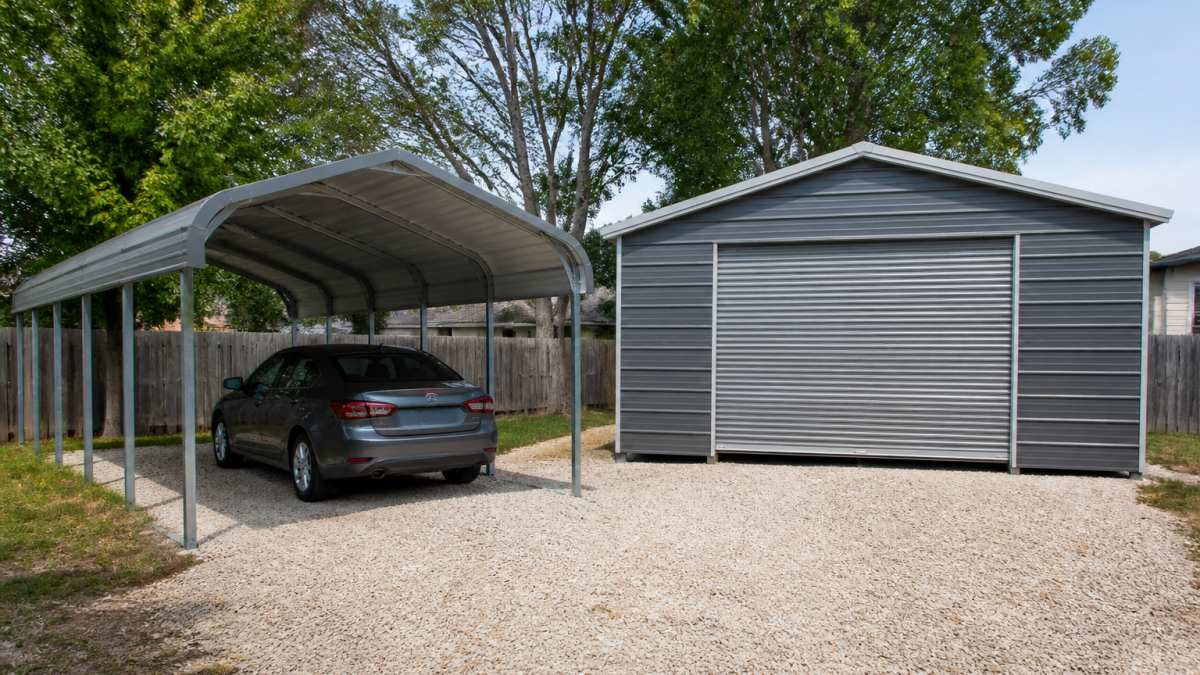
A portable carport is an open-sided shelter built for quick deployment and relocation. A permanent metal garage is enclosed, with lockable doors and a fixed foundation. That difference ripples across cost, installation, weather protection, security, and long-term value.
Open-Sided Carports vs Enclosed Structures
An open-sided carport provides roof coverage without walls: protection from sun, rain, and snow overhead, but exposed sides.
The open design of a carport has a genuine advantage most people overlook: constant airflow.
An enclosed garage trades that ventilation for complete weather isolation, protection from hail, salt spray, intense UV, and temperature swings. Sealed spaces can accumulate moisture, but active use naturally cycles air.
Portable vs Permanent Installation
Portable structures arrive ready to assemble, needing no foundation work beyond leveling the ground and securing anchors, most set up in a weekend with basic tools.
Portability is the defining feature. If you might relocate, need seasonal coverage, or want to avoid permanent property modifications, a portable structure wins, which is why renters and owners with uncertain tenure prefer it.
Permanent installations anchor into concrete and solid frames, built for decades of exposure with minimal maintenance. You sacrifice flexibility for stability and longevity.
Portable Metal Carport Cost: What You'll Actually Pay
Portable carport pricing varies by size, material quality, and anchoring system. A basic 12-by-20-foot portable carport canopy starts around Superior Tool Garage and Outdoors product catalog.
Larger portable metal carports run higher. The 20-by-20-foot models from Superior Tool Garage and Outdoors range from $1,269.99 to $2,659.99 depending on frame material and roof specifications, accommodating two vehicles, boats, or equipment.

Installation costs are minimal, mainly labor if you hire help, plus site leveling or anchoring upgrades. No concrete means no excavation bills.
Long-term costs include periodic maintenance: checking anchors, inspecting fabric, resealing seams, and replacing worn components.
Permanent Metal Garage Cost: Installation and Long-Term Value
Permanent metal garages carry higher initial costs but spread across a longer ownership horizon. The real question is which costs less per year of service once you account for site prep, anchoring, permits, maintenance, insurance, and replacement, a total cost of ownership (TCO) comparison.
Breaking Down the Upfront Costs
A permanent metal garage's price tag is only part of the initial outlay. Budget for these line items:
- Structure and materials: The building package itself, including frame gauge, roof panels, and any doors or windows.
- Site preparation: Grading, excavation, and compaction. Costs vary widely with slope and soil.
- Foundation: A concrete slab or footings set below frost depth. This is often the single largest add-on and is highly regional.
A portable carport involves the structure, minimal site leveling, and an anchoring kit, no concrete, no excavation, and usually no permit for a temporary structure below local size thresholds. Verify locally, because thresholds vary.
A Side-by-Side TCO Framework
Rather than quoting a single number that won't fit your property, use this framework to compare the two options over a defined ownership period, say 10, 20, or 30 years. Fill in local quotes for each line.
| Cost Category | Portable Carport | Permanent Metal Garage |
|---|---|---|
| Structure purchase | Lower | Higher |
| Site preparation | Light leveling | Grading, excavation, compaction |
| Foundation | Anchors or pads | Concrete slab or footings |
| Permits and inspections | Usually none for temporary structures below local thresholds | Often required; fees vary |
| Installation labor | Minimal; often DIY | Significant; often contracted |
| Routine maintenance | Anchor checks, fabric or panel inspection, seam resealing | Roof resealing, hinge and door hardware, paint touch-ups |
| Major repair or replacement | Replacement typically at end of service life | Component repair; structure may outlast ownership |
| Insurance | May be covered under homeowners policy as personal property; confirm with your carrier | Often added as a scheduled structure; premiums vary |
| Resale or property value | Minimal or none | May contribute to appraised value; confirm with a local appraiser |
Multiply annual maintenance and insurance by your ownership horizon, add upfront costs, and divide by years of service. Compare that per-year figure, not the sticker price.
Lifespan and Replacement Math
A portable carport's service life is shorter, with replacement the practical end-of-life option; a permanent metal garage lasts decades with component-level maintenance. Over a long horizon, the permanent structure's higher upfront cost spreads across more years, narrowing or reversing the gap. Over a short horizon, or if you may relocate, the portable structure wins on TCO by avoiding sunk foundation and permit costs.
Run the TCO math for your actual ownership horizon. If you plan to stay put for decades, the permanent garage's cost per year of service often competes favorably once foundation and permit costs are amortized. If your timeline is short or uncertain, the portable carport's lower sunk cost is the rational choice.
What Competitors Leave Out
Most comparisons quote an upfront price range and stop. The missing piece is the ownership cost stack: permits, foundation, insurance treatment, and replacement timing. Get local foundation and permit quotes, and ask your carrier how each structure would be covered, those two calls change the math more than any online price list.
Boss Buildings Steel Buildings & Garage Industry Stats 2026
20×20 FT Heavy duty Galvanized Steel Carport →
Metal Garage Foundation Requirements and Site Preparation
Permanent metal garages require proper foundation work for stability and longevity; the type depends on soil conditions, frost depth, and local codes. Portable carports need anchoring but not deep foundations. The practical difference is what your jurisdiction requires before you build, and whether site conditions let a portable structure be safely anchored and moved.
Foundation Basics: Frost Depth and Drainage
Most permanent installations use concrete slabs or footings set below the frost line, preventing frost heave, upward soil movement during freeze-thaw cycles, that can crack concrete and misalign doors and walls.
Site prep involves grading for drainage away from the structure, removing vegetation and topsoil, and compacting the base. Poor drainage pools water around the foundation, causing rust, rot, and structural problems, grading costs upfront but prevents expensive repairs.
Anchoring and Site Conditions for Portable Structures
Portable carports are secured with ground anchors, concrete pads, or stake systems. The right anchor depends on what's under the structure:
- Soil: Screw-in or auger anchors are common; holding power depends on soil type and moisture. Sandy or loose soil holds less than compacted clay.
- Gravel or crushed stone: Anchors may need to be driven deeper or supplemented with ballast.
- Concrete or asphalt: Expansion bolts or adhesive anchors are used; drilling is required.
Installation quality matters as much as anchor type: a structure rated for a given wind speed only performs to that rating when anchored per the manufacturer's instructions. If you plan to relocate, choose a reversible anchoring method that won't damage the surface.
Local Code, Permit, and Property Restrictions: A Practical Checklist
Requirements vary by jurisdiction and depend on structure size, foundation type, setbacks, and intended use. Before you buy either option, verify these items with your local building department, zoning office, and homeowners association (HOA):
- Is a permit required? Ask whether the threshold is based on square footage, height, or whether the structure is permanent or temporary. Temporary structures below a local size threshold are often exempt, but confirm.
- What are the setback requirements? Minimum distances from property lines, easements, and other structures vary. A carport placed too close to a line may need to move.
- Are there height or size limits? Many jurisdictions cap accessory structure height and footprint relative to the lot.
- What foundation or anchoring is required? Some jurisdictions require engineered anchoring or a permit-stamped foundation plan for permanent structures.
- Are there HOA or deed restrictions? HOA rules can be stricter than municipal code and may prohibit visible carports or require specific materials and colors.
- Does intended use change the rules? Storing a vehicle, operating a business, or using the space as a workshop can trigger different requirements.
- What inspections are required? Permanent structures often require foundation and final inspections; temporary structures usually do not.
Rules change and vary block by block. A structure that is exempt in one jurisdiction may require a permit in the next. Get written confirmation from your local building department before you buy, and keep a record of the response.
How Site Conditions Affect the Portable-vs-Permanent Decision
If your site is flat, well-drained, and you want to keep the option to move the structure, a portable carport with appropriate anchors is the lower-commitment path. If it slopes, drains poorly, or sits in deep frost, a permanent foundation solves problems a portable can't, but locks you in. The site, not the marketing, should drive the choice.
Superior Tool Garage and Outdoors product catalog
Portable Carport Wind and Snow Ratings: Weather Performance Explained
Portable carport specs include wind and snow load ratings, how much stress the structure handles before failure.
Snow load ratings measure how much accumulated snow the roof supports without collapsing: a 50 lb/sq ft rating means 50 pounds of snow per square foot of roof area.
The Heavy Duty 12'x20' Carport Canopy from Superior Tool Garage and Outdoors is tested to 55 mph winds; larger metal carports with reinforced frames and higher-gauge steel roofing handle greater loads.

Security, Access, and Protection Comparison
Security differs fundamentally between open and enclosed structures. An open carport offers no theft prevention, visible tools, equipment, or vehicle contents are vulnerable.
Access also varies: a carport allows drive-through access from any angle, while a garage requires opening doors, seconds longer, but that's the security trade-off.
Weather protection is comprehensive in an enclosed garage but partial in an open carport, where sun, hail, winter-road salt spray, and intense UV all reach your vehicle.
| Factor | Portable Carport | Permanent Metal Garage |
|---|---|---|
| Initial Cost | $729-$2,660 | Higher (includes foundation) |
| Installation Time | 1-2 days | 2-4 weeks |
| Relocation | Easy | Permanent |
| Weather Protection | Roof only | Complete enclosure |
| Security | None | Lockable doors |
| Wind Rating | Up to 55 mph | 90+ mph typical |
| Lifespan | 10-15 years | 30-40 years |
| Resale Value Impact | Minimal | Adds property value |
Which Option Is Right for Your Situation
Choose a portable carport if you need temporary coverage, plan to relocate, want minimal upfront cost, or rent.
Climate matters: in milder climates, a portable carport may serve adequately for years.
Budget constraints are real: with limited capital, a portable carport lets you protect your vehicle immediately while planning for a permanent structure later.
The choice between portable carports permanent metal garages depends on your timeline, budget, climate, and property situation.
Frequently Asked Questions
What is the difference between a portable carport and a permanent metal garage?
A portable carport is an open-sided shelter with a roof, typically anchored with bolts or stakes, and can be relocated or disassembled. A permanent metal garage is a fully enclosed structure with lockable doors, a foundation, and is designed to stay in one location. Carports offer faster setup and lower cost; garages provide security, enclosed storage, and weather protection on all sides.
How much does a portable metal carport cost compared to a permanent metal garage?
Portable metal carports range from $729 to $3,320 depending on size and materials. Permanent metal garages typically cost more upfront due to foundation requirements and enclosed construction, though exact pricing varies by specifications.
Do you need a permit for a portable carport or permanent metal garage?
Permit requirements vary by local jurisdiction and zoning laws. Many areas require permits for permanent structures like metal garages, while portable carports may have different rules depending on whether they're classified as temporary or semi-permanent. Check with your local building department before purchasing. Some areas have height, setback, or size restrictions that affect both types of structures.
Which offers better protection from weather and theft: a carport or a metal garage?
A permanent metal garage offers superior weather protection and theft prevention because it has fully enclosed walls, a roof, and lockable doors. An open-sided carport protects vehicles from sun, rain, and snow on top but leaves sides exposed to wind and offers no security. However, carports provide constant airflow that can reduce trapped moisture and heat buildup, which some owners prefer for vehicle ventilation.