


Last Updated: October 23, 2026
Quick Summary
To choose the right workbench size, measure your garage wall, vehicle clearance, and walkways before shopping, then match height to your body and length to your projects. Standard workbench height is around 36 to 38 inches, depth is usually 24 to 30 inches, and length runs about 4 to 8 feet.
- Mark the bench footprint with chalk and stand in it to test reach and car door clearance.
- Leave at least 2 feet between the bench and the car door swing.
- Keep at least 3 feet of clear walkway in front of the bench, or 4 feet for carts.
- A 30-inch bench against shelving behaves like a 22-inch bench because of reach.
- Adjustable legs should offer a range of at least 4 inches.
Table of Contents
- Start With Your Space, Not the Bench
- Standard Workbench Height and How to Match It to Your Body
- Picking Workbench Depth for Tools, Vises, and Reach
- Workbench Length: Match It to Project Size and Materials
- Workbench Space Planning for Walkways, Storage, and Access
- Dimension Recommendations by Garage Task
- Modular and Adjustable Options When Your Needs Change
- Common Sizing Mistakes to Avoid
- Frequently Asked Questions
Start With Your Space, Not the Bench
Most people shop for a garage workbench the way they shop for a couch: they find one they like, then hope it fits. That is backwards. Workbench size is a space decision first and a furniture decision second, and the right garage workbench size depends on your room, your body, and the work you actually do.
So start by measuring. Not by browsing.
A Simple Measuring Method for Any Garage Layout
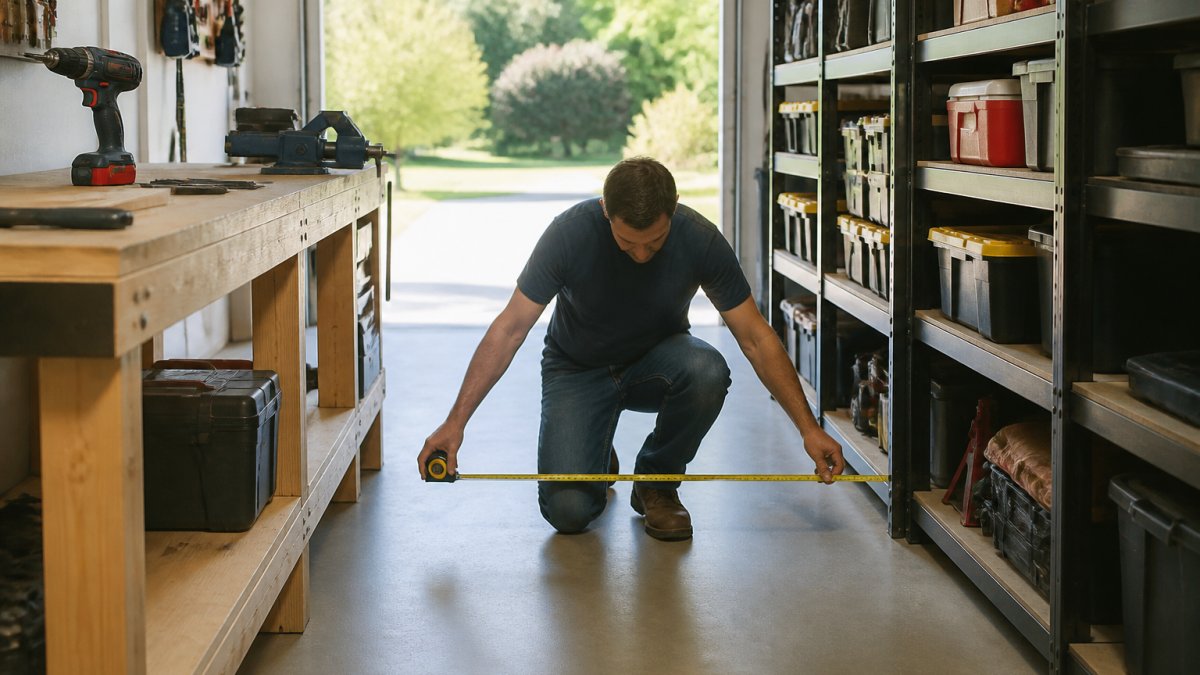
Grab a tape measure, a piece of chalk, and a notepad. Mark the floor where the bench could go, then mark where you need to walk, park, and open doors.
Here is the garage-specific method we recommend:
- Measure the full wall where the bench will sit, in feet and inches. Note any outlets, hose bibs, or floor drains that would be blocked.
- Measure the vehicle footprint. Park as you normally do and mark the outermost points of the tires and open doors with chalk. A typical midsize sedan needs about 8 to 9 feet of width and 16 to 18 feet of length; a full-size pickup needs more. Leave at least 2 feet between the car and the bench so you can open the driver's door without hitting the work surface.
- Measure the garage door swing and overhead clearance. A single-car overhead door needs roughly 9 feet of clear width and 7 feet of headroom when open. Do not place a bench where the door panel travels or where the tracks hang low.
- Mark walkways. Leave at least 3 feet of clear path from the bench to the house entry door, and 4 feet if you wheel a cart or snowblower through.
- Mark the bench footprint with chalk and stand in it. Can you reach the back wall without stepping sideways? Can you open the car door without touching the chalk line?
- Walk your daily path from the car to the house door. Is it clear with the bench in place?
If you are working with a tight garage, our guide on how to build a custom workbench for a small garage walks through measuring and framing for odd spaces. Measure twice here.
Standard Workbench Height and How to Match It to Your Body
Standard workbench height is usually around 36 to 38 inches for standing work, but that number is a starting point, not a rule. Your body decides the final figure.
Paul Sellers, writing on sizing a workbench, describes a common bench at about 2 feet deep, 5 to 6 feet long, and 38 inches tall, and notes that a 5- to 6-foot length should suit most people. Treat that as a reference point, then adjust.
A quick test: stand at the bench and rest your palms flat on the surface. Your elbows should bend slightly, not lock. If your hands sit below your hips, the bench is too low.
Ergonomic Sizing Beyond Bench Height
Height gets all the attention, but reach and clearance matter just as much. Ergonomics here means how your body moves around the bench, not just how tall it is.
- Reach: you should touch the back edge of the work surface without leaning in.
- Clearance: leave room under the bench for your feet and knees if you ever sit.
- Grip height: vises and clamps should sit near elbow level.
If you plan to sit for detail work, our article on the ideal workbench height for sitting covers the lower numbers in detail. Standing and sitting benches are not the same height, and one bench rarely does both well.
Picking Workbench Depth for Tools, Vises, and Reach
Workbench depth is the front-to-back measurement, and 24 to 30 inches suits most garages. Deeper benches hold more, but they also eat floor space and push the back wall out of reach.
Think about what sits on the surface:
- A miter saw needs depth plus clearance behind it for long stock.
- A vise needs a solid overhang so clamped material clears the bench edge.
- Hand tools and small parts need shallow trays, not deep shelves.
What most guides miss is the wall behind the bench. If you mount pegboard or shelves, that depth counts against your reach. A 30-inch bench against a shelved wall behaves like a 22-inch bench.
Workbench Length: Match It to Project Size and Materials
Workbench length runs from about 4 to 8 feet for most garages, according to Car and Driver's workbench sizing guidance, which notes the right size depends on the user and the space available. Length is where project size matters most.
Ask yourself what you build:
6 or 8 FT Portable Folding Table →
- Small repairs and hobby work: 4 feet is plenty.
- General home projects: 6 feet gives you room to spread out.
- Full sheets of plywood or long boards: 8 feet, or plan for infeed and outfeed support.
A longer bench is not automatically better. Every extra foot is floor space you cannot walk through. If your projects are mostly small, a 6-foot bench with a folding side table beats an 8-foot bench you have to squeeze past.
Workbench Space Planning for Walkways, Storage, and Access
Leave at least 3 feet of clear walkway in front of the bench, and more if you wheel carts or ladders through. Workbench space planning is really traffic planning. The bench is fixed; everything else moves around it.
Garage-specific constraints matter more than generic shop advice. Plan around these before you commit to a footprint:
- Vehicle clearance. Keep at least 2 feet between the bench edge and the car door swing. If you park two vehicles, measure the gap between them and treat that as your maximum bench depth plus walkway.
- Garage door travel. Overhead doors need clear space for the panel and tracks. Do not place a bench under the door path or where the open panel would strike tall items on the bench.
- Outlets and lighting. A bench that covers the only outlet on that wall forces an extension cord across the floor. Note outlet locations and leave at least one reachable within 3 feet of the bench. Add a task light above the bench rather than relying on the ceiling fixture behind you.
Storage belongs above and beside the bench, not on it. If you need to move the bench for access or seasonal storage, our guide to heavy duty workbench casters for concrete floors covers load ratings and floor protection.
For a full layout plan, including where storage and walkways should sit, see this step-by-step workshop layout guide. It pairs well with the measurements you just took.
Dimension Recommendations by Garage Task
Different jobs want different bench dimensions. This table gives you a starting point, then adjust for your body and space.
| Task | Length | Depth | Height | Notes |
|---|---|---|---|---|
| General home repairs | 6 ft | 24 in | 36-38 in | The all-rounder |
| Woodworking and assembly | 6-8 ft | 24-30 in | 34-36 in | Lower for hand planing |
| Auto and bike maintenance | 4-6 ft | 24 in | 36 in | Keep floor clear |
| Detailed sit-down work | 4 ft | 20-24 in | 28-30 in | See sitting guide |
| Cutting long stock | 8 ft | 24 in | 36 in | Add infeed support |
For a folding surface you can set up and stow, our 6 or 8 ft portable folding table gives you a metal frame and a 29-inch base-to-top height, with a simple fold-down design and non-slip feet. It works as a second bench, an outfeed table, or a project surface when the main bench is full.

Modular and Adjustable Options When Your Needs Change
Adjustable legs and modular systems let you change bench height and length without rebuilding. That flexibility matters if you share the garage with a car, or if your projects shift over time.
Look for:
- Adjustable legs with a range of at least 4 inches.
- Bolt-together frames so you can add a section later.
- Leveling feet for sloped garage floors.
If you are weighing modular systems, this comparison of modular workbench systems for home garages covers the trade-offs in more depth. The main drawback of modular benches is cost and assembly time.
Common Sizing Mistakes to Avoid
The same errors show up again and again. Here are the ones worth catching before you buy or build.
- Shopping before measuring. Measure the wall, the walkway, and your reach first.
- Ignoring your own height. A standard bench height is not your bench height.
- Going too deep. A 30-inch bench against shelving leaves you reaching.
- Forgetting tool clearance. Saws and vises need room beyond the bench edge.
Get your measurements down on paper, mark the floor, and test the fit before you commit. That is the whole method.
Frequently Asked Questions
What is the typical height of a garage workbench?
Most garage workbenches sit around 34 to 38 inches tall, and a common reference size is about 38 inches. That figure fits an average-height standing user, but it is not a rule. Your own body decides it: stand at the bench and check that your forearms rest level when your hands are on the work surface. If you are taller or shorter than average, adjust the height rather than forcing your posture to fit a standard number.
Is 24 inches deep enough for a workbench?
For most garage tasks, yes. A 24-inch workbench depth holds a miter saw, a vise, and hand tools without pushing you too far from the wall. Go deeper, to 30 or 36 inches, only if you plan to work on large panels or need serious clamping room. Remember that depth eats floor space along the whole length of the bench, so measure the remaining walkway before you commit to anything deeper than 24 inches.
How wide should a garage workbench be?
Width, or length, depends on what you build. Most workbenches run 4 to 8 feet long, which covers everything from small repairs to full sheet goods. A 5- to 6-foot bench suits most home garages and leaves room to move. If your projects involve long boards or cabinet parts, push toward 8 feet. If the garage is tight, a 4-foot bench with good storage underneath beats a longer bench you cannot walk around.
How much space should you leave around a garage workbench?
Leave at least 36 inches of clear floor in front of the bench so you can step back, swing a hammer, and slide materials through. Aim for 36 to 48 inches on any side where you load long stock. Keep the area under the bench open or fitted with drawers you can open fully. Park a car in the same garage and you need that clearance even more, so mark the walkway with tape before building or buying.
Choosing a garage workbench size comes down to measuring your space, matching the height to your body, and sizing the length to your projects. Superior Tool Garage and Outdoors carries the storage solutions and garage equipment to finish the job, from heavy-duty shelving to a portable folding table that doubles as a second work surface. Shop now and get the bench and storage working together instead of fighting for the same floor space.
