


Last Updated: October 29, 2026
Quick Summary
Retractable backyard canopies offer adjustable shade and can be pulled in before storms, while stationary backyard canopies provide permanent, low-maintenance coverage with no moving parts. Choose retractable for flexibility and open sightlines, or stationary for set-and-forget durability in mild climates.
- Retractable awnings can cut solar heat gain by up to 77% on south-facing windows, per the U.S. Department of Energy.
- Quality retractable frames last roughly 15 to 20 years, while stationary frames may last 20 years or more.
- Most residential retractable awnings are rated for light breezes only, so retract them before storms.
- The 10x15 ft pop-up canopy with mosquito netting is priced at $294.99 and needs no installation labor.
- Clean canopy fabric twice a year with mild soap, rinse fully, and air-dry before retracting.
Table of Contents
- Retractable vs Stationary Backyard Canopies: The Core Differences
- Pros and Cons of Retractable Canopies
- Pros and Cons of Stationary Canopies
- Average Cost to Install a Retractable Awning and Price Factors
- Retractable Awning Wind Resistance Ratings and Safe Operating Limits
- How to Clean and Maintain Backyard Canopies for a Long Lifespan
- Which Canopy Fits Your Yard: A Decision Framework
- Pick Your Canopy and Set Up Your Shade This Weekend
- Frequently Asked Questions
Retractable vs Stationary Backyard Canopies: The Core Differences
The core difference between retractable and stationary backyard canopies comes down to control: retractable units extend and retract on demand, while stationary canopies stay fixed in place year-round. According to the U.S. Department of Energy, retractable awnings can cut solar heat gain by up to 77% on south-facing windows. That single number explains why so many homeowners now weigh flexibility against permanence. Buyers often want shade that adapts, but they also want something that survives a storm. Below, we break down the benefits of retractable vs stationary backyard canopies so you can match the system to your deck, your climate, and your budget.
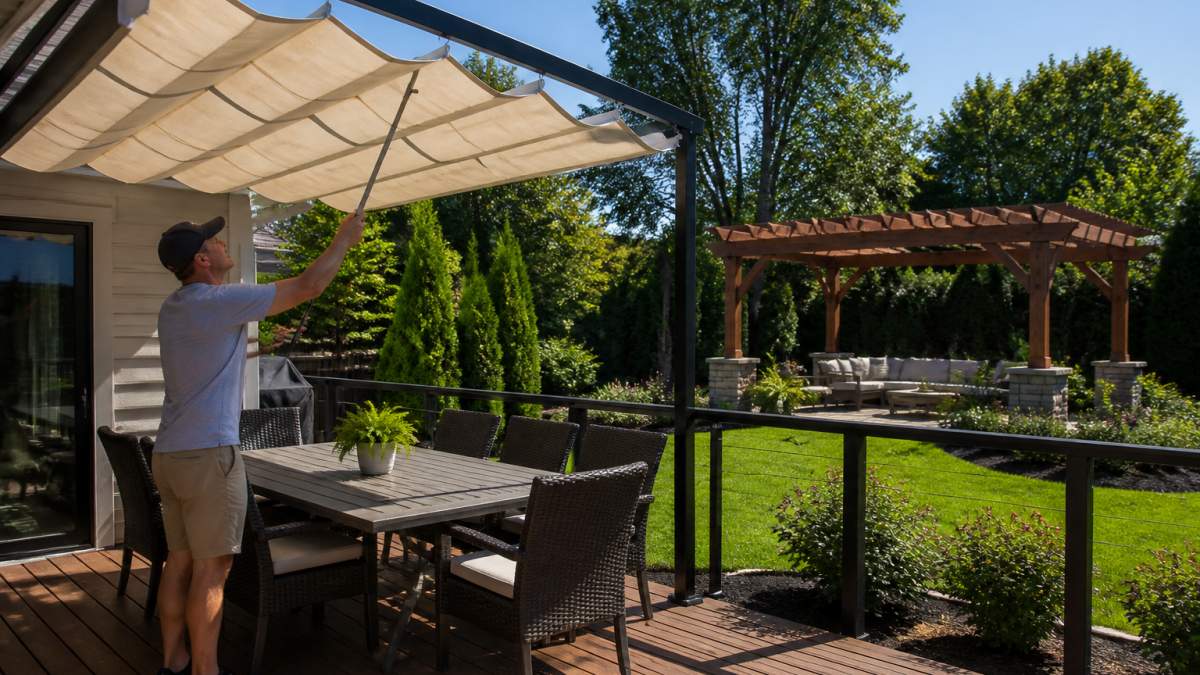
How Each System Handles Shade, Sun, and Rain
Shade control is where these two systems diverge most. A retractable canopy lets you dial coverage from full sun to open sky in seconds, which matters on a west-facing patio that bakes from 2 p.m. onward. Stationary structures deliver constant, predictable shade but no adjustment. On rain, both shed water when properly pitched, yet only the retractable unit can be pulled in before a downpour turns into a wind event. That retraction mechanism is the whole argument in miniature.
Pros and Cons of Retractable Canopies
Flexibility is the headline benefit, and it is not a small one. You get shade when you want it, open sightlines when you do not, and seasonal use without a permanent footprint. Motorized and manual operation both exist, and motorized units add convenience for older homeowners or anyone managing a large span.
The trade-offs are real. Retractable systems carry more mechanical parts, which means more maintenance over time. A quality frame lasts roughly 15 to 20 years, according to DoorServPro's awning comparison, while the fabric needs periodic cleaning and eventual replacement. Wind is the other limit: most units must be retracted in gusty conditions.
For a portable, budget-friendly take on flexible shade, our 10x15 FT Heavy Duty Pop Up Canopy with Mosquito Netting Walls sets up in minutes and its top fabric blocks 99% of UV rays.

Best for: renters, deck owners who want open sky half the time, and anyone in a mixed climate. Skip if: you need shade that stays put through high winds without any action from you.
Pros and Cons of Stationary Canopies
Durability favors the fixed build. Stationary awning frames may last 20 years or more, per DoorServPro, because there are no moving parts to fail. They handle constant sun exposure and stay deployed through weather that would force a retractable unit indoors.
The downside is permanence. You get the same shade footprint every day, whether you want it or not, and installation usually means anchoring into structure. Cleaning and repair are simpler, but you cannot reclaim the open sky or the view.
If you are leaning fixed, our Heavy Duty 12'x20' Carport Canopy is built for demanding outdoor use, and the 20x40FT Party Tent suits large events.


Best for: homeowners who want set-and-forget coverage and live where storms are rare. Skip if: you value adjustable shade or plan to move.
Average Cost to Install a Retractable Awning and Price Factors
Cost is where the retractable-versus-stationary decision gets real, and it is also where most comparisons stop too early. The sticker price is only the first number. The number that matters is total cost of ownership over the life of the canopy.
Upfront cost ranges
Retractable awnings vary widely in cost depending on frame, fabric, and operation method. Stationary canopies and fixed awnings usually cost less upfront for the same coverage area because they have no motor, no arms, and no retraction hardware, but the gap narrows once you add professional anchoring and structural mounting.
Freestanding pop-up canopies are a budget option. The 10x15 ft pop-up with mosquito netting is priced at $294.99 and requires no installation labor.
10x15 FT Heavy Duty Pop Up Canopy with Mosquito Netting Walls →
What moves the price
- Width and projection: larger spans need stronger arms, bigger fabric runs, and heavier mounting hardware.
- Manual vs. motorized: motors, remotes, and wiring add cost but improve daily use and are often the difference between a canopy that gets used and one that stays retracted.
- Mounting surface: brick, stucco, and soffit mounts require different anchors and sometimes a custom bracket. Second-story or awkward mounts raise labor.
- Fabric grade: solution-dyed acrylic resists fading and mildew longer than entry-level cloth, and replacement fabric alone can run several hundred dollars.
- Installation labor: professional installation is usually a meaningful share of the total, and permits or HOA approvals can add time and cost.
Total cost of ownership
A retractable unit costs more upfront but can trim cooling costs during peak sun hours, and awnings can reduce solar heat gain on south-facing windows. Over a 15- to 20-year frame life, the owner of a retractable unit should budget for fabric replacement once, annual lubrication and inspection, and occasional arm or tension-cord repair. A stationary canopy has lower mechanical maintenance but may need fabric replacement on a similar schedule and can face storm damage that a retractable unit avoids by retracting.
Retractable Awning Wind Resistance Ratings and Safe Operating Limits
Wind is the single biggest differentiator between retractable and stationary backyard canopies, and it is also the topic most comparisons handle badly. A wind resistance rating tells you when to roll the canopy in, not how much wind it can fight. Treat it as an operating limit, not a challenge.
How ratings are set
Manufacturers test retractable units under controlled conditions and assign a wind class, often expressed in mph or in a Beaufort-style scale. Most residential retractable awnings are rated for light breezes only. Manufacturers generally advise retracting retractable units before sustained winds become strong. Stationary canopies tolerate more because they have no moving arms, but no fabric structure is storm-proof, and freestanding pop-ups should always be staked or weighted.
Limits by canopy type
- Wall-mounted retractable awnings: most sensitive to wind because the arms and fabric act as a sail. Retract before storms, not during them.
- Pergola-mounted retractable canopies: the pergola frame adds rigidity, but the fabric still needs to be retracted in gusty conditions, and the pergola itself must be anchored for the combined load.
- Freestanding pop-up canopies: rated for temporary use. Use pegs and sandbags on grass, expansion screws on concrete, and never leave one up overnight unattended.
- Stationary carports and party tents: tolerate more sustained wind when properly anchored, but should still be inspected after storms and never occupied in severe weather.
Safe operating rules
- Retract before storms, not during them.
- Never leave a retractable unit extended overnight unattended.
- Inspect arms, tension cords, and anchors each season.
- Follow the manufacturer's specific wind limit; do not substitute general advice for the label.
How to Clean and Maintain Backyard Canopies for a Long Lifespan
Maintenance is straightforward if you stay ahead of it. Brush off loose debris, then wash fabric with mild soap and water, rinse thoroughly, and let it air-dry fully before retracting. Mildew is the usual culprit on shaded panels; treat spots early rather than scrubbing hard. For a deeper walkthrough, see our guide on how to clean mildew off outdoor canopy fabric.
Frame care matters just as much. Lubricate moving parts annually, tighten mounting bolts, and check for rust at connectors. Store removable sidewalls dry. A canopy that gets cleaned twice a year and inspected once will outlast one that gets ignored until spring.
Which Canopy Fits Your Yard: A Decision Framework
Use this simple matrix to decide. Answer each row honestly, then count which column wins.
| Your Situation | Choose Retractable | Choose Stationary |
|---|---|---|
| Climate | Mixed seasons, occasional storms | Mild, stable weather |
| Usage | Weekends, adjustable shade | Daily, all-season coverage |
| Budget | Higher upfront, lower cooling bills | Lower upfront, fixed cost |
| Space | Deck or patio with open views | Driveway, yard, or carport |
| Mobility | Renters or plans to move | Long-term homeowners |
If privacy is part of the plan, our guide to outdoor canopy side walls for privacy covers what actually works.
Pick Your Canopy and Set Up Your Shade This Weekend
The right choice depends less on price than on how you live outside. Retractable wins when you want control, open sightlines, and seasonal flexibility. Stationary wins when you want permanence and minimal fuss. Neither is universally better, and anyone who tells you otherwise is selling one product.
At Superior Tool Garage and Outdoors, we stock heavy-duty canopies built for real yards: UV-blocking fabric, reinforced frames, and hardware that holds. Browse our outdoor canopy collection, check the specs against your space, and get your shade up before the next heat wave.
Frequently Asked Questions
What is the average cost to install a retractable awning?
Installation cost depends on width, fabric grade, and whether you choose manual or motorized operation. Retractable units cost more than fixed frames because of the retraction mechanism and hardware. Budget separately for the canopy itself and for labor, and ask whether removal of an old unit is included. For a budget-friendly alternative, a pop-up canopy like the 10x15 FT Heavy Duty Pop Up Canopy at $294.99 delivers shade without installation costs.
How do retractable awning wind resistance ratings compare to fixed canopies?
Retractable awnings should be retracted before storms, and you should follow the manufacturer's stated wind limit. Fixed structures handle constant exposure better, and some freestanding canopies are rated to 55 mph, such as the Heavy Duty 12'x20' Carport Canopy. Always follow the manufacturer's wind limit and anchor the frame with the supplied stakes, ropes, or sandbags. No canopy should stay up in severe weather.
Can I leave my retractable awning open all the time?
No. Retractable awnings are designed to roll up when not in use, and leaving one extended overnight or through bad weather risks fabric stretch, frame damage, and seam failure. Retract it after each use and before wind or rain picks up. Stationary canopies tolerate staying up, but they still need seasonal inspection of anchors and fabric. If you want permanent coverage without daily fuss, a fixed frame or a heavy-duty carport is the better fit.
How do I clean and maintain backyard canopies?
Rinse the fabric with mild soap and water, let it dry fully before retracting or folding, and brush off debris from the frame. Check seams, connectors, and anchors each season, and lubricate moving parts on retractable units. Stationary frames need touch-up paint on any rust spots. Store removable sidewalls and tops dry to prevent mildew. A quick monthly inspection catches loose bolts and small tears before they become replacement costs.
Your backyard is only as useful as the shade over it. Superior Tool Garage and Outdoors carries heavy-duty canopies with 99% UV blocking, wind-rated frames, and tool-free assembly so you can set up in an afternoon. Shop now and get the job done right.
