


Last Updated: October 30, 2026
Quick Summary
Decorate a backyard canopy by choosing one theme and repeating it three times: overhead, at table height, and at eye level. Plan both daytime and evening lighting, clip lights and fabric to the frame instead of piercing the fabric, and set up the tent before tables, lights, and fabric.
- A 10x15 canopy gives about 150 square feet of shade and seats 10 to 15 people comfortably.
- Keep the palette to two colors plus a neutral, since three colors starts to look busy under a white ceiling.
- Hang lights by clipping to the frame rails, never by piercing the fabric panels.
- Split your budget into four buckets, buying structure first because decorations cannot fix an unstable tent.
- Set up the tent first, then tables, then lights, then fabric.
Table of Contents
- Start With a Plan: Size, Layout, and Guest Flow
- Party Tent Decorating Ideas That Set the Theme
- Backyard Canopy Lighting Ideas for Day and Night
- How to Hang Lights on a Canopy Without Damaging It
- DIY Party Canopy Decorations That Cost Little
- Fabric Draping, Ceiling Treatments, and Secure Installation
- Set Up Your Canopy and Decorations With the Right Gear
- Frequently Asked Questions
Start With a Plan: Size, Layout, and Guest Flow
A backyard canopy looks best when you plan the space before you buy a single decoration. Get the layout right and the decorating gets easier.
Map the Space Before You Buy a Single Decoration
Grab a tape measure and a notepad. Walk the yard and mark three things:
- The footprint. Measure the flat, level area where the canopy will sit.
- The path in. Note where guests enter and where food and drinks land.
- The sun. Watch where shade falls at 2 p.m. and where it falls at 7 p.m.
Then match the tent to the crowd. A 10x15 canopy gives about 150 square feet of shade and seats 10 to 15 people comfortably. A 20x40 party tent handles 100 to 130 guests and over 8 tables.
If you are planning a big event, look at a 20x40FT party tent to see whether the size matches your guest list.

Leave a clear walkway between the tent edge and the food table. A common mistake is filling every inch with decor and leaving guests nowhere to stand.
Party Tent Decorating Ideas That Set the Theme
Party tent decorating ideas work best when you pick one theme and repeat it three times: overhead, at table height, and at eye level. A theme that shows up in all three zones reads as designed. A theme that shows up once reads as an afterthought.
Choose a Theme That Works With Your Canopy
Match the theme to the tent, not the other way around. A white canopy is a blank canvas. A netted canopy already has texture, so keep decor simple.
Try these starting points:
- Garden party: greenery, white linens, potted herbs on tables
- Rustic: burlap runners, wood slices, mason jar candles
- Tropical: palm fronds, bright fabric, paper lanterns
- Elegant evening: draped white fabric, candles, low floral centerpieces
Side walls do a lot of the theme work by framing the space. If privacy and theme matter, browse outdoor canopy side walls for privacy before you commit to a look.
Keep the palette to two colors plus a neutral. Three colors starts to look busy under a white ceiling.
Backyard Canopy Lighting Ideas for Day and Night
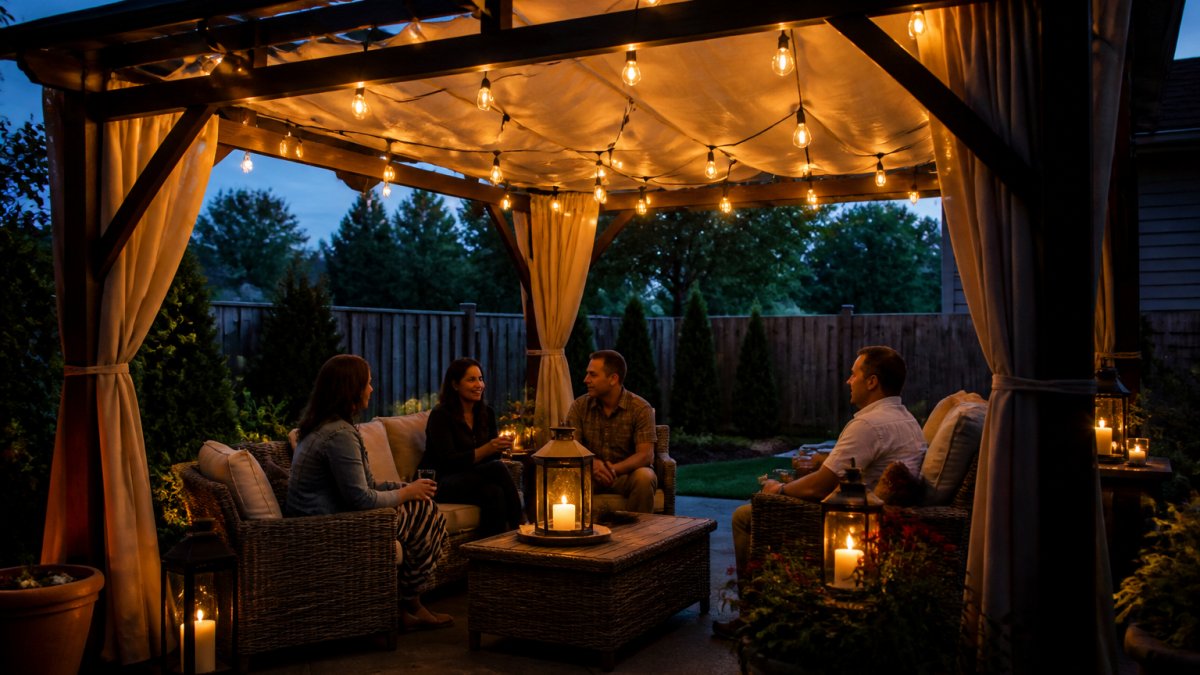
Backyard canopy lighting ideas should cover both shifts: the sunny afternoon and the dark evening. Most guides plan for one and forget the other. Plan both and the tent works all day.
Daytime: Let the Canopy Top Do the Work
In daylight the canopy top is your main light control. A white or light-colored top reflects light and keeps the space bright; a dark top absorbs heat and light and can make the interior feel dim even at noon. Add shade-friendly touches that read well in bright sun:
- Paper lanterns hung at different heights so they cast soft shadows
- Fabric bunting along the frame for color without glare
- Potted plants at the corners to soften the structure
Evening: Plan Brightness, Power, and Placement
Evening lighting fails for three reasons: not enough light, no power plan, and cords in the walkway. Fix all three before the event.
Brightness. A common pattern is to aim for layered light rather than one bright source: overhead for ambient light, table height for tasks like eating and reading cards, and ground level for safety along walkways.
Power sources. Battery and solar options save you from running cords across the yard. Rechargeable LED lanterns and solar string lights are the simplest choice when outlets are far away.
Cable routing. Route cords along the canopy legs and frame rails, then secure them with plastic clips so they do not sag into walkways. Keep connections off the ground and under cover where possible. Tape cords down only on hard surfaces; on grass, use cable stakes.
Placement. Zigzag overhead lights across the ceiling rather than running them in straight lines, the zigzag spreads light more evenly and looks intentional. Put table lanterns at the center of each table, not at the edge where they can be knocked off.
For more evening setups, see these outdoor canopy lighting ideas for evenings.
How to Hang Lights on a Canopy Without Damaging It
Hang lights on a canopy by clipping to the frame, never by piercing the fabric. Use plastic clips, zip ties, or light-hanging hooks made for tents. Tape and staples tear the top and void the waterproof coating.
Here is the safe order of operations:
Patio String Lights and Poles →
- Set up the canopy fully and lock the legs.
- Plan the light path in a zigzag, not a straight line.
- Clip lights to the frame rails, not the fabric panels.
- Keep weight even on both sides of the frame.
- Check every clip before guests arrive.
Watch out: hanging heavy fixtures from the fabric ceiling can pull seams apart in wind. Keep it light.
If you want a cleaner look, a patio string lights and poles set lets you run lights beside the canopy instead of across it.

DIY Party Canopy Decorations That Cost Little
DIY party canopy decorations come down to three cheap moves: fabric, greenery, and light. Those three cover most of the visual impact, and none of them requires a big spend.
Start with these low-cost and no-cost ideas:
- Cut branches and greenery from the yard for centerpieces
- Use borrowed or household vases and jars
- Print signs and menu cards at home
- Reuse fabric from curtains or sheets for draping
- Group candles on trays instead of buying centerpieces
Budget Breakdown and Shopping Checklist
Split your budget into four buckets and you will not overspend:
| Bucket | What It Covers | Priority |
|---|---|---|
| Structure | Canopy, weights, side walls | First |
| Light | String lights, lanterns, batteries | Second |
| Fabric | Drapes, runners, tablecloths | Third |
| Accents | Greenery, signage, candles | Last |
Use this checklist before you shop:
- Canopy size confirmed against guest count
- Weights or stakes for every leg
- Light count and extension plan
- Fabric yardage measured
- Table count and seating
- Trash and cleanup plan
Buy structure first. Decorations cannot fix a tent that is too small or unstable.
Fabric Draping, Ceiling Treatments, and Secure Installation
Fabric draping changes a plain tent ceiling faster than anything else. A draped ceiling softens the frame, hides hardware, and makes the space feel finished. The trick is securing it so wind cannot grab it and rain cannot wick into it.
Measure Fabric Before You Buy
Estimate yardage by the look you want. A light swag that runs from the center peak to each corner uses roughly one length of fabric per run, plus slack. A fuller gathered ceiling uses more. Buy a little extra rather than running short.
Choose lightweight, breathable fabrics, chiffon, voile, or sheer curtains, for ceilings. Heavy fabric puts more load on the frame and sags. For table runners and accents, sturdier cotton or linen works well.
Secure Fabric So Wind Cannot Grab It
Use these rules for a draped ceiling:
- Start at the center and work outward
- Leave slack in soft curves, not tight lines
- Clip fabric to the frame at every crossing point
- Keep fabric off the ground to avoid stains and tripping
- Tie or clip every loose end; a hanging tail acts like a sail
Attachment Methods That Do Not Damage the Canopy
Avoid piercing the canopy top. Use plastic clips, zip ties, or light-hanging hooks made for tents. Tape and staples can tear the top. For a cleaner look, run a tension line between frame rails and drape fabric over it, clipping at each crossing. Check every clip before guests arrive and recheck after any wind.
Rain and Weather Prep
If rain is possible, keep fabric away from the canopy edges where water runs off. Raise fabric slightly above table height so splashes do not reach it. Have a plan to remove or lower fabric quickly if a storm rolls in, clipped fabric comes down faster than tied fabric.
For curtains and full fabric walls, follow a step-by-step plan so the panels hang evenly. These steps to install curtains on a backyard canopy walk through measuring, clipping, and securing each panel.
Set Up Your Canopy and Decorations With the Right Gear
The right gear makes setup faster and keeps decorations in place. Sturdy tables, proper weights, and a tent that sets up without tools turn a stressful morning into a quick one.
A few gear choices that pay off:
- Tables: folding tables with locking legs stay steady under centerpieces
- Weights: sandbags or stakes on every leg, especially on grass
- Canopy: a frame that opens and locks in minutes
A portable folding table gives you a stable base for food and decor, and it folds flat for storage between events. Pair it with a canopy that has removable netting walls for bug-free evenings.
Set up the tent first, then tables, then lights, then fabric. Decorating before the frame is locked wastes time.
Frequently Asked Questions
How do you decorate a backyard canopy for a party?
Start with the structure: decide where tables, the food station, and the dance floor go, then decorate around that flow. Drape fabric across the ceiling for softness, hang string lights along the frame, and add lanterns or centerpieces at eye level. Keep decorations lightweight and tie them to the frame rather than the fabric top. A 10x15 canopy gives about 150 square feet of shade for 10 to 15 people, so scale your decor to the space you actually have.
How do you hang lights on a canopy without damaging it?
Use plastic clips or zip ties around the metal frame, never nails or staples through the fabric. Run lights along the truss bars and corner posts, and leave slack so wind does not pull the wire tight. For a 10x15 pop-up, the thumb-latch height system lets you set the frame lower while you work, then raise it once the lights are secured. Keep extension cords off the ground and use outdoor-rated cords with a GFCI outlet.
What decorations can you hang from a party canopy?
Lightweight items work best: paper lanterns, fabric swags, ribbon streams, faux greenery, and string lights. Avoid heavy chandeliers or anything that holds water, since the frame and top fabric are not built for point loads. Spread the weight across multiple points. Test each attachment with a gentle pull before the party starts.
How do you keep decorations secure on an outdoor canopy?
Anchor the canopy first with pegs and sandbags on grass or expansion screws on concrete, then attach decor to the frame with clips and zip ties. The 20x40 party tent listing advises taking precautions when wind speeds reach 25 mph or higher, so check the forecast and plan to remove loose fabric and hanging items if wind picks up. Weigh down tablecloths and centerpieces, and avoid paper decor on exposed sides where wind hits first.
Decorating a backyard canopy for a party comes down to planning the space, picking one theme, and layering light and fabric with care. Superior Tool Garage and Outdoors carries the gear that holds it all together, from heavy-duty canopies and side walls to string lights and folding tables built to last season after season. Get started with Superior Tool Garage and Outdoors and set up a party space that looks planned, stays stable, and cleans up fast.
