


Table of Contents
- Affordable Garage Workshop Flooring Options for DIY
- Garage Floor Paint: The Cheapest Way to Refresh a Concrete Slab
- Epoxy Garage Floor Cost: What You Pay and What You Get
- Interlocking Garage Floor Tiles: Snap-In Durability
- Rubber Garage Flooring: Comfort and Impact Absorption
- Concrete Condition, Moisture Testing, and Surface Prep
- Comparing Total Cost, Installation Time, and Workshop Performance
- Choosing the Right Flooring for Your Workshop Type
- Frequently Asked Questions
Last Updated: October 4, 2026
Affordable Garage Workshop Flooring Options for DIY
The cheapest way to upgrade a garage workshop floor is to seal or paint the existing concrete slab, but the best value for a working shop usually comes from interlocking tiles or rubber rolls once you factor in comfort and repairability. This guide breaks down affordable garage workshop flooring options for DIY installation, with real trade-offs on cost, prep work, and durability.
Concrete dust is the enemy of every garage shop. It settles on tools, clogs filters, and works its way into everything you store. According to the Occupational Safety and Health Administration, respirable crystalline silica from concrete dust poses real health risks, which is one more reason a sealed or covered floor matters in a workspace.
Below, we cover six realistic options, what each one costs in materials, how long installation takes, and which workshop types each suits best.
Garage Floor Paint: The Cheapest Way to Refresh a Concrete Slab
Garage floor paint is a latex or acrylic coating rolled directly onto a clean, etched concrete slab. It is the lowest-cost floor upgrade available and the easiest to apply yourself.
A single gallon covers roughly 300 to 400 square feet in one coat, and most slabs need two. You will spend a weekend on prep, application, and curing. The catch: paint sits on the surface, so hot tires, dropped tools, and road salt wear through it within a few years in a working shop.
- Best for: Light-duty shops, storage garages, quick cosmetic refreshes
- Watch out for: Peeling at the edges of a sloped entry apron where water sits
Epoxy Garage Floor Cost: What You Pay and What You Get
Epoxy is a two-part resin that cures into a hard, chemical-resistant surface.
Material pricing depends on kit size, solids content, and whether you add a clear topcoat, so check current listings rather than trusting an old estimate.
The real expense is prep. Epoxy needs a profiled, moisture-free slab, which usually means grinding or acid etching. If your concrete is cracked or spalling, budget for crack repair first.
- Best for: Automotive bays, welding corners, shops that see oil and solvents
- Watch out for: Hot tire pickup on cheap kits with low solids content
Interlocking Garage Floor Tiles: Snap-In Durability
Interlocking garage floor tiles are rigid PVC or polypropylene squares that click together over a prepared slab with no adhesive. They are the most forgiving option for a DIY installer because there is no curing time and no coating failure risk.
Most tiles are 12 by 12 inches or 20 by 20 inches with a snap-lock edge.
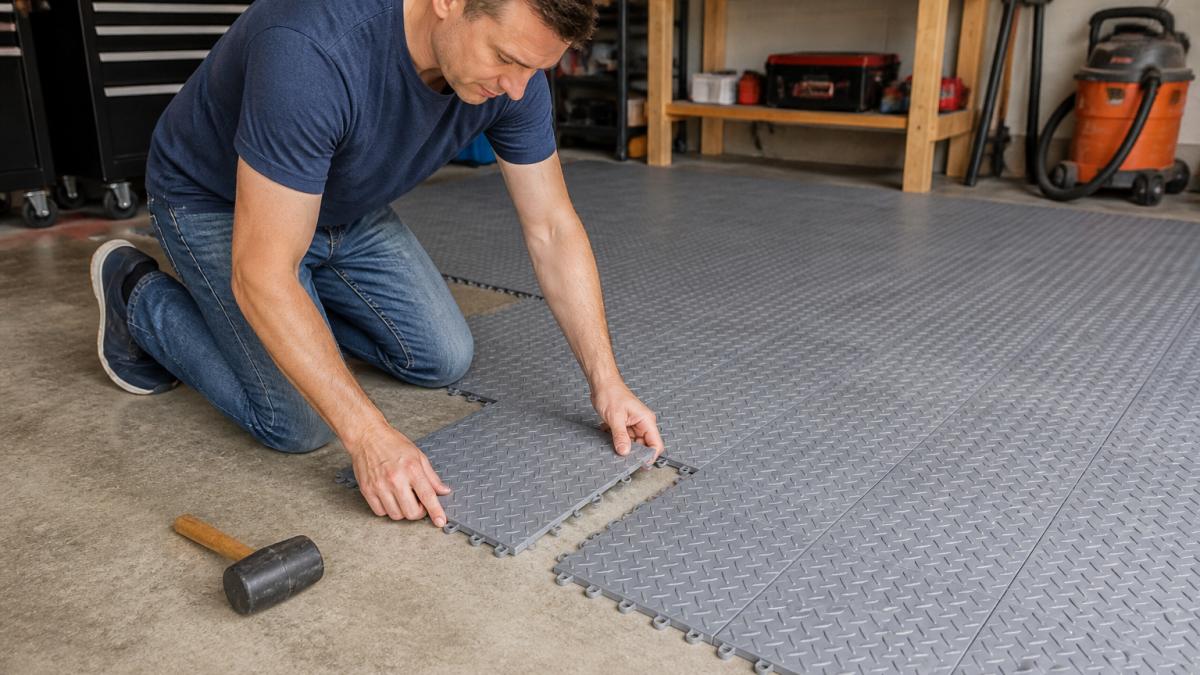
Cost per square foot lands in the middle of the range. You pay more than paint but less than a professional epoxy install, and you get slip resistance, oil resistance, and easy sweeping in return.
- Best for: Woodworking shops, mixed-use garages, renters who need removable flooring
- Watch out for: Small tiles can shift under heavy floor jacks without a solid base
Rubber Garage Flooring: Comfort and Impact Absorption
Rubber garage flooring comes as interlocking mats or rolled sheets, and it wins on comfort underfoot and impact absorption. Standing on rubber for a few hours beats standing on bare concrete by a wide margin.
Rolled rubber is the faster install of the two. Unroll it, let it relax, trim the edges, and you are finished.
Rubber resists oil and most chemicals, but it is heavy and costs more per square foot than paint or basic tiles.
- Best for: Assembly benches, long standing sessions, gym-style workshop corners
- Watch out for: Cheap recycled rubber can carry a strong odor for weeks
Concrete Condition, Moisture Testing, and Surface Prep
Every flooring option above fails for the same reason: a bad slab. Before you buy anything, test the concrete and fix what is broken.
Moisture testing is the step most DIYers skip.
Crack repair comes next. Fill structural cracks with a concrete patching compound, then grind or etch the surface so a coating can grip.
Cleaning is the last step. Degrease oil spots, scrub with a stiff brush, and rinse until the water runs clear.
- Plastic sheet moisture test, 24 hours
- Crack and spall repair with patching compound
- Degrease and scrub the full slab
- Acid etch or diamond grind for coatings
- Vacuum all dust before applying anything
Comparing Total Cost, Installation Time, and Workshop Performance
Relative rankings hide the number that actually decides a DIY budget: total cost per square foot over the life of the floor. The table below breaks out the four cost buckets most buyers forget, material, prep, tools, and maintenance, so you can estimate a realistic out-of-pocket number for a typical 400-square-foot two-car garage.
| Cost bucket | Garage floor paint | Epoxy coating | Interlocking tiles | Rubber rolls or mats |
|---|---|---|---|---|
| Material | Lowest | Low to mid | Mid | Mid to high |
| Prep (cleaning, etching, crack repair) | Low | High, grinding or acid etch plus moisture mitigation | Low to mid, clean and level only | Lowest, clean and roll |
| Tools | Roller, brush, etcher | Grinder or etcher, mixing buckets, spiked shoes | Utility knife, jigsaw, mallet | Straightedge, knife |
| Maintenance over 10 years | Recoat every 1-3 years | Patch and recoat at 5-10 years | Replace individual tiles as damaged | Replace worn sections |
| DIY difficulty | Easy | Moderate to hard | Easy | Easiest |
| Downtime | 1 weekend plus cure | 2-3 days plus cure | Same day | 1-2 hours |
| Repairability | Poor, full recoat | Poor, patch and blend | Excellent, swap a tile | Good, cut and replace a section |
The hidden cost in every column is prep. A coating job that fails because the slab was damp or dusty costs more to strip and redo than the original coating cost to buy.
How each option performs under real workshop abuse
A parking garage and a working shop put very different demands on a floor. Here is how the four options hold up against the tasks that actually happen in a shop:
- Dropped tools and sharp edges. Rubber absorbs impact and hides dents. Interlocking tiles can chip at the seam but the damaged tile is replaceable. Epoxy and paint both chip and gouge, and the repair is visible.
- Rolling machinery and floor jacks. Rigid tiles need a solid, flat base or they flex and shift at the seams under point loads. Rubber rolls handle rolling loads well. Coatings are fine until the wheel digs into a soft spot in the slab.
- Sawdust and fine debris. Smooth rubber and tight-seamed tiles sweep clean. Textured diamond-tread rubber traps dust. Paint and epoxy are easy to sweep but show scratches from dragged lumber.
- Oil, solvents, and brake fluid. Cured epoxy resists these best. Rubber resists most but can swell with prolonged solvent contact. Paint stains and lifts. Tiles depend on the plastic, polypropylene handles chemicals better than some PVC blends.
- Welding sparks and hot slag. This is the option-killer. Bare concrete, tile, and rubber can all be damaged by hot slag; epoxy can scorch and discolor. No affordable DIY floor is truly weld-proof, so plan a welding blanket or a dedicated bare-concrete corner.
- Heavy workbenches and stationary tools. Point loads from a loaded bench or a floor-mounted vise stress the floor at the legs. Rubber and tile spread the load; a coating offers no cushioning at all.
If you want the lowest total cost over ten years in a real workshop, interlocking tiles usually beat paint and epoxy once you count recoating, patching, and the prep a coating demands. If you mostly stand and assemble, rubber wins on comfort per dollar.
Choosing the Right Flooring for Your Workshop Type
Match the floor to what you actually do in the space, not to what looks best in photos.
Woodworking shops generate sawdust and dropped chisels.
Automotive bays see oil, solvents, and hot tires. Epoxy handles chemicals best, but only if the slab is dry and properly prepped.
Assembly and hobby benches reward comfort.
Welding and grinding corners need special handling. No affordable DIY floor survives sustained hot slag.
Safety and ergonomics most guides skip
- Slip resistance. Bare sealed concrete is slick when wet or oily. Coin-pattern rubber and textured tiles add grip; a glossy epoxy can be dangerously slick unless it includes an anti-slip additive.
- Fatigue. Standing on concrete for hours is hard on feet, knees, and back. Rubber and cushioned tiles reduce fatigue; coatings do nothing for it.
- Trip hazards. Loose mats curl at the edges and catch a boot. Interlocking tiles sit flatter, but a poorly cut edge at the garage door can lift. Tape or trim mat edges.
- Static. Dry winter air plus rubber can build static that zaps you or a sensitive tool. If you work with electronics, grounded tile or a coated slab is safer than an isolated rubber mat.
- Machinery stability. A floor that flexes under a bandsaw or drill press lets the machine rock. Rigid surfaces win under stationary tools; cushion wins under your feet. Split the difference with rubber only at the bench.
Climate and seasonal performance
Temperature swings and moisture move a slab, and the floor has to move with it.
- Freeze-thaw. A rigid coating bonded to a slab that heaves will crack. Tiles and rubber flex and tolerate movement better.
- Dampness. If a plastic-sheet moisture test shows condensation, skip coatings entirely, they will blister. Tiles and rubber can go down over a damp slab with a vapor barrier underneath.
- Heat. Interlocking tiles expand in summer; leave the quarter-inch gap at walls and the door so the field does not buckle.
- Cold. Rubber stiffens and can be harder to unroll in a cold garage; let it relax indoors first. Some coatings need warmer temperatures to cure properly, so check the label before a winter install.
For storage-heavy garages with light traffic, a quality floor paint is still the budget pick. It will not survive a working shop, but it will stop the dust. We stock heavy-duty storage and workshop gear to finish the job, from workbenches to tool organization, so your floor upgrade is not the only thing that gets done right.
Frequently Asked Questions
What is the cheapest flooring option for a garage workshop?
Garage floor paint is typically the least expensive upfront option, followed by roll-out rubber mats. Paint costs the least per square foot, but it requires thorough concrete cleaning and crack repair before application. Interlocking tiles and epoxy coatings cost more initially but may last longer under heavy equipment and floor jacks, so the cheapest option depends on how long you plan to keep the floor.
Is epoxy or interlocking tile better for a garage workshop?
Epoxy gives a seamless, easy-to-sweep surface with strong chemical and oil resistance, which suits welding, painting, and automotive work. Interlocking garage floor tiles handle impact better, hide cracks, and can be replaced one tile at a time if damaged. For heavy woodworking or dropped-tool environments, tiles often win on repairability; for a clean, permanent coating, epoxy is the stronger choice.
Can you install rubber garage flooring over a concrete floor?
Yes. Rubber garage flooring, whether rolls or mats, can be laid directly over a concrete slab with no adhesive in most cases. The main requirement is a clean, dry, relatively flat surface. If the slab has moisture issues, use a moisture barrier or test first, because trapped moisture can cause mold under rubber. Rolls are heavy, so bring a helper for installation.
How do you choose garage workshop flooring for woodworking and heavy tools?
Prioritize impact resistance, slip resistance, and comfort underfoot. Interlocking tiles and rubber rolls absorb dropped tools and reduce fatigue during long sessions. If you use floor jacks or move heavy equipment, check that the flooring can handle point loads without denting. Epoxy works if the slab is sound, but it can chip under heavy impacts, and repairs are more involved than swapping a tile.
Your workshop floor takes a beating every time you roll out a jack, drop a wrench, or drag a bench across the slab. Superior Tool Garage and Outdoors carries the storage solutions and workshop equipment that keep the rest of the space as organized as your new floor. Browse our heavy-duty storage and specialized tools to finish the build, and get the job done right the first time.